
The Royal Ballet, Birmingham Royal Ballet and The Royal Ballet School
The Royal Ballet & Opera, London
October 8, 2026
Founded in 1926 by Dame Ninette de Valois as the Academy of Choreographic Art, The Royal Ballet School celebrated its centenary with a three-part programme bringing together dancers from The Royal Ballet, Birmingham Royal Ballet and the School itself. Presenting works by choreographers whose careers have been shaped by the School, the evening offered a remarkable showcase of its enduring contribution to British ballet.
The standard of dancing was outstanding throughout, from the youngest students to established principals. While the women generally demonstrated greater technical assurance and dramatic sensitivity than their male counterparts, there was much to admire in the artistry, versatility and expressive range on display.
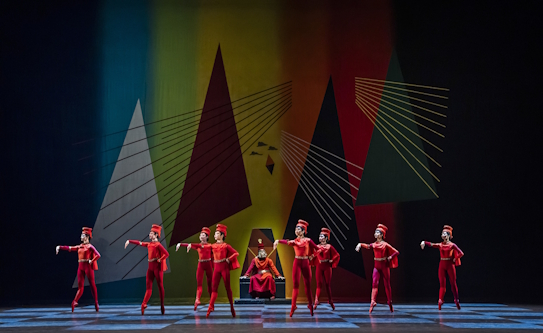
Photo Tristram Kenton
The evening opened fittingly with de Valois’ Checkmate Suite, featuring dancers from the School’s pre-professional year alongside members of The Royal Ballet. The young dancers were excellent, demonstrating impressive technical precision, beautifully coordinated ensemble work and an exceptional sense of timing and line. It was a considerable credit to the School and its current teaching staff.
Frederick Ashton’s Birthday Offering, proved less engaging, however. Although regarded as a classic of the repertoire, its considerable length and repetitive choreography makes it feel rather dated. Despite technically accomplished dancing, there was insufficient dramatic engagement to sustain interest, and the ballet seemed longer than it was.
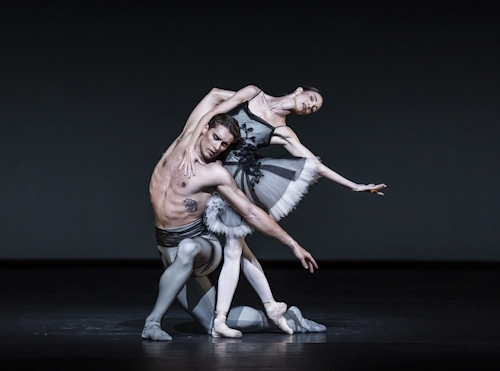
in Christopher Wheeldon’s Beautiful Shadow
Photo Tristram Kenton
The programme gained considerable momentum with Christopher Wheeldon’s Beautiful Shadow, created for Lauren Cuthbertson and Lukas B. Brændsrød. Rooted in the English classical tradition, it was superbly danced, combining technical excellence with an absorbing emotional and dramatic connection between the performers.
Equally compelling was Cathy Marston’s Night Falling, set to Benjamin Britten’s melancholic Night covers up the rigid land. Matthew Ball and William Bracewell were mesmerising, completely inhabiting the emotional world of the choreography. Their deeply expressive performance made this one of the evening’s most memorable works.
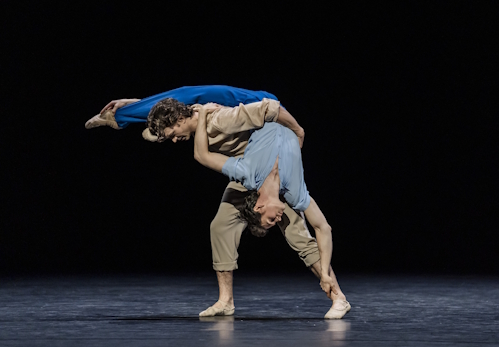
Photo Tristram Kenton
In Kenneth MacMillan’s Winter Dreams pas de deux, Yaoqian Shang brought beautiful fluidity and languid expressiveness to a performance rich in dramatic emotion. Unfortunately, Mathias Dingman was unable to match her intensity.
Wayne McGregor’s Nimbus, created in 2007, was a striking reminder of how genuinely innovative choreography can transcend its period. Performed by Miki Mizutani, Sae Maeda, Joseph Sissens and Tzu-Chao Chou, it felt remarkably contemporary, combining classical technique with an inventive, distinctly modern movement vocabulary. Nearly twenty years after its creation, it could have been choreographed yesterday.
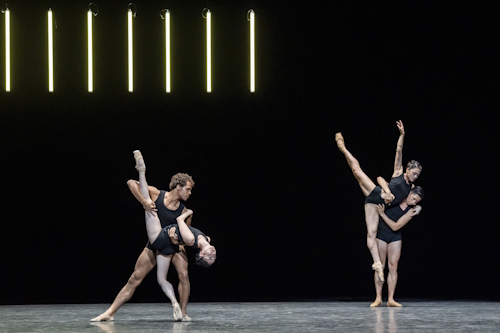
in Wayne McGregor’s Nimbus
Photo Tristram Kenton
Joshua Junker’s Unforgettable, set to songs by Elvis Presley, was another highlight. Exploring the extravagance and sometimes absurdity of celebrity worship, the choreography was witty, inventive and exuberantly performed. The dancers embraced its theatricality with tremendous panache, capturing both the excitement and excess of fan adulation.
David Bintley’s Southern Cape Zebra, from ‘Still Life’ at the Penguin Café, was perhaps the most unexpectedly thought-provoking work of the evening. Created in 1985, it remains astonishingly relevant. Yasiel Hodelín Bello was delightful as the zebra, surrounded by an elegantly dressed female ensemble suggestive of fashionable racegoers. The apparent light-heartedness of the choreography makes its sudden conclusion, when the zebra is shot, all the more disturbing. Forty years on, its reflection on humanity’s casual destruction of the natural world carries a particularly powerful resonance.
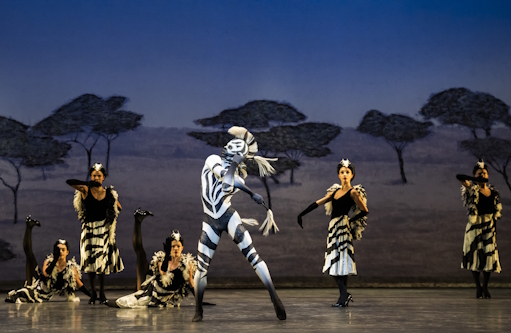
Photo Tristram Kenton
Danse Russe, choreographed by Loughlan Prior, brought another outstanding performance from Sarah Lamb and Steven McRae. Creative, emotionally expressive and technically exceptional, it demonstrated the seamless relationship between musicality and movement at its best.
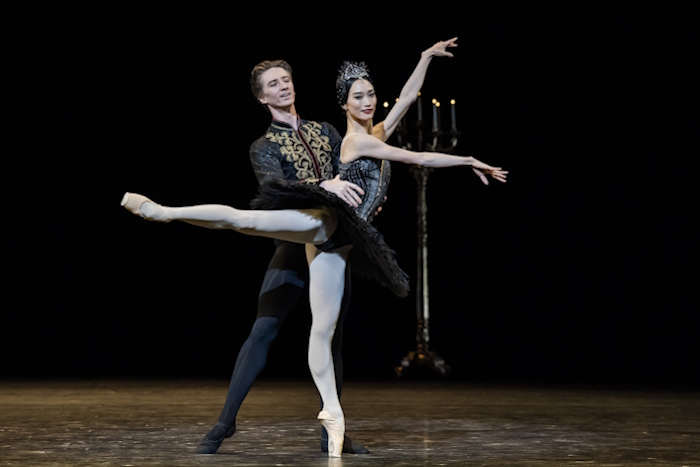
The familiar Manon Act I bedroom pas de deux, danced by Francesca Hayward and Marcelino Sambé, was beautifully performed, while Fumi Kaneko and Vadim Muntagirov delivered a magnificent account of the Act III Black Swan pas de deux from Swan Lake. Their technical brilliance was matched by compelling dramatic involvement, making this one of the finest performances of this celebrated excerpt I have seen.
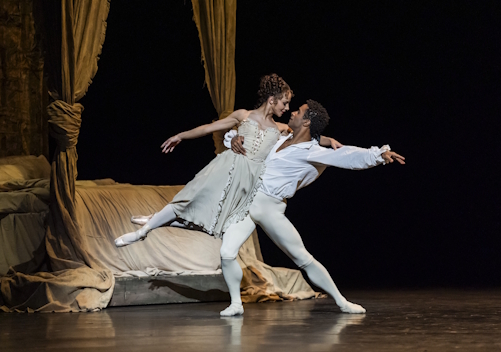
Photo Tristram Kenton
Sadly, the final work, Valentino Zucchetti’s specially commissioned Centenary, failed to provide the triumphant conclusion the occasion deserved. Intended as a rousing celebration bringing together dancers from all levels of the School alongside both companies, it was overcrowded, visually confusing and lacking in choreographic cohesion. The stage was filled with performers undertaking apparently unrelated sequences. Those positioned upstage were almost invisible. Rather than creating a unified celebration, the effect was chaotic. The costuming compounded the problem. The women’s white tutus, immediately following the Black Swan pas de deux, suggested an unfortunate visual connection with Swan Lake. A more coherent choreographic statement, with the full company assembled for a final celebratory tableau, might have proved far more effective.
It was a little disappointing that such a distinguished evening should end on this rather confused note. Nevertheless, the wealth of exceptional dancing and choreographic imagination that preceded it provided ample testimony to the extraordinary legacy of The Royal Ballet School.
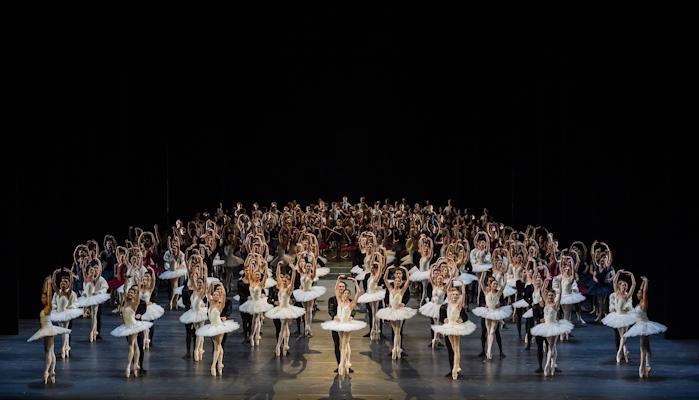
the finale of The Royal Ballet School Centenary Celebration
Photo Tristram Kenton
A century after de Valois established her vision, The Royal Ballet School continues to nurture dancers and choreographers of remarkable calibre. This celebration offered abundant reason to look forward with confidence to its next hundred years.