
City Center, New York City
October 3, 2026
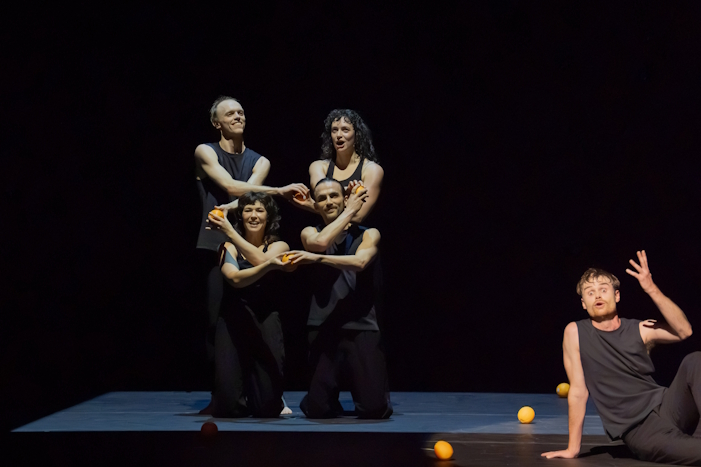
The final programme at this year’s Fall for Dance opened with something just a little different: a dance, or at least a creation, about the festival itself.
In their introduction, Claire Bird, Ava Campbell, William Strom, Dominic Weintraub and Hugo Williams, five performers of Pony Cam, a Melbourne, Australia-based artist-led collective, began by telling us that, “We never made a dance show before.”
They went on to explain that to make kinda like this, they researched all the 450-plus pieces that have been presented since the festival began in 2004. That’s a lot of videos. They also reckoned they had read all the reviews published by the New York Times, a remark that got a huge laugh from the audience.
“Everything you are about to see has happened on this stage before,” they told us. Well, sort of. Kinda.
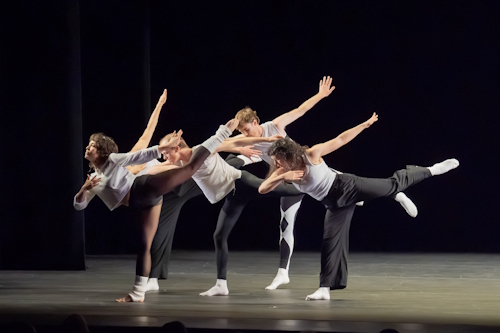
Photo Hisae Aihara
The jumble of glimpses of choreographers and performances in the mini recreations that followed was hugely entertaining. An absolute delight, it raised knowing smile after knowing smile. And the best thing about it? Yes, they were gently ribbing, they and us having a laugh at the festival and its artists’ expense, but it was all toned to perfection, done gently, done artfully with a lot of love for the art form.
Those videos had clearly been watched very closely because almost everything was instantly recognisable. Only the ballet seemed to pose problems. References to Justin Peck, William Forsythe and Frederick Ashton could quite honestly have been about anyone. But when it came to the big modern dance names, be it Martha Graham, Paul Taylor, Mark Morris, whoever, it was all spot on.
Some things got an extended look including Ohad Naharin’s famous chair dance piece, Echad Mi Yodea, which was incredibly well done. Some of the cast showed individual dance skills too, one proving a good tapper, as we discovered in a Michelle Dorrance moment.
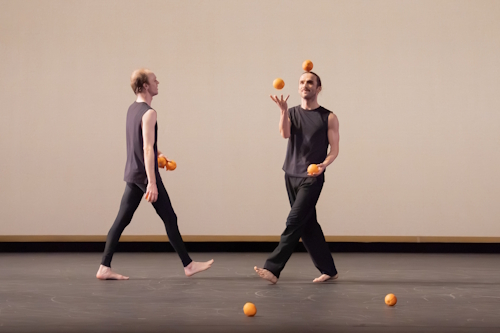
Pony Cam in kinda like that
Photo Hisae Aihara
Pony Cam even spoofed the spoof in a take-off of Gandini Juggling’s second Pina Bausch-referenced piece, Smashed2. That’s the one that involves a lot of oranges and melons getting, well, smashed. What else? Although one of the cast could juggle rather well, that the others clearly could not just added to the fun.
The real mish-mash of moments even included some audience participation in an attempted mass vague reworking of Charles Moulton’s Precision Ball Passing, although that proved the one moment that didn’t work well.
It really was all great fun, although kinda like that is also one of those creations that simply isn’t going to work anywhere else. Audiences simply would not ‘get it’ in the way the City Center audience did. It would have made a great closing to this year’s Fall for Dance. It probably should have done.
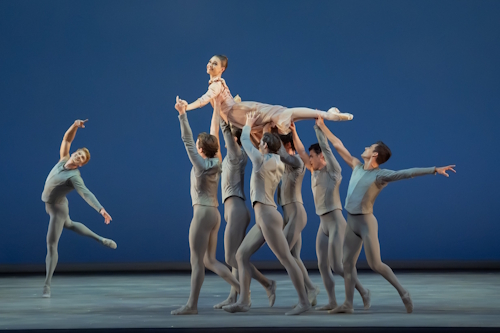
Photo Hisae Aihara
Roses from the South, Three Waltzes for Toby by Alexei Ratmansky for Miami City Ballet was created in honour of the company’s 40th anniversary, and founder Toby Lerner Ansin’s 85th birthday. It’s three waltzes are all by Johann Strauss II: first, ‘Lagoon Waltz’, danced by eight women; then ‘Roses from the South’, danced by eight men; before everyone comes together for the ‘Emperor Waltz’.
It disappointed. The choreography is pleasant if rather conservative. The patterns created are often pleasing but all too often predictable. This is not a ballet to set the pulses racing. Even a section with male couples has them largely in traditional male-female roles, passing up the opportunity for anything more interesting. Time seemed to pass increasingly slowly. The Emperor Waltz in particular seemed to go on and on.
Altogether more interesting was Stephanie Lake’s Seven Days, a dance of seven sections, performed by seven members of The Australian Ballet, to Peter Brikmanis’s seven very different and rather appealing reimaginings of J.S. Bach’s Goldberg Variations. Pony Cam’s earlier referencing of reworkings of Bach suddenly felt even more apposite. As a dance, it’s all about bodies and movement; about form, rhythm and connection.
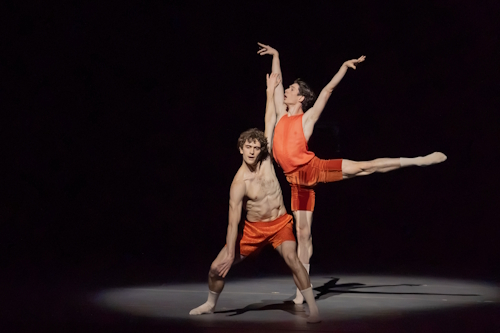
Photo Hisae Aihara
Seven Days is unpredictable, an anthology of dance shorts rather than scenes from a single piece. Each section stands very much alone, not connecting with what comes before or after. You certainly never know what is coming next. Yet that’s part of its appeal, even if some sections do work better than others.
It starts almost all in canon, the cast, all in rusty orange, forming lines, the movement flowing easily in both directions. It was extremely well performed. The timing was absolutely spot on, as it was in a unison section near the end.
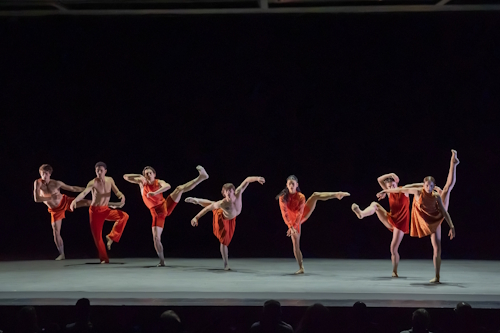
Photo Hisae Aihara
Day two features an interesting duet for two of the men. The work bursts into life in day three, a fast-paced trio. And it just keeps giving, the dance sometimes humorous, sometimes an easy watch, sometimes not. I could have done without the vocalisation here and there, though, which adds little. But whether more duets, some of which felt very Jiří Kylián-like, solos or ensemble dance, Seven Days always scores highly for invention.