
The Place, London
October 6, 2026
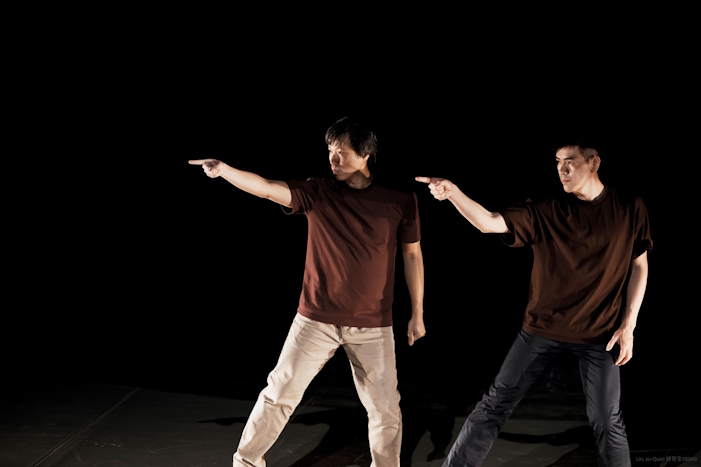
There is no doubting the ambition behind The Seas Between Us (當水落下). By Polymer DMT (聚合舞), directed by Taiwan-born, Germany-based choreographer Lo Fang-yun (羅芳芸) and co-created with performers Chou Shu-yi (周書毅) from Taiwan and Singaporean Lee Mun Wai (李文偉), the 70-minute work takes as its starting point the unresolved conflict between China and Taiwan, and considers how political systems and cultural influences shape identity, behaviour and relationships. But while that may well be the intention, the reality falls somewhat short.
The Seas Between Us is a strange piece. There is certainly a sense of conflict running through it, but its storytelling becomes so oblique and so dense that, particularly as the work progresses, it becomes increasingly difficult to understand what is happening, why it is happening, or quite what we are supposed to take from it.
It begins promisingly. Chou writes on a pad that he will not speak during the performance because it is too difficult, or too painful, to talk about what follows. His words appear on screens at either side of the stage and, for the first section at least, those screens provide a useful route into the work.
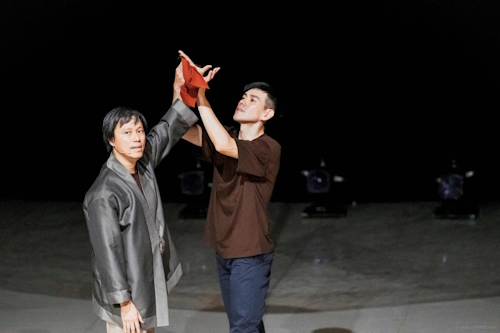
Photo Lin Yu-quan
What follows traces his early dance life, beginning in childhood. We see him encounter different forms of dance: Chinese folk dance, then Chinese classical dance with its influences from Russian ballet. These memories are punctuated by short demonstrations, beautifully performed. There is a softness and elegance to his movement, particularly through the arms, and the sequences are clean, precise and expressive.
Gradually, the work moves into later life and Chou and Lee’s different experiences of training and working internationally. Their biographies begin to intersect. The relationship between movement and spoken or written narrative changes too, although exactly who is speaking as whom, and from what position, becomes increasingly difficult to follow.
And that difficulty becomes a serious problem in the final section.
There is a lengthy passage spoken entirely in Mandarin. On Tuesday evening it was not translated, while the two screens that had previously helped communicate the narrative remained blank. For anyone who did not speak the language, that left no way into what was being said. The performers sat on chairs and there was little movement or visual information elsewhere from which meaning might be inferred. It may only have lasted a few minutes; it felt considerably longer.
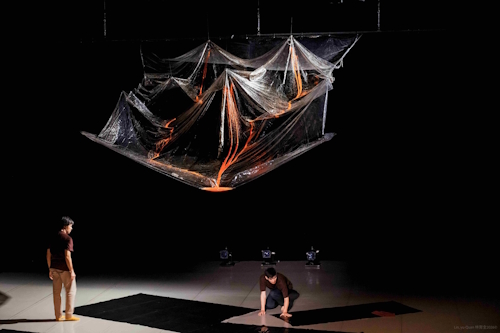
Photo Lin Yu-quan
More importantly, what was being said appeared to be crucial to understanding what followed.
Suddenly there is hostility between the two men, accompanied by a heavy, pounding soundscape. At times they seem to attack one another, at others to embrace, before conflict returned. Sounds of water enter the score. Finally, large pieces of black plastic are produced, unwrapped and moved around the stage for a considerable period.
Why? Perhaps the preceding Mandarin narration supplied the answer. Without access to it, the imagery remained completely opaque. The plastic was shifted and rearranged, the lights eventually faded, and the piece was over.
One was left with the unavoidable question: what was that all about?
This is not an argument for a neat ending. The political situation that inspires The Seas Between Us hardly offers one. Nor does dance theatre need to explain itself literally. Ambiguity can open up possibilities and allow the audience to bring something of themselves to what they see. But there is a difference between ambiguity and impenetrability. Here, particularly in the final third, there was too little information from which even to begin making those connections. That is frustrating because there is much here that is extremely accomplished.
Both Chou and Lee are highly skilled performers. The danced passages are excellent: tightly executed, refined and engaging. Even away from the more recognisably danced sections, there is a clear sense of carefully constructed choreography and performers working with great precision within it. One episode, in which objects and chairs are thrown around the stage in an eruption of apparent fury, is disturbing to watch. Yet because the source of that anger remains unclear, it is difficult to empathise with it emotionally rather than simply observe it.
Michele Piazzi’s set and lighting design is particularly impressive. The stage itself is sparse: a barre, a couple of chairs and a handful of smaller objects. But the lighting does a remarkable amount of work. At times grey, dark and ominous, it creates a threatening, overcast atmosphere without ever obscuring the performers. Elsewhere it becomes lighter and warmer. Indeed, the lighting is arguably the clearest storyteller of the evening.
The programme describes The Seas Between Us as opening up “a multi-layered space for reflection, encounter and exchange.” The problem is that, to reflect meaningfully on what is happening, one first needs enough access to it to engage. Too often here that access is missing. There are moments of considerable beauty, strong performances and obvious artistic intelligence behind the work. But over 70 minutes, the actual dance occupies relatively little space, while the narrative passages that should hold the work together feel that they instead push audience engagement away.
By the end, The Seas Between Us has become almost completely impenetrable. Skilfully made and well performed it certainly is. But, however worthwhile the questions behind it, they become lost in storytelling so opaque that one leaves the theatre not reflecting on them, but simply wondering what one has just seen.