
Sadler’s Wells East, London
October 1, 2026
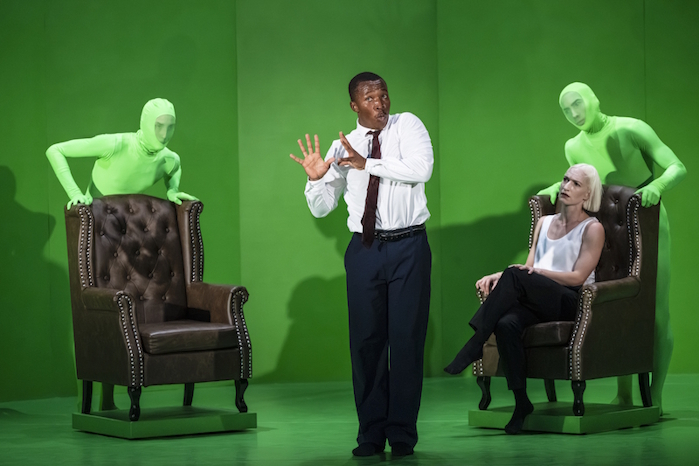
There is a moment in DEEPFAKE when it is difficult to decide where to look. The dancers are clearly there in front of us, cameras and green screens visible, the mechanics of the image almost deliberately exposed. Yet the screen offers another version of exactly the same event: cleaner, tighter and somehow more convincing.
That gap between what is happening and what we are being shown is where Jess & Morgs’ new work is at its most interesting.
Created and directed by Jessica Wright and Morgann Runacre-Temple, DEEPFAKE centres on a television interview between a prime minister, danced by Kennedy Muntanga, and political journalist Katie Fielding, performed by Rebecca Bassett-Graham. What begins as the familiar choreography of a broadcast interview gradually starts to come apart. Questions are repeated, answers slide away from them, and bodies begin to say things that words do not.
The opening situation is immediately recognisable. Two people sit opposite one another under studio lights. One asks questions; the other knows how not to answer them. Muntanga’s politician is particularly good at occupying that uncomfortable space between ease and defensiveness. A smile, a turn of the torso or a sudden withdrawal can change the temperature of an exchange before the voiceover has finished the sentence.
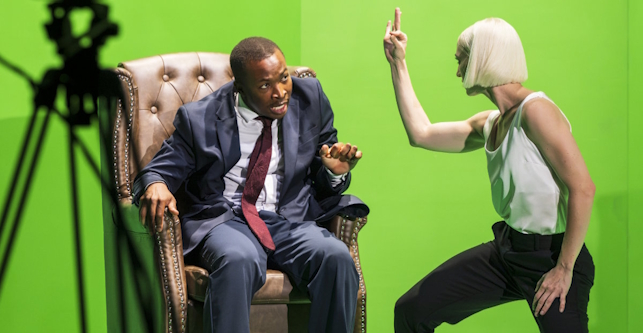
Photo Foteini Christofilopoulou
Bassett-Graham provides a sharper counterweight. Her movement has attack without becoming simply aggressive. She advances, redirects and interrupts, while Muntanga continually adjusts around her. Their duet starts to feel less like an illustration of an interview than a physical negotiation over who controls its rhythm.
The voiceover is important here. Much of the choreography sits closely against the spoken text, at times almost syllable by syllable. A shoulder shifts on a hesitation; a body folds away from a difficult question; gestures repeat until they begin to resemble the rehearsed habits of public speech. There is humour in this precision, especially when the choreography exaggerates the strange physical rituals that sit beneath apparently controlled conversation.
But DEEPFAKE becomes much more enjoyable once the green-screen dancers arrive.
Cathy Grealish, Dylan Springer and Tommi Sutton, dressed in green, move somewhere between dancers, technicians and visible special effects. They lift, position and interfere with the central figures while disappearing or transforming on screen. Their presence is knowingly ridiculous lots times, that is part of the pleasure. The production does not pretend that manipulation is invisible. Quite the opposite: we watch it being constructed a few metres away.
Marshall Stay’s role as the gimbal operator pushes this further. The camera becomes part of it. Stay has to negotiate the stage alongside the other performers, following bodies, finding angles and moving with enough precision to produce the image appearing above them. This is probably the cleverest thing about the work. Technology does not sit behind the dance as decoration. The physical labour required to produce an apparently effortless image is made visible.
At one point, what exists on stage and what exists on screen begin to feel almost equally credible. That is more unsettling than any straightforward warning about deepfakes. We know one image is being manipulated because we can literally see it happening, and yet we still instinctively watch the screen.
Jess & Morgs play with this contradiction very well.
There is also a certain old-fashioned quality to some of the illusion, despite the work’s very contemporary subject. Bodies vanish against green backgrounds; performers appear to interact with versions of themselves; scale, position and perspective are altered. Visibility often makes them funnier and more effective. The audience is allowed to understand the trick and still enjoy being tricked.
The production is less convincing when it explains an idea that the staging has already made perfectly clear. The central metaphor is strong enough that it rarely needs additional emphasis. Once we have seen an image constructed, distorted and reframed before our eyes, the relationship between media, truth and manipulation hardly needs spelling out again. At those moments, the text can feel heavier than the dance.
And despite the title, DEEPFAKE is perhaps less interesting as a work specifically about artificial intelligence than as one about framing. There is nothing particularly new about selecting an angle, rehearsing an answer or controlling what an audience is allowed to see. The technology has changed, and the speed of manipulation has changed, but the desire to construct an image has not.
That broader question gives the work more depth.
It also leaves the dancers with an unusual task. They are performing characters, performing an interview and, at the same time, performing for cameras whose images may contradict what the theatre audience can see directly. Their bodies exist in several versions at once.
For all its technology, DEEPFAKE more depends on that physical precision. A camera angle only works because somebody arrives on exactly the right mark. An illusion holds because a dancer supports another body at exactly the right height. A supposedly artificial image is built through very real coordination, timing and labour.
Perhaps that is the most satisfying contradiction in the evening. A work concerned with the instability of images repeatedly brings our attention back to something stubbornly physical: the body in front of us.
And unlike the screen, it cannot be cropped out so easily.