
City Center, New York City
October 1, 2026
Programme four of New York City Center’s annual Fall for Dance season brought together San Francisco Ballet, Friedemann Vogel of Stuttgart Ballet, and Gauthier Dance, also from the German city.
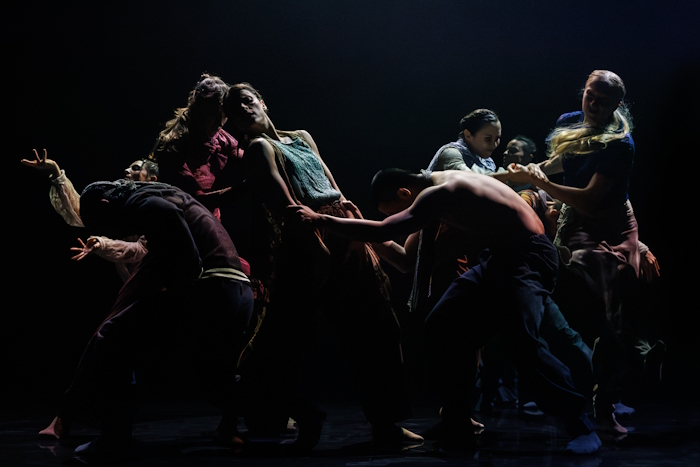
The best of the bunch came last. And boy, was it worth waiting for. Any way the wind blows was created by Hofesh Shecter for Gauthier Dance earlier this year. It is quite simply terrific. And it was terrifically danced too.
It opens with two separate groups of four and seven dancers, but it’s not long before they mingle. The choreography is Shechter through and through. Soft upper body movement is frequently interrupted by more jagged, angular moments. At times, it’s almost trance like. There are sharp changes of direction, in terms of travelling and individual limbs. It’s often fast, very fast. And yet, in those unexpected moments when the cast, or small groups of dancers within it, suddenly come together, the synchronicity was astonishing.
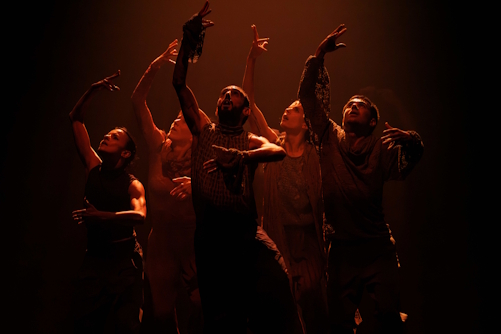
Photo Jeanette Bak
There are a few unexpected moments in Shechter’s music too, most notably when his usual pulsing beats (although it is not as loud as is often the case) gives was to sonorous orchestral strings.
The mood is all added to be Tom Visser’s magnificent lighting that is sometimes smoky and sometimes cuts the stage space down so focusing the eye. There is some super use of momentary blackouts too.
The standing ovation and repeated curtain calls were all fully deserved.
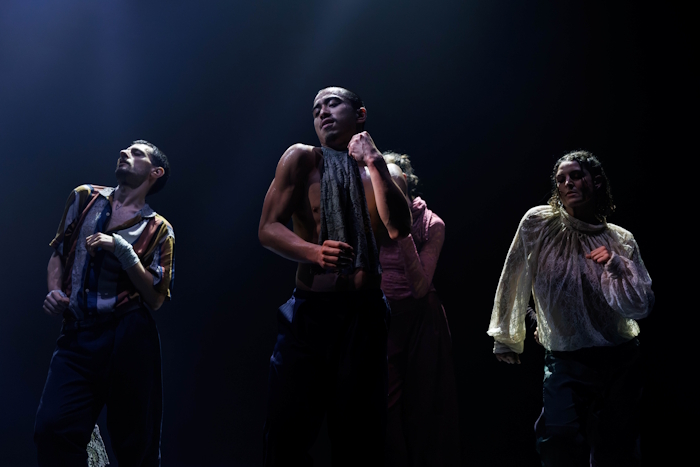
Photo Jeanette Bak
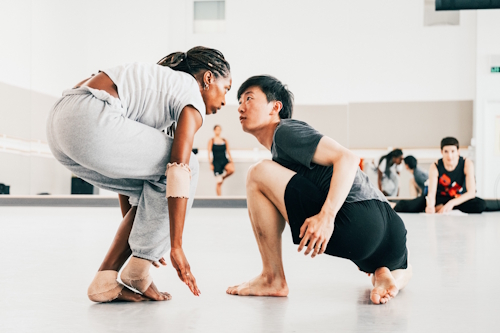
The evening was opened by Wei Wang and Jacey Gaillard from San Francisco in Sidi Larbi Cherkaoui’s Faun, the choreographer’s 2009 interpretation of Nijinsky’s iconic 1912 ballet, L’après-midi d’un faune. The premise is essentially the same, the ballet depicting the sexual awakening of a fawn, but comes with significant updating. For a start, Cherkaoui has just one nymph rather than several and, while still using Claude Debussy’s impressionist score, he occasionally interrupts it with additions by Nitin Sawnhey; additions that sit within the original remarkably comfortably.
Given the near 100-year age difference, it’s perhaps no surprise that Cherkaoui’s work is also very different in look and feel. Compared to Nijinsky’s stylised rather two-dimensional tableau vivant, in which the characters look like they come straight out of a Greek frieze version, his choreography is very three-dimensional, and has the two dancers very much as equals.
While the animalistic elements are still very much there, he also leaves us in no doubt that the wild and carefree creatures we witness are half-human. If anything, the result is a ballet that leaves a much more powerful and lasting impression.
rehearse Faun by Sidi Larbi Cherkaoui
Photo Lindsey Rallo
Wang’s opening solo was all you could wish for. He really does look like the titular creature. He’s strong, yet simultaneously wonderfully soft. He has pronking, the way deer leap into the air with all four feet off the ground at the same time, off to a tee. Gaillard’s nymph was powerful, bit not entirely young and innocent, it seemed. When the pair come together, the interaction between them includes some graceful acrobatics. It manages to be playful but the sexual tension usually associated with the piece didn’t always surface, the couple never quite managing to hit the heights of Debussy’s score.
Echo:Sog is a solo by Stuttgart Ballet principal dancer Friedemann Vogel, co-created with Thomas Lempertz, to Johann Sebastian Bach’s Chaconne in D minor, played live on stage by Abram Korsunsky.
It opens intriguingly with Vogel pushing Korsunsky and his piano onto the stage. In silhouette, it’s a striking image. Sadly, it was about the most interesting part of the piece’s fifteen minutes. Echo:Sog was as beautifully danced as one would expect. The clarity of movement was outstanding. There are hints of the choreography echoing lingering memories, most notably in a repeated motif that saw Vogel reach up with his right arm, then back towards the piano, although the ‘echo’ of the title seemed to be more the way the dance very much echoed, followed the music. But it all felt very distant. Cool, even. Matters were not helped by there not being a single lighting change once the lights came fully up. Perhaps it was just too introspective.