
Joyce Theater, New York City
October 6, 2026
So, here’s a question. A lot of contemporary and modern dance companies largely or even exclusively perform their founder’s choreography. But why, when that individual passes on, do some struggle so badly, closing down even, while others continue to build on thrive?
The answer surely lies in how successfully then walk that tricky tightrope of honouring the company’s founder and heritage while avoiding becoming a museum. New work that is interesting and relevant is very, very important.
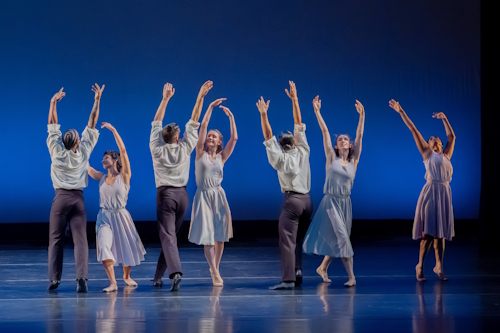
Photo Hisae Aihara
It’s now over fifty years since José Limón died. As it celebrates its eightieth birthday, the company that still bears his name is thriving. Programmes like the one seen in New York are a big part of the reason why. Something old, very old in fact, and something by one of today’s outstanding and in-demand choreographers.
Mazurkas was created in 1958 and is now being performed in its entirety for the first time since 1964. A group piece set to a suite of ten pieces of piano music by Frédéric Chopin, played live by Michael Scales, it’s a tribute to the resilience, strength and vitality of the people of Poland in the post-war era. Indeed, it was originally titled Dances in Honor of Poznan, Wroclaw, Katowicz, and Warszawa. And spirit courses through the choreography.
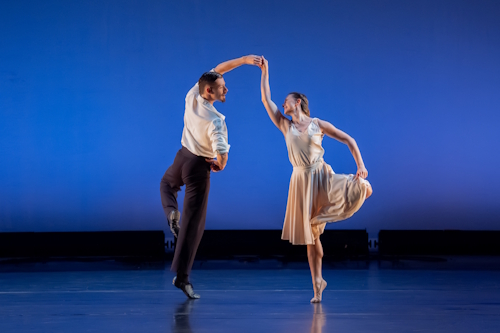
Photo Hisae Aihara
It may be stylistically rather old-fashioned, but Mazurkas is a light, playful work. The forty minutes of enjoyable dance is musically rich and full of life. It is layered with Limón’s signature flow, and fall and rebound. On to that is sometimes fused traditional mazurka stamping steps and postures, in one dance for Joey Columbus, Ian Debono and Stephen Haley in particular. Othe folk dance gets a look in too.
It’s also very polite. It opens with the seven dancers, dressed simply, meeting and nodding or bowing to each other and to the audience. Some of the individual dances start or end similarly.
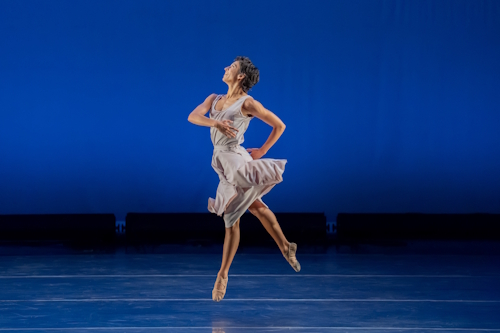
Photo Hisae Aihara
Time and again one sensed each dance had its own little narrative. In the opening duet, Columbus and Olivia Mozie were light and jokey. As they gazed into each other’s eyes, there was more than a hint of young love. A playful number by Mariah Gravelin was followed by a stronger one by Haley. A scintillating and very pleasing dance from the four women, Gravelin and Mozie joined by Jessica Sgambelluri and Lauren Twomley, is full of swirling patterns. Ian Debono then produced the work’s one darker dance in what was the stand out solo of the piece.
Mazurkas is very much a dance of hope and that looks to a bright future. It’s truly alive and just keeps on giving before Limón rounds it all off nicely with an ensemble section that revisits moments from earlier.
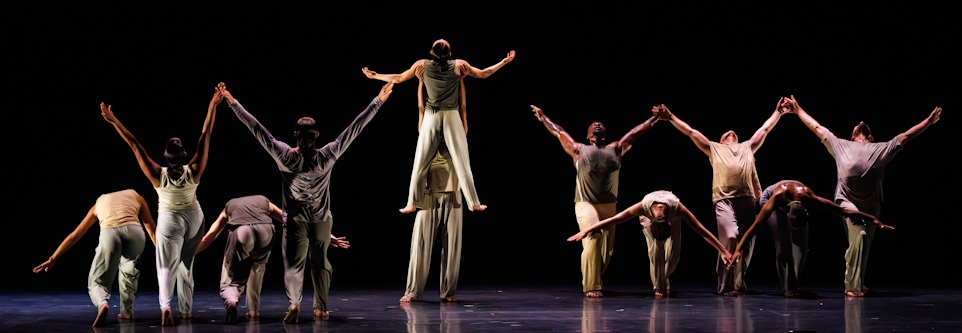
Photo Ben McKeown, courtesy American Dance Festival
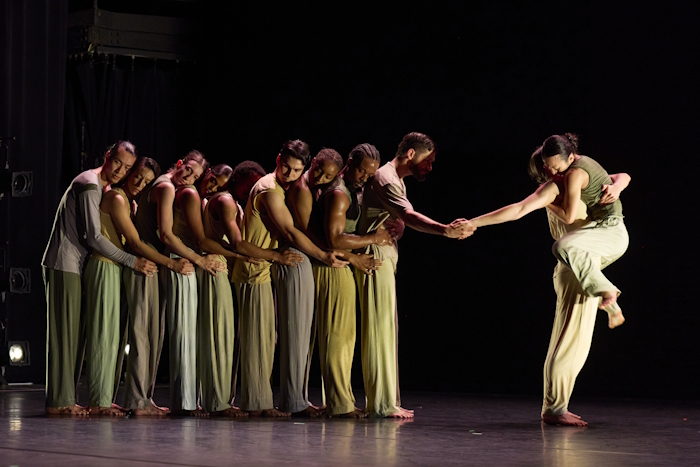
For Join, commissioned by the company in 2025, Aszure Barton and composer Ambrose Akinmusire, were inspired by Limón’s written description of Doris Humphrey’s never performed and now lost 1930s work, Orestes. The result is quite spellbinding.
It opens with the dancers in a line. They step forward, hands clasped and released in sequence. At first, they do not look at each other, but slowly heads start to turn and connections are made. Lines become a feature of the work, whether one long one or several smaller ones, across the stage or in a circle, the cast forming up time and again. At one point, a long line wheels, the dancer on the end leaping as if thrown into the air by the force of its acceleration. In between, the cast huddle collectively, protectively
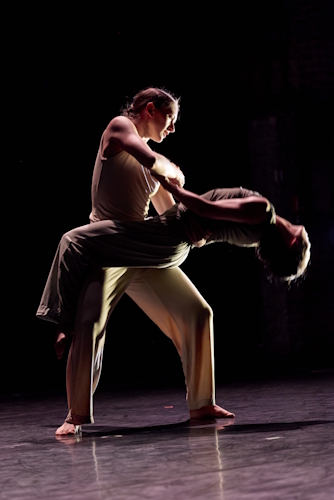
in Aszure Barton’s Join
Photo Kelly Puleio
Individually, there are lots of small gestures but overwhelmingly there is a sense of a single living, breathing whole. Some of the tableaux created feel almost spiritual, otherworldly. As the dance ebbs and follows, couples do sometimes breakout from the ensemble into complex and fluid duets, often angsty, but always easily return.
Trust is very much to the fore. Several times, one of dancers is held high by the others before falling into their arms, sometimes rebounding again, as if catapulted back up by some unseen trampoline. And yet one never got a sense that the move was being set up. It always emerged naturally.
It’s all supported beautifully by American avant-garde jazz trumpeter and composer Akinmusire’s atmospheric and deeply layered score that includes flute, piano, cello, chanting, and I’m sure the buzzing of insects.
As in Mazurkas, everyone performed with superb assurance. There was power, there was grace, there was beauty. Join draws you in and never lets go.