
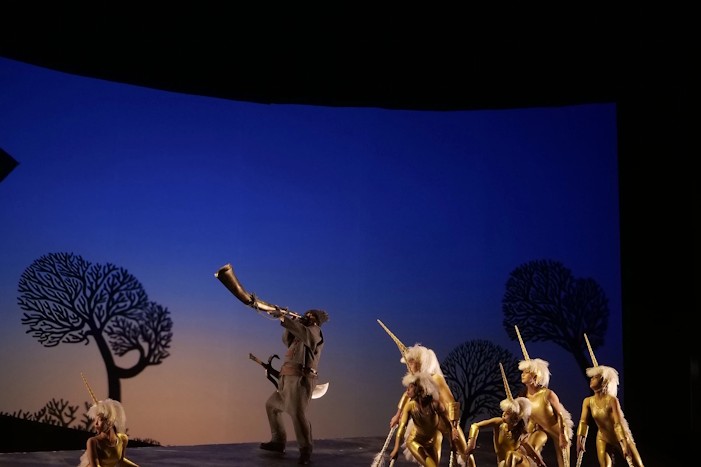
Barbican Theatre, London
October 9, 2026
A man stands with his shadow on the floor. Another appears, heavily bearded, dressed in uniform and carrying a blade, as though he has stepped out of a manga. He announces that shadows are not permitted in this town and proceeds to separate the man from his. The severed Shadow then dances with a group of black-clad performers. At one point, the performer stands still while an overhead light moves, sending his shadow sweeping across the floor like the hand of a clock. The dancers leap over it as it passes. A simple manipulation of light creates a playful encounter between bodies and something that should be inseparable from them.
This is the opening of Philippe Decouflé’s stage adaptation of Haruki Murakami’s Hard-Boiled Wonderland and the End of the World, which moves between two apparently separate worlds. In one, Watashi, a thirty-five-year-old man, becomes entangled in a struggle involving information, technology and the manipulation of human consciousness. In the other, Boku enters a town enclosed by an immense wall, where people must relinquish their shadows and live without their hearts. Both face the prospect of losing control over their own existence. Watashi confronts a future determined by forces beyond his understanding, while Boku discovers a seemingly peaceful world in which the absence of pain comes at the cost of memory, emotion and individual identity.
Murakami’s mixture of speculative fiction, psychological unease and deadpan absurdity meets Decouflé’s playful theatrical imagination. The choreography draws on ballet, contemporary dance, jazz and movement that occasionally approaches the floorwork of breaking. Performers become human figures, shadows, underground creatures and unicorns. The unicorns are especially strange, performed on pointe with sticks in hand and patterned unitards, gold in the first half and white in the second. Their appearance suggests giraffes almost as readily as mythical beasts.
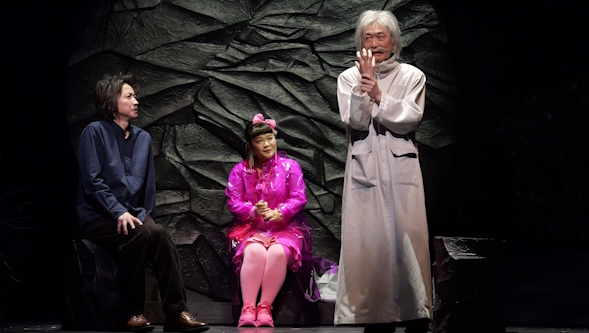
in Philippe Decouffle’s End of the World and Hard-Boiled Wonderland
Photo Takahiro Watanabe
The dancers have a varied physical vocabulary, although the choreography does not always make the most of it. When Watashi and the Professor’s granddaughter flee their pursuers into heavy rain, performers carrying umbrellas launch into a buoyant, jazz-inflected group dance. The cheerful choreography turns a moment of danger into an almost playful diversion, while the girl remains preoccupied with the prospect of sleeping with Watashi. It brings a brief change of mood without adding much to the characters’ predicament.
The relationship between Boku and the town’s librarian offers a more suggestive use of movement. She has neither shadow nor heart and is supposedly incapable of love, yet their developing intimacy seems to question that condition. During a duet, another pair of black-clad performers mirrors their movements on the sloping platform behind them. For a moment, two people who should have no shadows appear to acquire shadows of their own, intertwining through movement. The visual doubling makes their uncertain emotional connection tangible without further explanation.
Near the end, dancers in black sleeveless tops and shorts twist and contort through contemporary and street-dance floorwork as paper snow falls against the darkened stage. Their bodies fold, roll and turn into almost inhuman shapes. The Shadow tumbles from the sloping platform onto the dancers below before reaching the stage and joining them. The restless bodies beneath the falling snow create a melancholy beauty, one of the evening’s more affecting images.
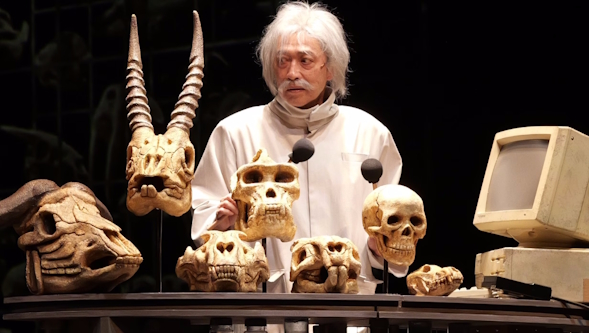
in Philippe Decouffle’s End of the World and Hard-Boiled Wonderland
Photo Takahiro Watanabe
The staging is economical. A sloping platform, limited props and projections accommodate the alternating worlds, creating landscapes and giving visible form to psychological imagery. A projected sequence of the Gatekeeper cutting an eye draws an audible gasp. At the side of the stage, a musician supplies live piano and sound effects, including percussion produced by striking a unicorn skull. The skulls preserve old dreams; Boku reads them hoping to restore the librarian’s missing heart.
Music brings fragments of Watashi’s ordinary life into the increasingly strange narrative. He listens to Bob Dylan at home, while Danny Boy accompanies his reflections on the value of his existence. A memory of watching Casablanca with his teenage girlfriend introduces As Time Goes By. The two librarians are played by the same actress, the modern-world woman speaking with greater directness and maturity, while her counterpart in the walled town appears almost childlike.
Decouflé retains the novel’s alternating narratives, but the two worlds are not particularly distinct in their theatrical rhythms or physical languages. The modern world occasionally moves at a faster pace, while the walled town is quieter, but the difference seldom extends into a sufficiently distinct physical language. Much of the story continues to depend on dialogue, while movement and imagery offer relatively little additional guidance through its complicated structure. For those unfamiliar with the novel, following these parallel narratives requires considerable concentration.
There is also a tension between the characters’ loneliness and the activity surrounding them. Scenes change rapidly, people come and go, and the stage is rarely still for long. There is so much happening around these isolated men that they are scarcely given the space to be lonely. Yet the constant activity does not produce sustained dramatic momentum, and the succession of strange encounters and explanations gradually becomes tiring.
Humour provides occasional interruptions, usually through broad physical comedy. Two intruders form a comic double act, the taller Big Guy following so closely behind his shorter companion that they appear almost joined together. Big Guy then wrecks Watashi’s apartment, smashing doors, furniture and a computer before struggling with a leather jacket that refuses to tear. The physical comedy raises some laughter, although the response is hardly enthusiastic.
More troubling is the relationship between the thirty-five-year-old Watashi and the Professor’s seventeen-year-old granddaughter. Intelligent, resourceful and capable of protecting and guiding him, she nevertheless repeatedly questions his penis and sexual performance, while actively pursuing the possibility of sleeping with him. The casual humour surrounding an adult man and a minor is deeply uncomfortable. These sexual jokes, character relationships and portrayals of women are inherited from Murakami’s novel, whose treatment of female characters has long been a subject of criticism and debate. Watashi’s preference for the more conventionally feminine librarian further highlights how closely the women’s roles remain tied to the male protagonist’s desires and psychological journey.
At almost three hours, the production feels increasingly drawn out, particularly in its final stretch. Decouflé finds moments of visual invention through relatively simple theatrical means, and the dancers demonstrate versatility across different movement styles. Yet the choreography too often serves to connect or decorate scenes, without adding much to the drama itself. Watashi and Boku inhabit different worlds, each struggling to preserve something of himself against forces beyond his control. Their stories arrive at different choices, but neither can return to the life he once knew. What should carry the weight of that loss is too often crowded out by the production’s restless succession of scenes and effects.