David H. Koch Theater, New York City
October 4, 2026
New York City Ballet’s Contemporary Choreographers programme brought together the two new works that premiered at this year’s Fall Fashion Gala, alongside two from previous years.
First, scrolling back to 2017, and Justin Peck’s Pulcinella Variations. Although choreographed to Stravinsky’s Pulcinella Suite, and danced in costumes by Tsumori Chisato that are a sort of 21st-century take on traditional commedia dell’arte, the choreography itself is non-narrative and has no connection to the Italian character.
Opening and closing ensemble dances bookend eight solo or duet variations. The dance is classical through and through, although Peck largely infuses it with a distinct contemporary feel.
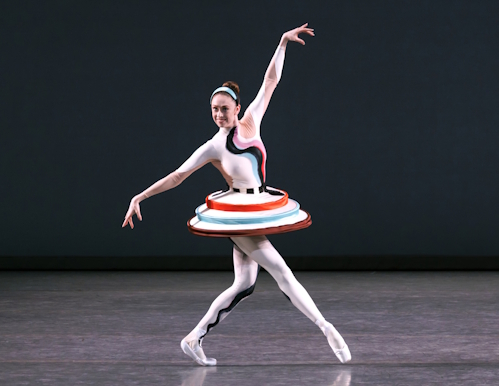
Photo Erin Baiano
The first pas de deux, Serenata, danced here by Kloe Walker and Preston Chamblee is probably the least successful. It’s certainly classical, perhaps the most so, but it feels heavy. Things quickly pick up, though. Meaghan Dutton-O’Hara was delightfully perky in the airy, light and bright Scherzino. Even better was the supremely musical Emma von Enck in the following effervescent Allegretto that follows. Other highlights included the livewire Simeon Daniel Neeld in the Tarantella, and the final pas de deux that is the Gavotte for Unity Phelan and Chun Wai Chan.
For each Fall Fashion Gala, New York City Ballet teams up choreographers with fashion designers. Fairly predictably, the costumes created have a habit of overwhelming the dance, taking attention away from the choreography. It’s a measure of Peck’s work that this doesn’t happen with Pulcinella Variations. While Chisato’s are almost works of art in themselves, they very much add to the dance, creating a pleasing aesthetic whole, rather than taking attention from it.
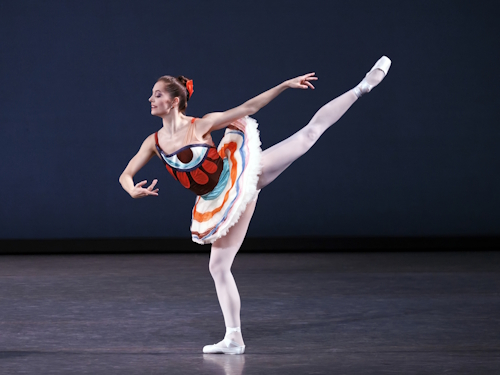
Photo Erin Baiano
For her ballet, Auspicy, choreographer Alysa Pires joined forces with Viktor Horsting’s label Viktor&Rolf.
The ballet attempts to look at the challenges of motherhood in turbulent times but struggles to say anything. It opens with the image of a giant, gilt, skirted figure that looks for all the world like a cross between a giant owl and an oversize Mother Ginger. And to add to that image, two Offspring, David Gabriel and Emma von Enck, rush out from her skirt, scooting around like the youngsters they are supposed to be.
The Mother soon appears in person as the normal-size Naomi Corti. Just in case we don’t get the idea, her elaborate stiff-looking coat has the word ‘PROTECT’ in huge letters standing tall on her shoulders. It looks clumsy. Quite how anyone thought it a good idea I really can’t fathom. It would look ridiculous even on a fashion show runway.
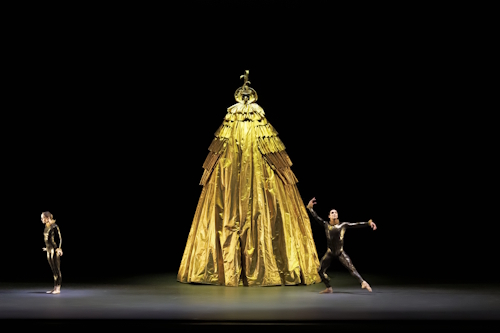
Photo Erin Baiano
The rest of the costumes are better, for dancing in at least, with everyone in very shiny gold or black bodysuits. That the Offspring are identically dressed as some other Fledglings as they are called, does help make them disappear into the ensemble, though.
There are more bird connections in Jocelyn Morlock’s score, one section of which is titled ‘Oiseaux bleus et sauvages’ (Wild Blue Birds).
Choreographically, there’s little to say, the ballet struggling to deliver its message. And you had to feel for Corti as she walked slowly and very carefully around the stage. At one point she holds out her hands to stop the curtain from falling, an action that’s repeated later. Presumably it does have meaning but quite what is anyone’s guess.
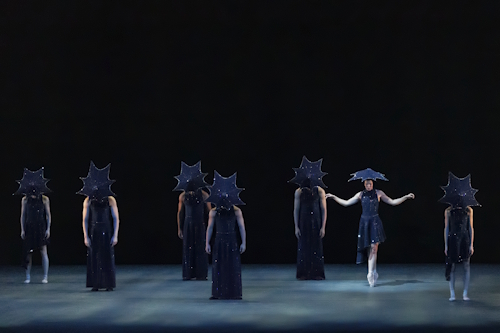
Photo Erin Baiano
This year’s other Fall Fashion Gala premiere, Shared Rain by Jennifer Archibald, oozes class, however. And here, the costumes by couturier Robert Wun work well. They are very glittering, but the dancer’s midnight blue bodysuits reflected and refracted Mark Stanley’s stage lighting wonderfully. A little like rain under city lights, in fact.
The work considers climate change, rain specifically. It opens with the dancers still, looking down, odd-looking six-pointed umbrella-type structures atop their heads. The music suggests a downpour. When they performers begin to move, Archibald’s background and experience is very apparent. A ballet for four men and four women, the classical but hip hop inflected choreography is urgent and intense. The dancers gave it all the energy in needed, and more.
It looks wonderfully elegant. Ensemble sections flow gorgeously. Several dancers get brief solos in a section that appears to mimic what often happens at the end of hip hop shows. One by one of the men that included a lot of small jumps was especially impressive.
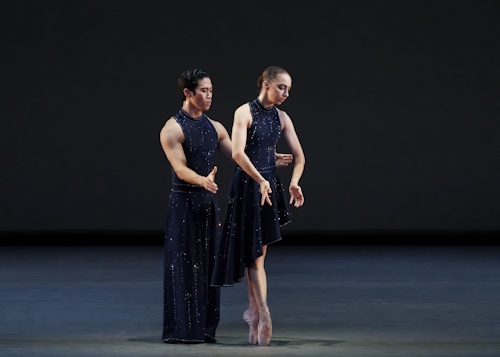
Photo Erin Baiano
Shared Rain is all very classy. Even the score, a fusion of compositions by no less than seven composers that shifted between the sound of breathing and driving percussion, works superbly. My only complaint? It’s not long enough. But always leave them wanting more, I guess.
The programme closes with Kyle Abraham’s terrific Love Letter (on shuffle), first seen at the 2022 Fall Fashion Gala.
To a collection of tracks by singer-songwriter James Blake, it opens with a male dancer looking anguished. Tormented, even. When other dancers appear, they maintain a distance. In a way, the ballet is about him coming to terms with himself, and within the community that’s he’s part of.
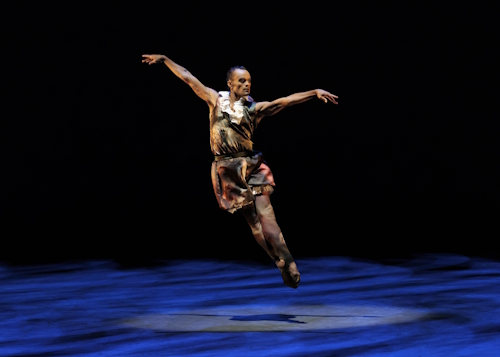
Photo Erin Baiano
In costumes by Giles Deacon that always enhance the choreography, the cast largely dance in pairs, each reflecting a relationship, whether straightforward young love or something more complex. Each paints a picture without being in any way judgmental. Two stood out. Alexa Maxwell and Alexander Perone were quite romantic in a duet to Blake’s ‘Are You in Love?’, constantly making suggestive eye contact. The all-male pairing of Jules Mabie and Taylor Stanley to ‘Love Me in Whatever Way’ that followed was equally impressive.