
Joyce Theater, New York City
October 2, 2026
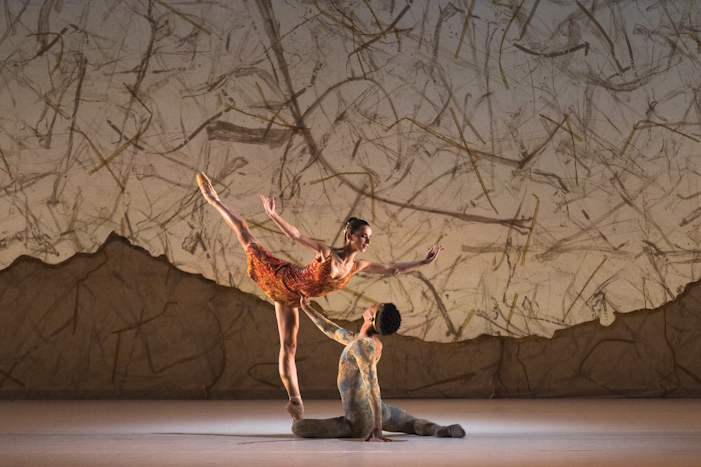
Sarasota Ballet returned to New York with the most English of evenings in a programme that brought together Antony Tudor’s Lilac Gardan, five Frederick Ashton divertissements and, most interesting and anticipated of all, Peter Wright’s one-act ballet, Summertide, that closed the evening.
Created in 1976 for Sadler’s Wells Royal Ballet and performed to Felix Mendelsson’s Piano Concerto No.2, the now fifty-year old Summertide was lost until recovered by Sarasota Ballet in 2015. That we can see it again is remarkable given there was very little notation, only a very poor quality video and the memories of Sarasota Ballet assistant director, Margaret Barbieri, who performed in the second movement adagio.
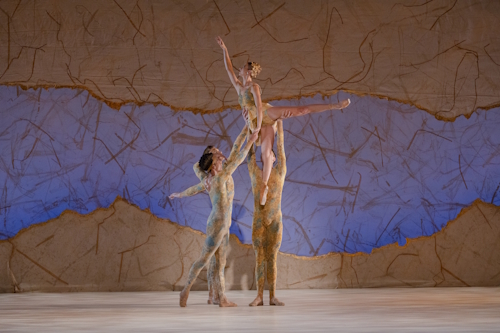
(pictured: Danielle Brown, Ricardo Rhodes, Juliano Weber, and Thomas Leprohon)
Photo Frank Atura
And it is that graceful second movement pas de quatre that is the highlight of the ballet. Marijana Dominis exuded grace and calm when dancing alone, but it’s the partnering that sticks in the memory. The choreography calls for her to be lifted and carried in so many different ways. Ricardo Rhodes, Nathan Smith and Simon Plante never put a foot, or a hand, wrong. Everything was made to look completely seamless.
In contrast, the colourful first and third movements are very lively. The attention isn’t given a chance to wander as Wright keeps you engaged with sparkling dance and super patterning. The men in particular have a lot of leaps and turns. One pas de cinq for them was especially impressively performed. Rhodes stood out in both movements, although the whole ensemble rose excellently to the challenging choreography.
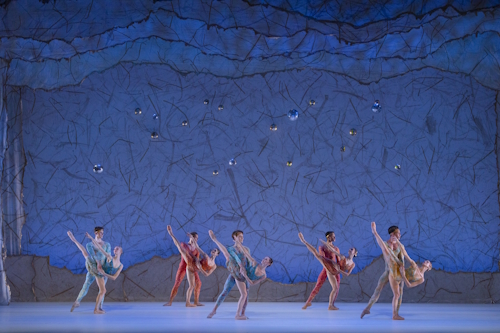
Photo Frank Atura
Dick Bird’s designs, new for the revival, feature very vibrant pinks and blues for the first and third movements, with more subdued tones in the second.
Wright has never made any secret of the fact that he loves the classics as much as audiences continue to love his productions. But it is very easy to forget that he created a lot of shorter works too, some of them, like Summertide, very good indeed. It’s very unfortunate that they have disappeared from view, many probably beyond recall, and that it takes an American company to revive one at least.
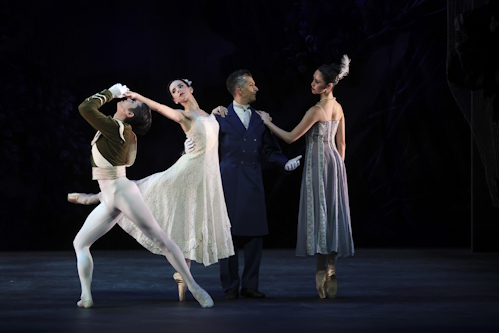
Anthony Tudor’s work is rarely seen in Britain these days, and less and less so in America. His tendency to be subtle and probing rather than technically virtuosic doesn’t sit as well with audience tastes as it once did. Aside maybe from The Leaves are Fading, Lilac Garden, which opened the evening, is probably his best-known ballet. Set to Ernest Chausson’s Poème for Violin and Orchestra, the bittersweet ballet is set in an Edwardian engagement party. The character names tell you all you need to know: Caroline (the woman at the centre of it all), Her Lover, The Man She Must Marry and An Episode in His Past.
in Antony Tudor’s Lilac Garden
Photo Frank Atura
It’s a polite ballet, one of emotions repressed, held in as the quartet of mismatched lovers snatch illicit moments. It’s theatre as much as dance.
The choreography calls for a lot of expressive detail. But while all the gestures, all the steps, all the looks, were there, it just didn’t always carry across the footlights. It felt, if anything, a little too subtle. There were also a couple of shaky moments early on.
I appreciate she’s hiding feelings but even so, I found Dominis’ Caroline hard to read. Apart from a couple of moments when she looked at or reaches towards Her Lover, she just seemed very resigned to it all. I certainly didn’t get that she felt anything much for either of the men. As The Man She Must Marry, Ricardo Graziano struck the perfect note with a strong, strict, very domineering presence. Quite cool, in fact. There’s so little romantic chemistry between them, you suspect it’s an arranged marriage of sorts. ‘Must Marry’ rather than ‘Wants to Marry’ feels a very deliberate choice of words. But then there was no sense of despair. Maybe she was just resigned to it.
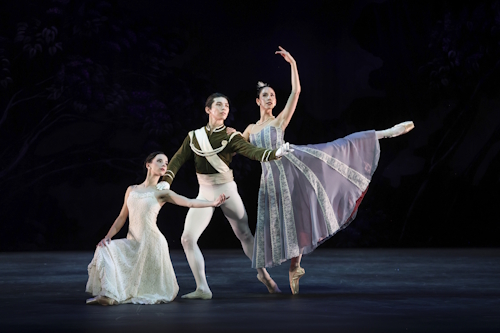
in Antony Tudor’s Lilac Garden
Photo Frank Atura
More intense, and certainly headstrong, was Brooke Wilson as An Episode in His Past. Like her former lover, she didn’t exactly elicit sympathy though, which is as it should be. The trickiest role is probably that of Her Lover, Samuel Gest, who needs to show passion, but that is hidden. There was certainly some angst, and I loved his resigned reaction to the sound of a church bell.
At the end, Caroline leaves on the arm of her betrothed. But it does feel like a decision she may come to regret, or at least down the line wonder, ‘what if…’
Under the direction of Iain Webb, Sarasota Ballet has made Frederick Ashton’s ballets a cornerstone of its repertory. And it was to five Ashton divertissements that the centre of the evening was given over to.
In a fine start, Kaitlyn Casey was beautifully partnered by Rhodes in the Meditation from Thaïs. It was quite sublime. The lifts were all serenely executed and her bourrées were as light as a feather.
The pas de trois from Les Rendezvous, one of Ashton’s early works from 1933, brought a complete change of mood. Andrea Marceletti, Pasha Levy and Gus Payne pulled off the cheeky, yet fast and fiendish choreography superbly. It all felt remarkably fresh. Not at all almost 100 years old.
Sumika Fujiwara and Andrii Ishchuk were dreamily lyrical in the Awakening Pas de deux from The Sleeping Beauty but it’s one that doesn’t work well out of context.
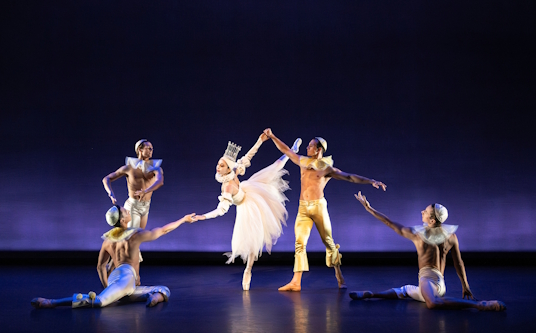
Frederick Ashton’s Illuminations
Photo Foteini Christofilopoulou
Starkly different again was the ‘Sacred Love’ Pas de cinq from Illuminations. Iku Okura was the lissome woman well supported by Trevin Ralphs, Jonah Glickman, Ze Ellis and Simon Plante. Cecil Beaton’s costumes do not do the dance any favours, however.
Completing the set, Sierra Abelardo and Samuel Gest were utterly delightful in the Balcony Pas de deux from Romeo and Juliet. It may be more gently romantic than the familiar MacMillan but it captures young love perfectly. I love the way she just sits and watches him dance out his love for her. Abelardo didn’t need to do anything to tell you how her Juliet felt. When the couple dance together, the way Gest made her seem so light in a series of small supported lifts across the stage said it all.
It was a super evening. An evening of ballet very much rooted in England. And Peter Wright’s Summertide really was the most wonderful closing ballet. Just a shame one has to travel across the Atlantic to see it.