
David H. Koch Theater, New York City
October 7, 2026
Eclectic NYCB said the title of the evening. It was certainly that. Three ballets, very different in style and mood.
First up, Christopher Wheeldon’s complex but intriguing 2002 work, Continuum. Set to the difficult micropolyphonic keyboard and harpsichord music of György Ligeti, it takes Goerge Balanchine’s neoclassicism and looks at it through a very austere, very modernist lens.
Bookended by sections for all four couples (Emma Von Enck and David Gabriel, Unity Phelan and Gilbert Bolden III, India Bradley and Davide Riccardo, and Mira Nadon and Chun Wai Chan), each of the ballet’s duets and occasional solos are rather elegant in their own way.
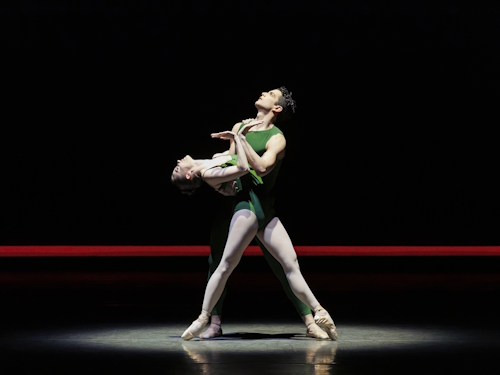
Photo credit Erin Baiano
A work of many tones, Continuum is very much a visualisation of the music. While there are undoubted echoes of Balanchine’s more experimental works, Wheeldon surprises again and again with his invention in what is a series of choreographic miniatures. The movement is often staccato. It also has a fascinating geometry. Legs extended then held bent 90 degrees at the knee appears frequently. Feet and similarly flexed then pointed. Arms are often held straight rather than in traditional ballet ways.
At one point, one of the women is flipped a full 360 degrees, her limbs like the hands of a clock. Another, when held upside down, moves her legs as if they are minute and second clicking round from point to point.
There is frequent use of the floor as the dancers kneel and roll. But amidst the strange sculptural shapes and angularity are one or two unexpected moments of tenderness, most notably when Bolden and Phelan kneel and roll their heads along each other’s shoulders, almost nuzzling one another.
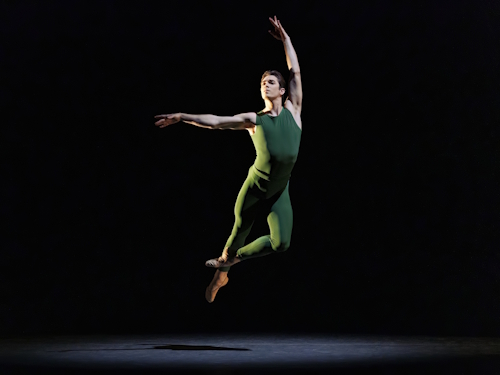
Photo Erin Baiano
Continuum is certainly strange, certainly challenging. But it’s also very appealing. As the scenes come and go, each separated by a brief blackout, the ballet also has an odd serenity. And the final section, with the four couples reunited, spotlit by lighting designer Natasha Katz in a way that casts giant shadows and the back scrim, is quite beautiful. And it was stunningly danced too.
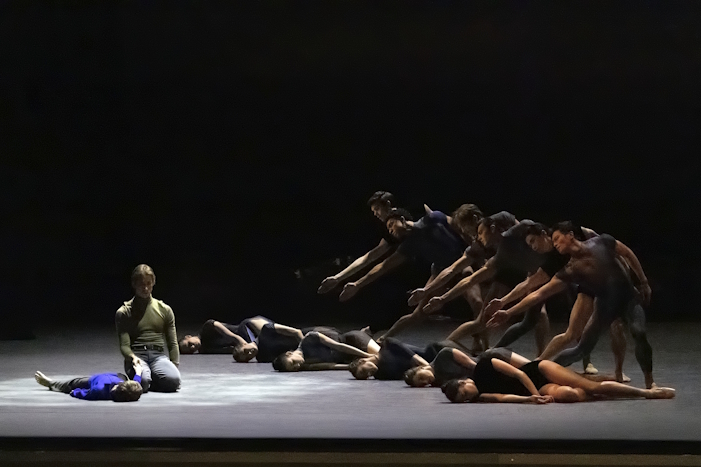
Alexei Ratmansky’s Solitude is inspired the struggles of the Ukrainian people, specifically by a photo taken during the first year if the invasion that shows a father holding the hand of his dead son by a bus-stop in Kharkiv after being killed by a Russian missile. Apparently, the man sat there hours, his eyes empty.
And that is precisely what is seen for much of the opening, Joseph Gordon, motionless, empty, kneeling next to the body of his child, played by School of American Ballet student Ethan Schimdt. As a visualisation of psychological trauma, of someone utterly lost in grief, I’m not sure I’ve ever seen anything better.
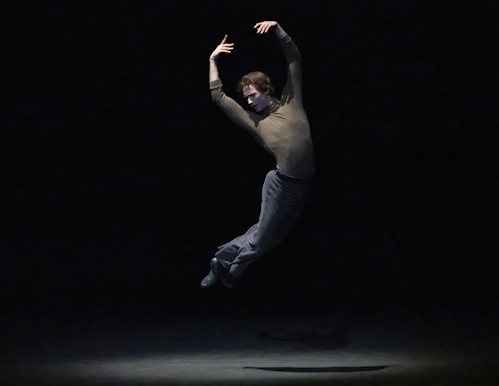
Photo Erin Baiano
Behind him, and accompanied by the third movement ‘Funeral March’ from Gustav Mahler’s Symphony No.1, which includes the melody from the dark nursery rhyme Frère Jacques, we see the community. Dancers bend and twist, as if not in control. They look at Gordon, occasionally offer sympathy, but always move on, as if they have become desensitised to death. It is, for them, the new norm.
At one point, the ensemble all fall slowly to the floor as if they had been hit by a hail of machine gun fire. The dark, muddy coloured low set across the back, which could be taken as rubble or a churned-up battlefield, just emphasises the scene even more.
The boy having been led away, the second half of the ballet, to the fourth movement Adagietto from Mahler’s Symphony No.5, sees what appears to be the father having a dream. Gordon’s solo is incredibly impressive technically. The leaps and pirouettes are all amazing. But is he dreaming of happier times past, or dancing out is emptiness, perhaps raging at what has happened? Maybe it’s all three. Whatever, the spell cast by the opening scenes is broken. The emotion gets lost in the virtuosity. It hides the human beneath.
The feeling returns in a moment when Gordon dances a few steps with his son though, and especially when he returns to the spot where his son had lain. When the ensemble returns with the boy, it’s like watching ghosts. Then, like a sudden flashback, bodies fly and fall and we’re back to where we started, the man, the boy, grief, pain, numbness, solitude.
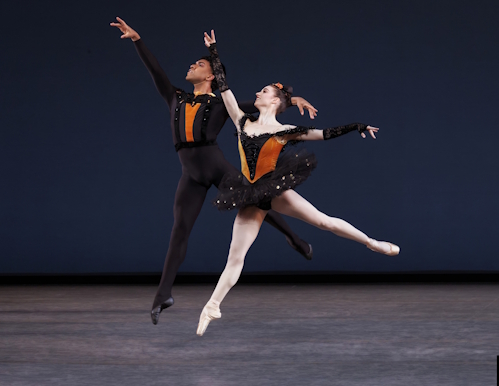
Photo Erin Baiano
In complete contrast, Balanchine’s Bourrée Fantasque that closed the evening is light and bright. A classical showpiece set to music by Emmanuel Chabrier, it runs from comedy, through romance, to glorious exuberance.
The opening movement, from which the ballet takes its title, sees Balanchine play the old little man, tall woman gag for all its worth. KJ Takahashi longs for a kiss, just one kiss, from the Emily Kitka. But she’s teases him and makes him wait and wait. The moment she tries to cool his ardour by fanning him was particularly funny. He does eventually get his kiss, by the way.
There’s no such luck for the man in the Prelude, which brings a total change of pace and mood. Ruby Lister and Preston Chamblee were the couple who meet but who cannot connect. They were full of poise, before eventually sliding apart.
The dazzling Fete Polonaise recaptures the mood of the opening, and some. The corps makes a running entrance (Theme and Variations, anyone?) before launching into upbeat choreography full of huge kicks and high lifts with split legs. Then Victor Abreau arrives with Alexa Maxwell and makes her soar highest of all. It’s irresistible, overflowing with joie de vivre, and all in Karinska’s colourful costumes. Then, just when you think it’ can’t get any better, Chabrier ramps up his mix of mazurka and waltz rhythms and everyone gives even more.