Sadler’s Wells East, London
September 24, 2026
National Dance Company Wales brings together two very different works in Blue|Glas: Theo Clinkard’s Ordinary Courage, first created in 2012 and now remade for the company, and Alesandra Seutin’s new Untamed. They share ideas around struggle, change and moving forward, but they come from opposite directions. One keeps returning to touch and stillness; the other seems determined to run until there is nothing left.
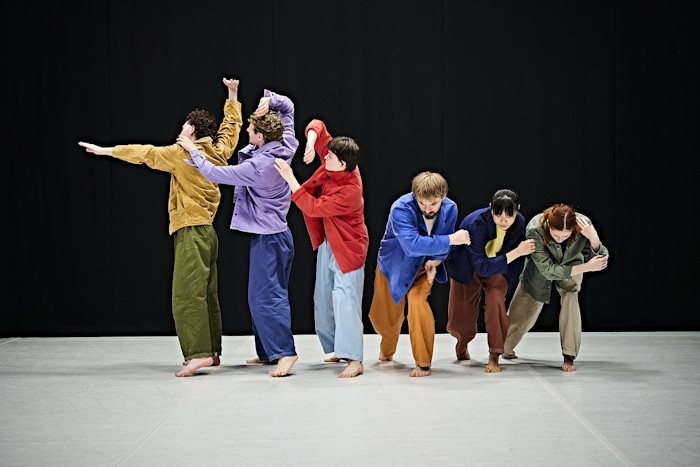
Ordinary Courage begins quietly. Six dancers stand together in simple, everyday clothes and move almost as one. There is no need to explain the relationship between them. It is already there in the way one body follows another, how weight passes through the group, and how quickly a small separation suddenly feels significant.
Clinkard’s subject is grief, but the choreography rarely tries to ‘perform’ grief in an obvious way. That is one of the work’s strengths. It appears through changes in behaviour. Someone breaks away from the group. Someone needs to be held. A dancer collapses or becomes heavy in another person’s arms. At other moments, people simply continue with what they are doing while somebody nearby is clearly struggling.
That feels much closer to how loss actually sits inside ordinary life.
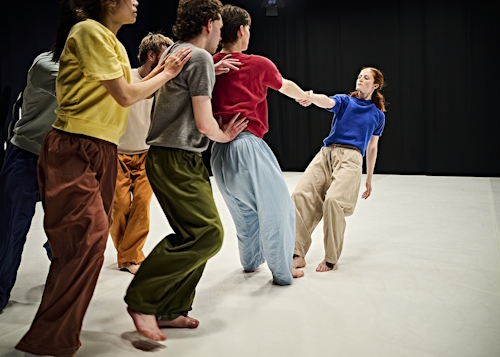
Photo Jorge Lizalde
The dancing moves between group passages, solos and duets, and the physical language is often surprisingly loose. Bodies swing, twist and throw themselves off balance. Arms sometimes seem to arrive slightly after the rest of the body. Even when the dancers move together, there is a sense that each person is carrying something different.
NDCWales dancers handle that individuality very well. The work depends on allowing six personalities to remain visible inside the same structure. Small details matter: the way a hand stays on another dancer for a little longer than expected, a body that resists being helped, or a sudden burst of energy after a long period of still.
Music by Bach and Scarlatti enters and leaves the space but silence is equally important. Without music, footsteps become the music it’s louder. Breathing becomes noticeable. You start to hear the effort involved in keeping another body upright.
There are some beautiful passages, particularly when Clinkard allows the choreography to remain simple. A dancer sometimes watching somebody stand apart from the others is enough.The work is strongest when it trusts the bodies and does less around them.
Yet its return to the opening group material near the end is quietly effective. The movement is familiar, but after everything that has happened between the dancers, it no longer looks the same.
After the interval, Untamed changes the temperature completely.
Alesandra Seutin begins with bodies that look awkwardly contained. Limbs jerk and pull in different directions. Knees lift strangely; torsos tilt and recoil. The dancers can look almost mechanical at first, as though their bodies have been given instructions that they are trying to resist.
Gradually, running takes over.
Not naturalistic running exactly, but its rhythm, effort and urgency. Bodies lean forward. Feet repeatedly against the floor. Breath becomes of the sound. The dancers accelerate, stop, gather and start again.
Seutin is interested in the question of whether we are running away from something or towards something, but Untamed works best when that question stays inside the movement, we do not needing an answer.
In Ordinary Courage, tiredness often feels emotional. In Untamed, it becomes openly physical. We hear the dancers breathe. We hear voices, calls and sounds coming from their bodies. By the final section, the effort is impossible to hide.
That vocal element gives the work much of its character. Randolph Matthews’ score, with Sam Frankie Fox as musical collaborator, mixes electronic textures with voices and the distinctive sound of traditional Welsh instrumentation. At times the stage feels less like a theatre, more than some strange race, ritual or gathering whose rules we have arrived too late to understand.
Ryan Dawson Laight’s costumes add to that uncertainty. Loose, pale sportswear suggests runners, but not from any recognisable contemporary competition. Together with Elanor Higgins’ lighting, which sometimes catches the dancers harshly from behind, the bodies seem to belong somewhere between athletes and figures from an old photograph.
There is plenty of power in Seutin’s choreography, but what interests me more are the moments when running fails.A body stops. Someone falls behind. One dancer seems to pull against the direction of the group. The apparently simple act of moving forward starts to become difficult.
The final part becomes increasingly wild. Movement, breath, sound and voice pile on top of one another. There is something deliberately excessive about it. The dancers look close to spending every bit of energy they have left, and the audience is made very aware that these are real bodies doing real work.
Not everything in Untamed is equally easy to read. Its references to spirit children and freedom may be clearer from the programme than from the choreography itself. But I am not sure that matters very much. Trying to decode every image would probably reduce what is enjoyable about the work.
As a double bill, one work asks how we continue after losing something. The other asks why we feel such a need to keep moving in the first place. Neither offers much of an answer. Thankfully, neither really needs to.