
Barbican Centre, London
October 2, 2026
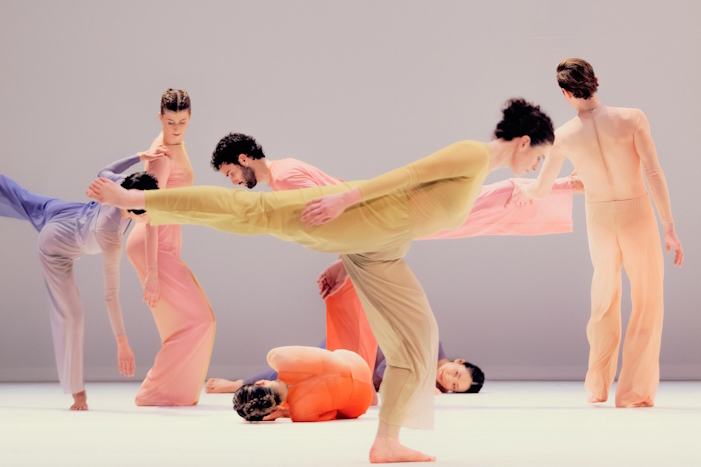
Pastoral is a surprisingly difficult work to review. Taken piece by piece, there is so much to like. The dancers are excellent, the movement has a sly sense of humour, Sarah Crowner’s set is beautiful, and Caroline Shaw’s sound world keeps throwing up new ideas. Put everything together, though, and those pleasures rarely seem to gather. Somewhere around twenty-something minutes in, I found myself wondering how much longer this succession of beginnings would continue.
Ballet keeps peeking through Tanowitz’s movement language, usually with something slightly peculiar attached. A deep second-position plié comes with a little bounce and passes from dancer to dancer. Elsewhere, dancers travel sideways in the same low position like crabs making a hurried escape. Marc Crousillat walks on demi-pointe, knees bent, feet turned out and arms held in third, with such solemn concentration that the sight raises a smile. Early balances on demi-pointe tremble beside the fluttering bassoon, while Lindsey Jones can stop suddenly on demi-pointe with a leg lifted behind her and barely flicker. Later, Crousillat and Anson Zwingelberg face one another with an arm curved overhead, taking turns to sink into side lunges while their shadows rise and fall across the white backdrop like two figures in a music box.
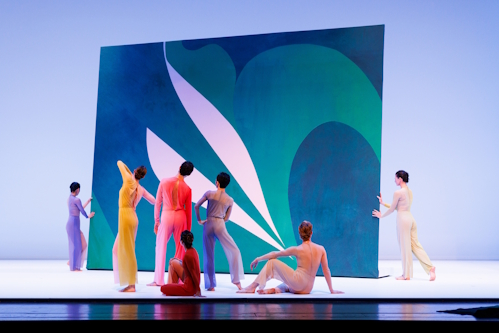
Photo Maria Baranova
Crowner surrounds them with soft colour and crisp geometry. Her three-dimensional set never quite settles, as green panels shift and turn, red blocks arrive, and openings appear and disappear. Sometimes the dancers move the scenery themselves, remaking the picture as they go.
Shaw keeps the ears equally occupied. Beethoven’s Symphony No.6 surfaces through new music, birdsong, thunder, traffic and domestic sound, and at one point a car horn seems to have picked up Beethoven’s phrasing. The three live musicians have plenty to do too; at one point, bassoonist Dana Jessen even adds a hand whistle to the proceedings.
In fact, everybody is busy. The dancers are busy, the musicians are busy, the recorded score is busy, the set is busy. The stage keeps changing its mind.
And yet my attention kept wandering.
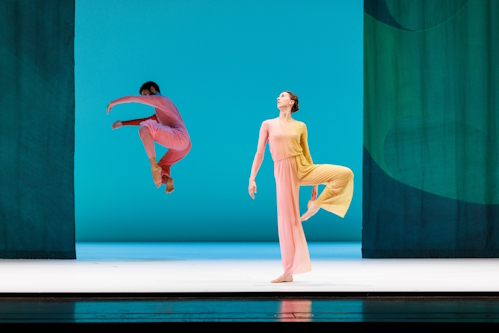
Photo Lawrence Sumulong
That was what puzzled me. Pastoral could always win me back. A strange movement phrase would do it, or a joke, or one of Crowner’s shifting compositions, or Beethoven suddenly poking through the noise. Then the moment would pass, and very little of its weight seemed to travel with me into the next one. The work keeps producing fresh beginnings, but too few leave much consequence behind.
Tanowitz spoke after the performance about keeping ‘swatches’ of movement, making sections separately and later sewing them together. She described the collaboration as “sort of chance, but also not chance.” Crowner and Shaw have similarly fragmentary ways of working, and together the three seem to have made a larger patchwork out of three smaller ones. Sometimes the pieces meet beautifully. A trembling balance finds the bassoon; two bodies and their shadows become little music-box figures; Beethoven slips into an urban soundscape and briefly changes its flavour. At other times, a section arrives, has its moment and gives way to the next. Chance can produce wonderful collisions. It can also be a little… well, chancy.
That is the risk of a patchwork this large. Some pieces suddenly make each other brighter; others remain perfectly nice pieces sitting side by side. Pastoral has plenty of those illuminating encounters, but not quite enough to carry an hour.
That is how an hour filled with movement, sound, colour and invention can still feel flat. I left remembering many individual things I liked, some very much. I only wish more of them had changed what came next.