
Birmingham Hippodrome
June 18, 2026
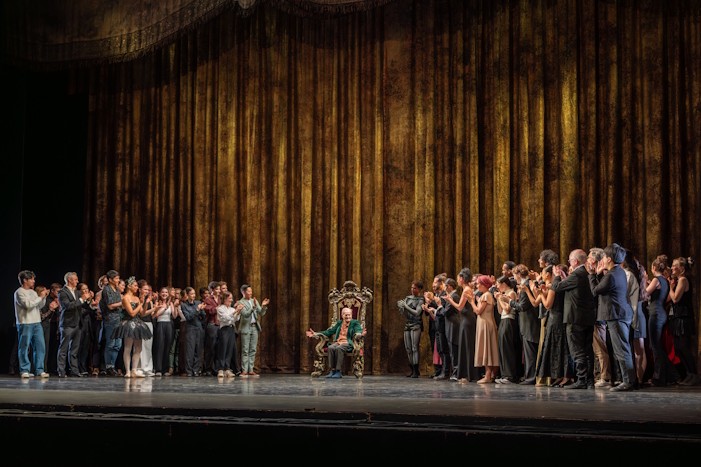
It was an evening filled with heart. As he approaches his 100th year, an evening that put Birmingham Royal Ballet Founding Director Laureate, Sir Peter Wright, firmly at its centre.
And it was very much an evening of two halves. The first part featured excerpts from Wright’s brilliant productions of the classics that are still much loved by audiences today. A change of mood then brought the company’s first performance of Kurt Jooss’s The Green Table since 1994, Sir Peter having brought it into the repertory two years earlier.
After a fine opening Grand Defilé featuring all the students of Elmhurst, Acosta spoke warmly of Sir Peter, speaking of his sharp eye for detail, his often dry wit, that that he was someone who did not just make ballets, but built worlds.
And that last point was all too clear in the classical excerpts that followed. Each was performed as one would expect but even in their cut down designs necessary for the evening, each transported the viewer to another special place.
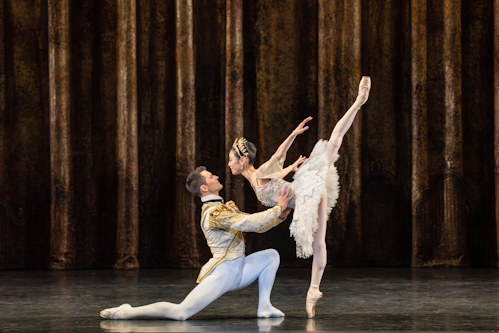
Photo Johan Persson
The excerpts from Act III of The Sleeping Beauty brimmed with colour and life; a picture of gold and silver. Rosanna Ely particularly stood out in the Pas de quatre, before Momoko Hirata and Mathias Dingman treated everyone to a fine Grand pas de deux. The connection between them was outstanding, and I particularly loved a moment at the beginning when she looked at him as if to say, ‘We got this. Let’s give them one to remember.’ And they did. Hirata, one of the best technicians in the company was pitch perfect with lovely ports de bras and pirouettes that stopped on a sixpence.
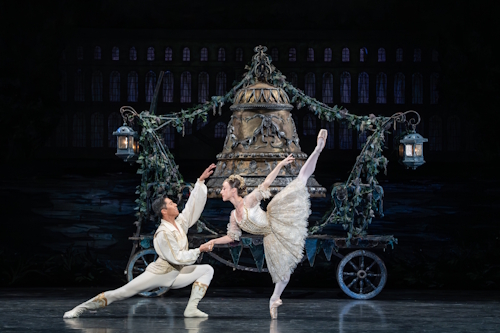
Photo Johan Persson
In more tender vein, Tzu-Chao Chou and Beatrice Parma then gave an excellent rendition of the Act III pas de deux from Coppélia, followed by Miki Mizutani and Max Maslen in that from Act II of Giselle. The ghostly Mizutani was a delicately ethereal as one could wish for, while Maslen proved a subtly nuanced Albrecht.
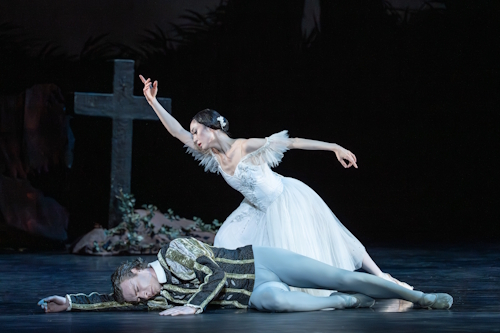
Photo Johan Persson
The excerpts from Act III of Swan Lake opened with the Czardas and Neapolitan Dance, before Eilis Small, Lucy Waine, Gabriel Anderson and Haoliang Feng gave us an excellent, fiery Spanish Dance, full of all the vigour and zest it should have.
Ballet, especially narrative ballet, is about way more than happens from the waist downwards. Céline Gittens doesn’t just dance Odile, she lives it. Here is a Black Swan who knows just what she’s after and who is determined to get it. So much is in the body language, the eyes especially, the little sideways glances towards Rothbart and Siegfried, those quick looks to make sure she really has him snared. As Siegfried, the immensely talented and very young looking Yasiel Hodelin Bello looked like he didn’t know quite what had hit him. Confused, besotted and scared to death, all at the same time. And who can blame him?
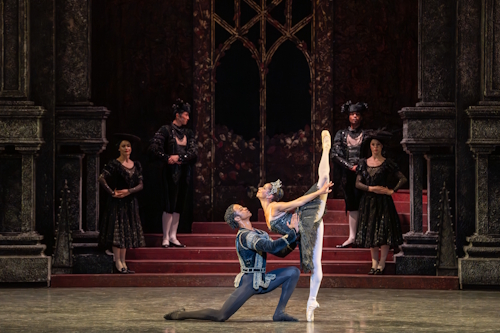
Photo Johan Persson
Missing from the programme were any of Sir Peter’s one act ballets, things like Summertide, created in 1976 for the then Sadler’s Wells Royal Ballet, which is being revived by Sarasota Ballet in the autumn. But this is Birmingham, where it is the classics he is known for, which makes the programme for the evening pretty much about right. The only omission, The Nutcracker, his gift to the city after the company first arrived in 1995. But that can be anjoyed again in November.
Acosta may have referred to Sir Peter creating worlds but that’s only half the story. There is something deeper. A few years ago, in a long conversation I had with him about his approach to the classics, he insisted that, while they might be his productions, they were not his ballets. Rather, he was simply doing his best to update them and “Go along with the times a bit.” Just as important, I think, is that he loves them and the music, and that he understands the importance of narrative. He also believed that tinkering with them helps keep them alive. “Things can get very set, and then the heart goes out of them somehow,” he said. No chance of that on this evening, when heart was everywhere.
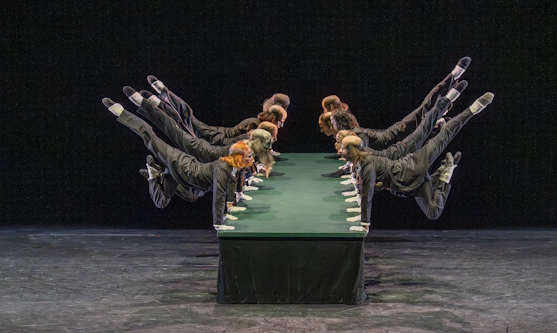
in Kurt Jooss’ 1932 classic, he Green Table
Photo Johan Persson
The Green Table is not only a work Sir Peter admires. He started his stage career by appearing in it with Ballet Jooss in 1943, just down the road at the Grand Theatre, Wolverhampton. He played the role of a soldier, meaning that, as he once joked with me, “I died on my debut.” He went on to dance in it many times, including in the 1950s with the late, great Pina Bausch.
It’s a work that’s still as relevant as when it was created back in 1932. Indeed, if anything, it has become even more topical with time. It delivers its indictment of war forcibly and with not an ounce of sentimentality. Jooss’ choreography with its economy of movement is wonderfully expressive, and is beautifully highlighted by Berry Classen’s lighting. The spare tones of Fritz A. Cohen’s score are just as terrific. The Green Table really is as good as its legendary reputation.
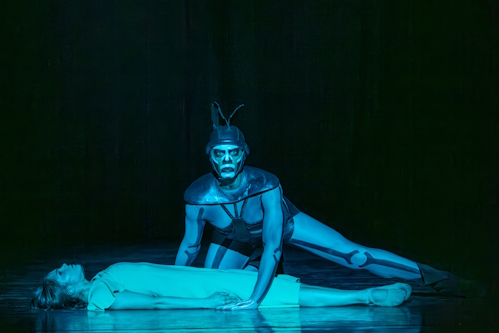
Photo Johan Persson
With no set other than the eponymous table itself, it’s all about what the dancers bring to their roles. And at the centre of it all is the omnipresent figure of Death. Presence, power, weight. With his still impressive physique, Carlos Acosta delivered on all counts. He dominated the action, watching, drawing his victims to him. And yet, he’s not the villain. More the inevitable consequence of war.
Every scene is powerful. Everyone is a victim. Death comes to young and old alike, and not always violently. Soldiers, of course, but also to the women left behind, people like The Old Woman (Samara Downs) and The Young Girl (Frieda Kaden), both desperately poignant in their own way. Among the men, Gabriel Anderson shone as The Standard Bearer, while Riku Ito was creepy as The Profiteer, not averse to making money out conflict any way he can, including as a pimp.
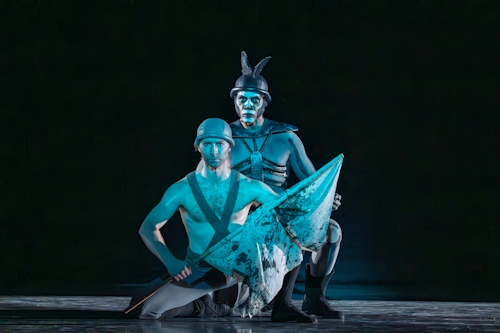
in The Green Table
Photo Johan Persson
Well, almost everyone is a victim. The Gentlemen in Black, who open and close the piece in their black formal suits, white spats and white gloves survive, still arguing, still doing their deals. They have come to be regarded as diplomats, although that wasn’t how Jooss particularly saw them. “I didn’t know, and I still don’t know who The Gentlemen in Black are,” he told American writer Tobi Tobias in 1976. “I don’t think they are diplomats. There may be one or two diplomats between them, but I think they are all the powers which can gain in a war, which in the end, through their machinations, cause a war.” So, there you have it. Diplomats, politicians, businessmen, high ranking military. Take your pick.
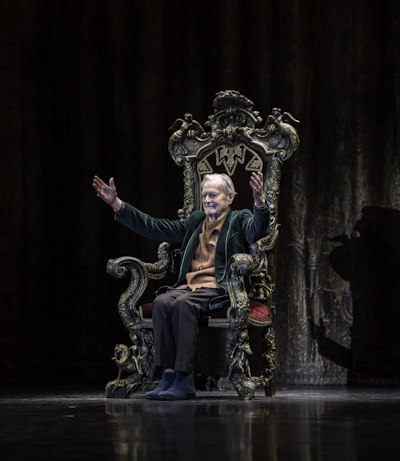
Photo Johan Persson
The evening closed with a brief video about Sir Peter’s life and words from Chair of Birmingham Royal Ballet, David Norrington, with the man himself now surrounded by the company. The emotion then ramped up still further as the group was joined by more friends and colleagues from the past, the scene topped off with a shower of golden glitter.