
WUK, Vienna
July 13, 2026
Alongside appearances by well-known names, ImPulsTanz has long also sought to present a view of new developments in dance, presenting new works by still very emerging choreographers. This year, under the direction of Breanna O’Mara and Chris Haring, the [8:tension] series is presenting works by twelve international dance-makers.
French contemporary dancer, performer, and choreographer Taous Bertrand describes herself as being influenced by cultural anthropology, queer historiography and philosophy. Having graduated in modern literature and philosophy, her choreography is linked to issues of gender, and memory of the ghosts and feminine archetypes. Her 45-minute self-created solo, Nymph, is all about transformation.
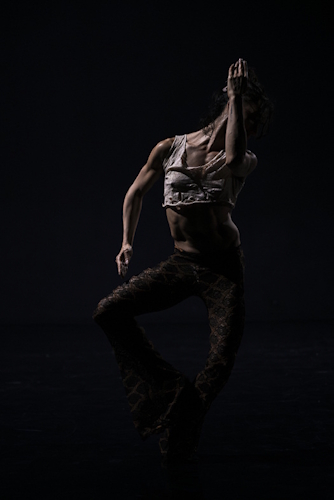
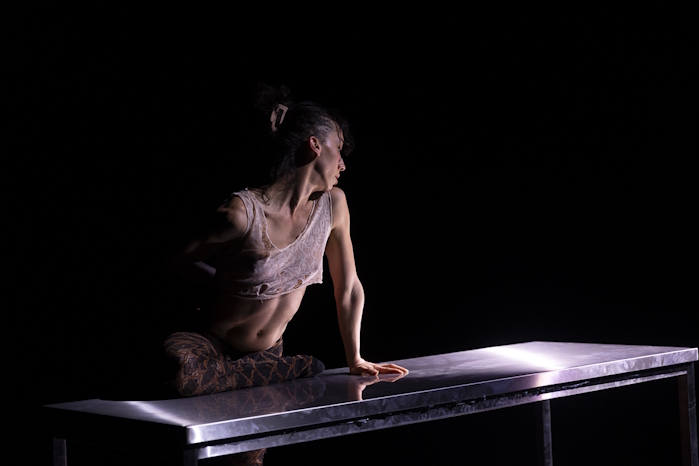
Photo Thibault Lefebure
It begins promisingly. Having entered from the gloom of an upstage corner, edging her way around one of those wheeled stainless steel catering tables, she opens with an eloquent dance of largely arm and hand movements. Circles and chops are pin sharp. Fast too, especially when her arms interfold. The meaning is unclear, even after reading the programme note, but the interest is captured.
Numerous ideas follow as Bertrand considers the ideal of beauty, drawing on the story of the nymph, Echo, for her work. The connection is far from immediately apparent, although Nymph can be seen as restoring Echo’s voice, in movement and words, so she can tell her own story.
In the dance scenes, there are a few obvious ballet references but she looks awkward. It’s some way from the ballet ‘ideal’ of grace. Perhaps she’s questioning the meaning of beauty. She puts on a pair of heeled ankle boots and dances loosely to a song in them. But the works were unclear, so gaining any semblance of meaning was difficult. I’m assuming there was actually a connection.
One scene sees her swing on a rope hung from the ceiling. It has a sense of lightness, invokes a sense of freedom, but she seems to find it difficult and continually pauses. Beauty, freedom being temporary, maybe.
More interesting is the scene that sees her sit and describe a Utopian paradise in the shape of a house, although it comes with no movement. She describes in detail the perfect home. The way the speech, in English, was projected behind her, broken up and in French, was surprisingly effective.
Bertrand later brings that catering table into the action, swinging it round and round, echoing vaguely the movement on the rope. When she then lays on it, a video shows a masked face breaking out of a metal egg. That video is excellent, but it’s so far from her, that one has to make a choice: watch her or watch the film. And as so often the way, the film wins.
Another staging issue raises its head in a floor-based dance scene performed so close to the front row that Bertrand was all but invisible to many in the audience. Frustrating to say the least. She’s far from the first choreographer to have done this, but why don’t artists think about the view of those watching?
One left Nymph deeply frustrated. Most of Bertrand’s ideas have merit and interest but they fail to gel into any sort of coherent whole. How some linked to her theme was also difficult to see at the time, although the fog did lift a little with time. Oh for a dramaturg.