
Sadler’s Wells, London
July 31, 2026
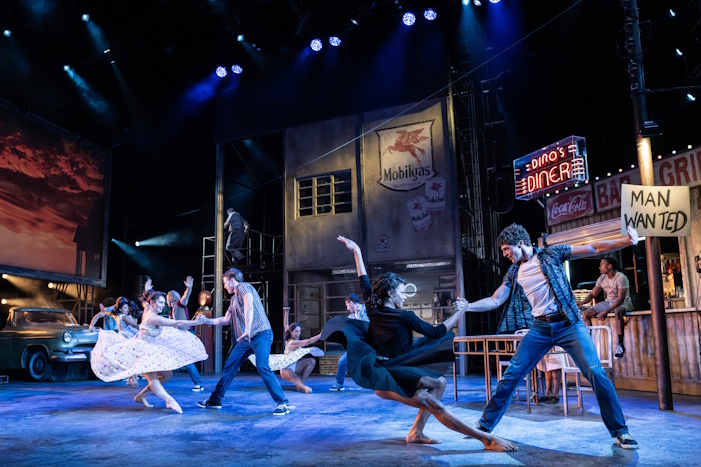
It may be 26 years young, but Matthew Bourne’s The Car Man is still packing audiences in, taking them on a supercharged ride. As the title hints, the show is Bourne’s reimagining of George Bizet’s Carmen, musically making much use of Rodion Shchedrin’s Carmen Suite alongside new compositions by Terry Davies. All the expected sexual jealousy and crime passionnel are still there, although the plot is reworked and made more complex as the location is switched from a nineteenth-century Spanish cigarette factory to Dino’s small-town garage-diner in late-1950s America.
“Welcome to Harmony, population 375” the huge sign that greets visitors to the town proclaims. “Drive Safely.” But the town is only superficially peaceful. It already hides secrets simmering away just beneath the surface, not least Dino’s abusive nature when it comes to his wife, Lana. Even so, there’s a sort of order as people go about their business. Mechanics tinker with cars past their prime, at least when they’re not flirting with the women in their period skirts.
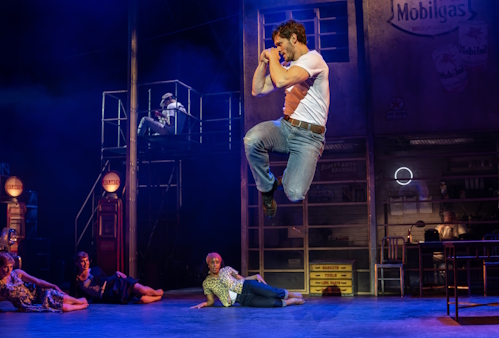
Photo Johan Persson
Visually, in mood, and to some extent narratively, The Car Man is significantly influenced by The Postman Always Rings Twice, Tay Garnett’s 1946 American film noir in which drifter Frank Chambers gets a job at a roadside diner owned by Nick Smith and his young wife, Cora.
The arrival of the drifter Luca in the town is also hugely reminiscent of Clint Eastwood walking into San Miguel in A Fistful of Dollars. He’s a stranger. Charismatic, handsome, strong and silent stranger with piercing eyes and a magnetic gaze that captivates almost all. And just like Eastwood’s The Man with No Name, and John Garfield’s Frank in ‘Postman’, Luca, soon hired as a mechanic by Dino (a mistake if ever there was one) turns everyone’s lives upside down.
Turmoil comes as Luca strikes up an affair with Lana. Her sweeter-natured sister Rita, meanwhile, has eyes for Angelo, a sensitive and much put-upon hired help who is bullied by the other mechanics. Bourne goes beyond the exploration of love in Carmen by considering the fluidity of sexuality, however. When Luca takes him under his protection, he falls for the stranger too.
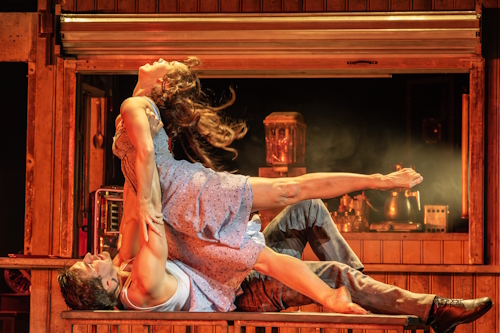
Photo Johan Persson
While some of the show is overtly sexual, it’s generally handled well. The one or two comedic moments didn’t work for me, but then humour is very personal. I’m not convinced of the need for a glimpse (and that is all it is) of full-frontal male nudity, even if it is done with humorous intent and even if it did bring a laugh from some.
Things go badly wrong when Dino catches Lana with Luca, who murder him. It’s the innocent Angelo who gets arrested, though, having found the body and got smeared with the dead man’s blood. That leads us into the altogether darker, and altogether harder-hitting Act Two.
All this takes place between some full-throttle, high-octane ensemble dance sequences that make much use of the two old cars, tyres, tables and chairs. The choreography is classic Bourne. It’s incredibly fluid, classical ballet moments sitting easily alongside contemporary dance and musical theatre elements. Indeed, it’s as good as anything you’ll see down the road in the West End. It might not particularly move the story along, and it times it feels quite non-stop, perhaps a little too much so, but it’s a thrilling ride nonetheless.
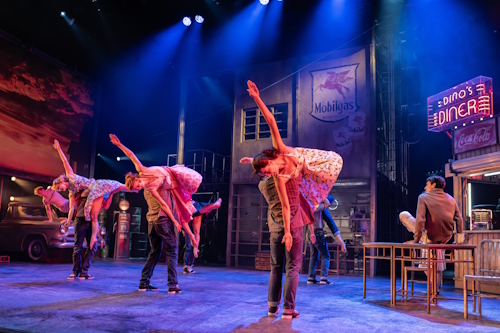
Photo Johan Persson
The best, certainly the most hard-hitting moments, come in the solos and duets, however. Early on, sexual sparks fly when Luca and Lana find themselves alone together, and there are tender moments for Luca and Angelo. Angelo’s Act One duet with Rita, all innocent love, contrasts starkly with the very poignant number in the very dark and nightmarish Act Two, the dance equivalent of film noir if ever there was one, when he has been irrevocably changed by trauma.
As Luca, Will Bozer was an imposing figure who oozed both sexual energy and ambiguity. There was a super chemistry with Ashley Shaw’s smouldering Lana, her character’s name being a nod to Lana Turner who played Cora in The Postman Always Rings Twice. Desperate for an escape from her marriage, one sensed she was calculating and knew precisely what she was doing.
But it’s the other couple who linger in the mind afterwards. In Act One, and in stark contrast to everything else going on, Anna-Maria de Freitas and Harry Ondrak-Wright’s Angelo brought innocence and genuine tenderness to the stage. That only made the events following Dino’s killing all the more heartbreaking. A victim in all senses of the word, Ondrak-Wright’s transformation into a bowed but not yet beaten individual bent on revenge was remarkable. His dancing in the County Jailhouse scene was especially emotionally intense and full of anguish.
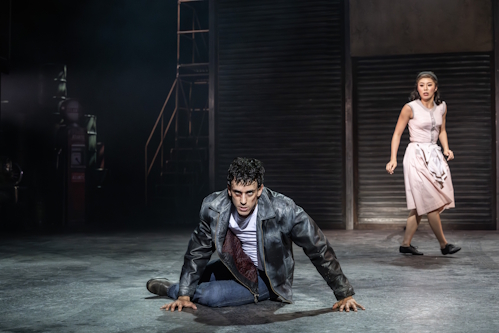
in Matthew Bourne’s The Car Man
Photo Johan Persson
Elsewhere, Danny Reubens was both menacing and buffoon-like Dino, who comes back to haunt Luca’s conscience. The supporting cast were flawless too.
Lez Brotherston’s set and Chris Davey’s lighting come together perfectly with the action to ramp up the temperature. The way Brotherston’s two-storey construction of scaffolding morphs from garage and office below and showers and living quarters above, to a seedy nightclub and then dark prison is utter genius. Davey’s use of red and orange in the lighting emphasises the heat of the climate and relationships. There is also some extremely effective use of shadows that hide and reveal.
In Bizet’s opera, Carmen is stabbed by her former lover for trying to leave him. In The Car Man, it is Luca who is murdered after having been seen to be unfaithful. You can’t argue that he didn’t deserve it. And yet, there’s no sense of relief that he got his just desserts. Just a feeling of tragedy, of wonder at how many lives he ruined and tore apart; and perhaps hope that Rita and Angelo do make it through.