
July 9-19, 2026
Various venues, Munich
When the theatres close for their summer vacation in Munich, the festivals begin. The first one this year was Think Big, which took place from July 9 -19. It is a biennial festival, now in its 11th edition, offering dance performances, music theatre and workshops for children of all ages, and lectures, discussions and workshops for professionals working in the field of dance education.
The focus this year was on performances, which turned the audience into an interactive part of things. The intention is to give the youngsters not only the possibility to watch, but also to experience the liberating powers of dance and the theatre. An array of young international choreographers presented their works, mostly performed by extraordinarily good dancers. The festival was also an opportunity to see how contemporary choreographers fuse different dance styles and create new ways of expression.
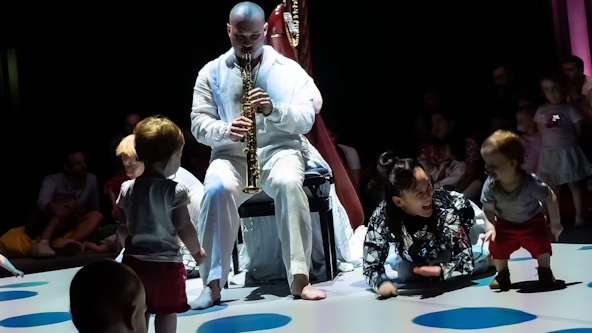
Photo Sébastien Grébille
Munich based Ceren Oran & her collective of artists, Moving Borders, demonstrated just how mesmerising dance can be with Rond au Carré, a piece for babies and their parents. At HochX, one of the smaller venues, the audience, amongst them non-walking babies, sat on cushions on the floor around a white square, on which forms in different colours were projected. The work sees a woman playing the harp joined by a man on saxophone and two dancers. They move with undulating arms and hands or roll on the floor, while the saxophonist walks around so close to the children, that they could touch him. Even the youngest in the audience were spellbound and quiet for 45 minutes until all were invited to join the performers.
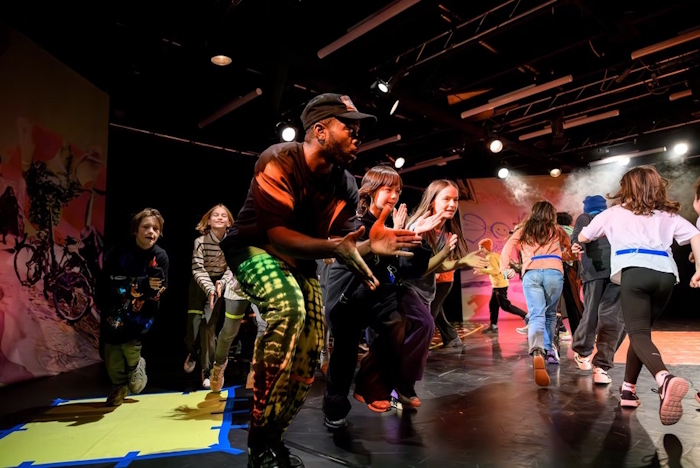
German choreographer, Janne Gregor’s Ich kann’s nicht lassen (I can’t help it), presented at Schauburg, was the most successful interactive piece. It featured four krump dancers: Queen Buckhype, krump world champion in 2018 and 2023; Iman Gele; Junior Wave; and Solomon ‘Big Liveness’ Quaynoo. Schauburg, a theatre for children and youths holding an audience of about 300, had been stripped of chairs and stage. The children, perhaps 2nd-graders at the performance I saw, were led into a room with dimmed light. They walked around, sat at the walls or in the middle.
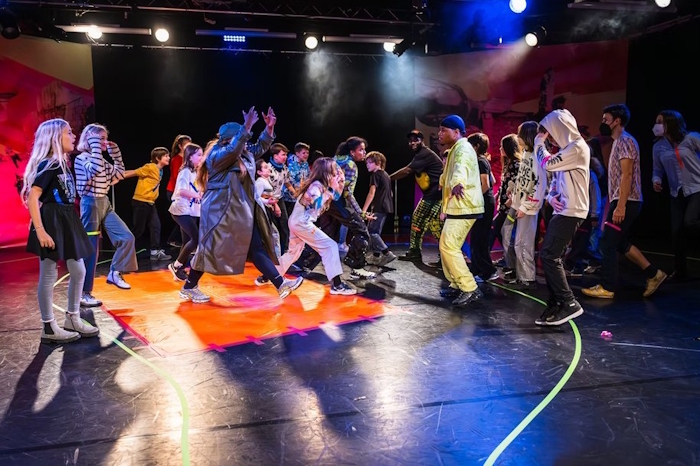
Photo René Löffler
The four performers each stood in a spotlight and danced a solo. On their own accord, some of the children moved in and out of the spots and started to imitate the dancers. With a wink, Solomon got a group of children to follow him. Others followed one of the other dancers imitating their movements without a word being said. Soon it turned into a street-dance like event with performers and children dancing in and outside the middle, the others cheering them on. Not everybody participated, but everybody moved, some doing their own thing. It was an hour of unbridled fun that left big smiles on faces, including those of the accompanying grown-ups.
Big smiles and happy children were also the outcome of a workshop for four-year-olds with an accompanying grown-up taught by dance facilitator Daniela Holloch at Muffatwerk. It was not about doing steps correctly, but about being big and small, fast and slow. At times the children took the lead, at times the grown-ups.
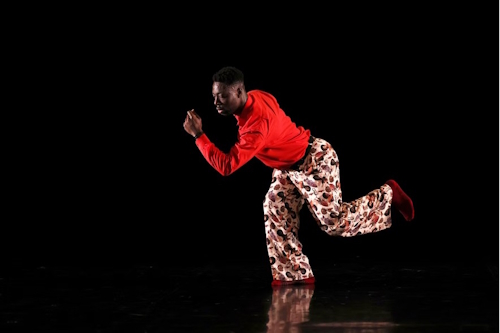
Photo Patrick Berger
At schwere reiter, [Superstrat] by French choreographer Anne Nguyen for teenagers was an emotional trip with Ivorian dancer Willy Kazzama (Mark-Wilfried Kouadio) who specialises in traditional and social African urban dance. To a mix of traditional African music, soul, blues and gospel songs by Pierre Demange and Grégoire Letouvet, Kouadio tells us a story, perhaps his own, perhaps a universal one, in a blend of African urban street dance and hip-hop. First, he presents himself, self-assured brushing dust specks off his shoulder, strutting around. Then he falls on the floor and worms around as if lost. To me it brought associations to boat refugees. Having arrived, he gets into fights with invisible attackers, until at the end he seems to find his, perhaps, new identity.
Kouadio draws the audience into his story with looks and gestures. He is an incredible dancer. Every single limb can move separately, his head shakes as if disconnected to the rest of the body, and his torso moves as if it is the drumhead on which the rhythm is beaten.
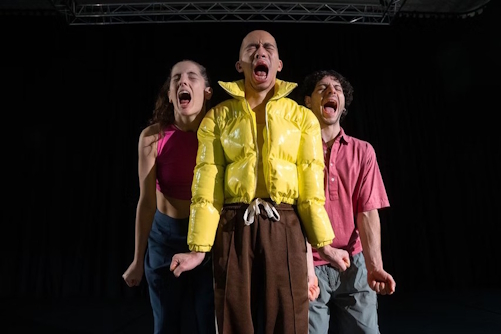
Photo Alexander Miller
Also at schwere reiter, Italian choreographer Miller de Nobili together with Alexander Miller explored the world of teenagers with Main Character: Lost to music by Gábor Halász. In a mix of breaking, contemporary, urban and acting the three charismatic and amazing dancers, Nam Tran Xuan, Giulia Russo and Ali Adic, take on different characters and live out their feelings, anxieties and hope. The only props are five chairs, on which they are on and off, alone, in duets or three together.
There was much more. The above-is just a glimpse of what took place at the festival. Think Big is popular and many of the performances also those taking place in the morning or afternoon were attended by a large number of grown-ups without children.