
Sadler’s Wells East, London
June 17, 2026
Acosta Danza Yunior arrives at Sadler’s Wells East as a company still in formation. Founded in 2023 as a bridge between the Acosta Dance Academy in Havana and Acosta Danza, it gives young Cuban dancers a professional platform while they continue to grow. Next Generation therefore carries a clear question: what can these dancers already do, and what kind of artists are they being asked to become?
Technically, the answer is promising. Across the evening, the dancers show strength, secure partnering and a physical language rich with possibility. Their bodies twist and fold through unusual shapes, while weight is shared with confidence and lifts are handled with clarity and trust. There is no doubt about the ability on stage. The more complicated question is whether the choreography always asks enough of them.
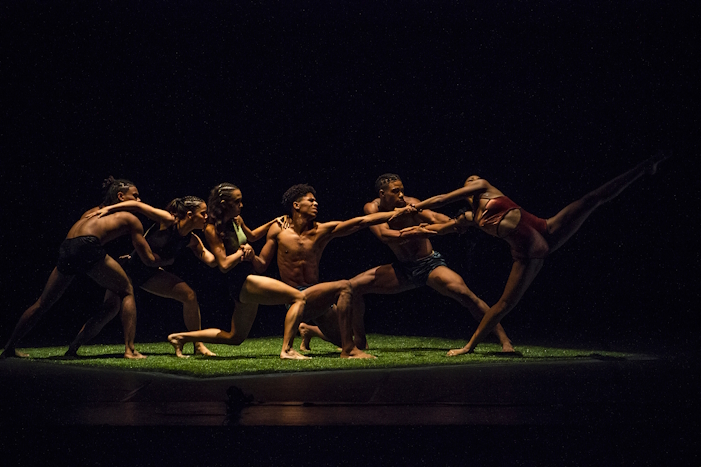
The opening work, Susana Pous’ Fuga, places six dancers inside a square of green light, with the sound of waves running through the piece. A white sphere to one side catches the light and throws a shifting moon-like shadow on the backcloth. The image is simple and effective. The dancers are held inside this luminous border, then gradually leave it one by one.
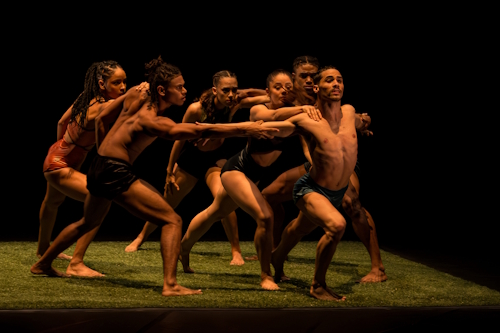
Photo Yuris Nórido
The programme describes Fuga as a response to the tragedy of migration, yet the departures often appear more determined than painful. One dancer rolls along the floor while others step over and around her, moving with her until, while they look elsewhere, she rolls out of the space altogether. Another dancer rushes towards the edge, is briefly stopped, then walks away with surprising ease. The work shows the act of leaving clearly. It gives less weight to the force of staying, the resistance, attachment or loss that might make each departure hurt.
Didy Veldman’s new, untitled duet follows. It makes good use of the dancers’ partnering ability and contains one of the evening’s more interesting reversals, with the woman frequently supporting and lifting her male partner. The shift in weight and scale quietly unsettles familiar expectations around who carries whom. Yet the duet stays curiously smooth. The dancers cooperate well, too well. Contact rarely develops into friction, and the relationship does not gather enough pressure to become memorable. The piece displays control where it might have risked disturbance.
Kit Holder’s Capriccio draws on René Magritte’s The Lovers. It opens with two male dancers emerging under a shared white cloth that covers both heads, an immediately recognisable and strange image that turns them briefly into one awkward, tender creature. Once the cloth disappears, the piece shifts into alternating solos before returning to duet form. The partnering is finely handled, and the opening conceit gives the work an appealing oddness. Still, the visual idea leaves a sharper trace than the choreography that follows. The covered faces suggest intimacy, concealment and desire, but the piece does not stay with those ideas long enough to let them deepen.
Juliano Nunes’ Mundo Interpretado is the most expansive work of the evening. Small white, water lilies hang above the stage and, when lifted into the air, look like stars. The dancers wear blue costumes that give the space a watery, painterly quality, close to the colours of Monet. The work unfolds in several sections: ritual-like ensemble passages driven by percussion, a trio of two men and one woman, a male solo with an Eastern-sounding wind instrument, and later a group sequence in which one dancer seems to awaken another through touch.
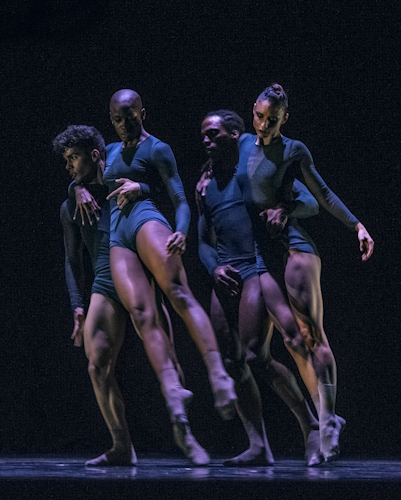
Photo Yuris Nórido
The most compelling section arrives under red light. Here, a duet finally introduces real resistance. The woman pushes, pulls and seems to control the man’s movement from a distance. They collide with audible force. When she pushes his chest, he pushes back and sends her off balance. For a moment, the dancing acquires attitude and consequence. The bodies affect one another. They challenge, interrupt and alter each other.
That sharpness fades in the final pointe duet, although the lighting has a lovely warmth, like sunlight passing through trees. The partnering is accomplished, and one near loss of balance is quickly recovered. Yet again the woman spends much of the section being lifted, turned and placed, often with her legs wrapped around the male dancer or lowered into split-like positions. The image is polished and attractive, but polish cannot carry the whole emotional weight. Beauty needs pressure behind it.
That becomes the evening’s central tension. These young dancers already possess something vivid: strength, agility, secure partnering and a body language that could travel much further. The choreography frames those qualities too politely. It shows their beauty and control when it could invite more rhythm, story, danger and emotional force.
Next Generation works best as a promise. It introduces dancers with real presence and considerable technical assurance. The next step is repertory that lets them push harder against form, character and consequence. They already know how to move beautifully. The exciting question is what might happen when they are asked to move with more urgency, risk and bite.