
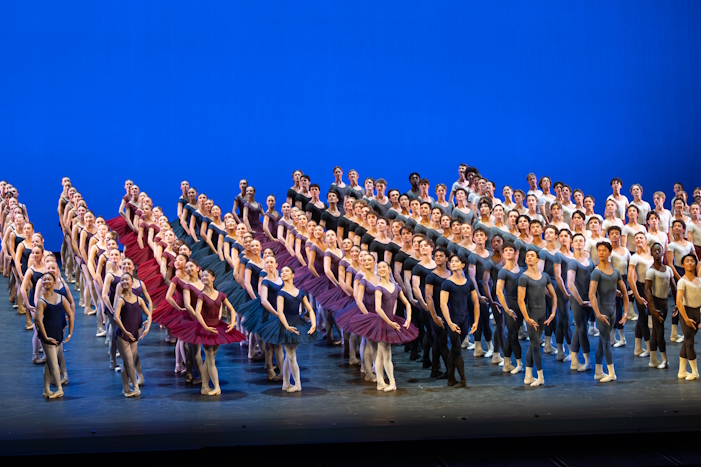
Royal Ballet & Opera, London
July 18, 2026
During an impassioned speech following Act III of Sir Peter Wright’s Swan Lake that opened the performance, Iain Mackay, former Birmingham Royal Ballet principal now artistic director of The Royal Ballet School, reminded the audience that the dancers we had just watched were still students, not professionals. “Although after that, you might not want to believe me,” he added. And it was difficult to credit. Over a marvellous three hours, time and again the young dancers rose marvellously to the pressure of the occasion in what was a wonderful display of skill and talent.
It was also a hugely enjoyable performance choreographically. When the first students entered Ninette de Valois’ new school in 1926 they were not joining The Royal Ballet School or even the Vic-Wells Ballet School, but the Academy of Choreographic Art. While there was no student creations performed at the Royal Opera House, it seemed very apt that, in this centenary year, all but one of the works presented were by British choreographers, all of whom have a strong connection to the School.
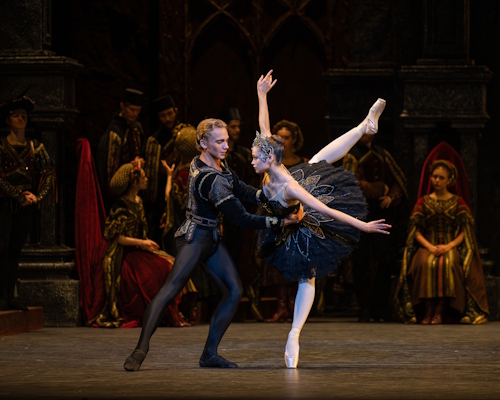
in Act III of Sir Peter Wright’s Swan Lake
Photo The Royal Ballet School/ASH
Birmingham Royal Ballet’s Swan Lake, which the company themselves will perform in their home city and then on tour this autumn, made for an excellent opening. The Siegfried and Odile roles were split, new dancers appearing for the solos and coda. All four impressed.
Students often find expressing character difficult but, as the first Siegfried, a very princely Ivan Malaguti did a very good job of looking bored, or at least wishing he was elsewhere, quite possibly with someone else. He also had lots of nice interaction with Benno. His Odile, Sophie Schulten, was technically perfect, although I would have liked a little more showing just how much she was delighting in reeling him in.
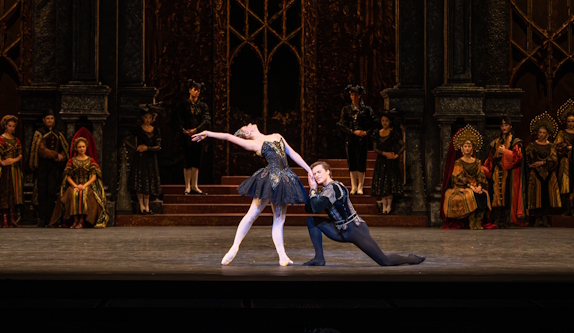
in Act III of Sir Peter Wright’s Swan Lake
Photo The Royal Ballet School/ASH
Fabrizzio Ulloa Cornejo and Samantha Striplin then both set off fireworks aplenty. Cornejo’s pirouettes were fabulous, not only lightning fast but concluded with the utmost care and finesse. He even outdid Striplin’s fouettés, which included a number of triples.
Elsewhere, I was especially taken by Nanoha Shigeoka’s Italian Princess. She produced some exceptionally fast and precise footwork, all while wearing a real-looking smile that suggested she was rather enjoying herself
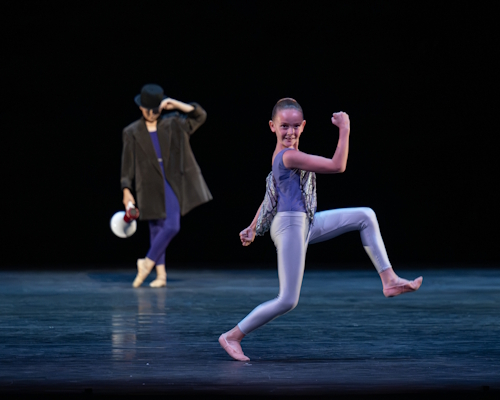
Photo The Royal Ballet School/ASH
Proceedings by Kristen McNally is a huge ensemble work full of quirky gestures and wit. Danced to music by Camille Saint- Saëns, the youngsters resembled busy insects. McNally succeeded in showing the everyone in the Lower Schools youngest three years at their best without the stage ever feeling overcrowded.
The first half concluded with the extremely appealing Beauchamp’s Garden, a new creation by David Bintley to Francis Poulenc’s Concerto for Two Pianos and Orchestra. Light and very easy on eye and ear, it’s full of interest and an absolute joy to watch.
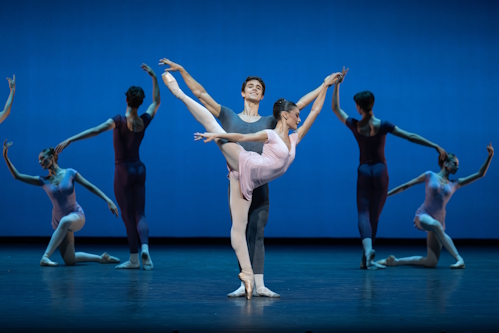
in Beauchamp’s Garden by David Bintley
Photo The Royal Ballet School/ASH
As he was planning and creating the ballet, Bintley has explained how he started thinking about the origins of ballet in France and the French classical school. That influence is certainly there, although the first movement in particular reminded me more of Balanchine in the way the dance so perfectly reflects the music in its movement and patterns.
There was a lovely rapport between the two leading couples, Emma Lucano and Malaguti in the first movement, and Alecsia Maria Lazarescu and Millán de Benito in the second. Both pairs later appear together walking through the ensemble, which brought images of people wandering through trees looking for each other.
Beauchamp’s Garden may have been created for The Royal Ballet School but it is very much not a student work; just a very, very good ballet. And one that deserves to be seen again and more widely. Surely a company somewhere will take this up.
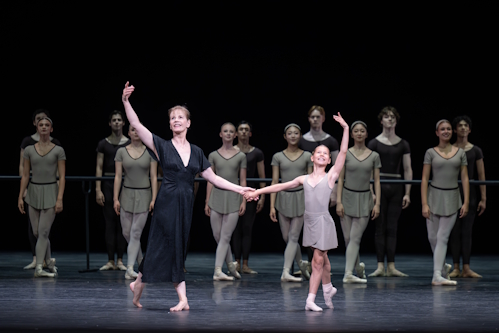
Photo The Royal Ballet School/ASH
Following the interval, A Line in Reflection by Cathy Marston, which featured Deborah Bull alongside the students was incredibly poignant. A diagonal barre right across the stage acts as a mirror. Dancers enter either side, warming-up. It’s a scene instantly recognisable to anyone who has taken class regularly. When Bull enters, in black dress and barefoot, she moves among the dancers, there but not there. It’s as if she’s watching a memory, until, at the end, she mirrors a present student. Or was it her younger self? Beautiful and sentimental in equal measure.
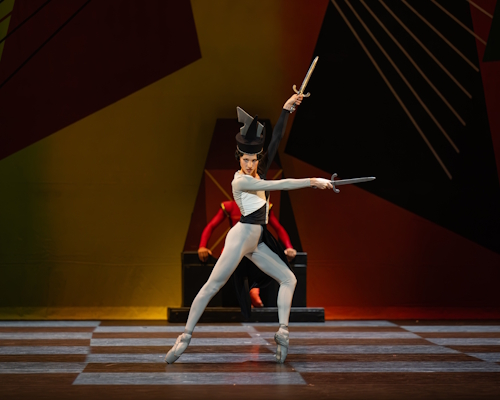
in Checkmate by Dame Ninette de Valois
Photo The Royal Ballet School/ASH
In the School’s 100th year, there had to be some de Valois choreography, although little survives. A suite from Checkmate, premiered in 1937 was full of stylised movement, that I suspect today’s young dancers might find quite tricky to learn. The costumes and especially the colourful, eye-catching, modernist backdrop, all designed by E. McKnight Kauffer remain startling.
Of Strength and Grace by Andrew McNicol to music by Edvard Grieg, showcased the classical talents of Years 10 and 11. Again, there is lots of interest in the structuring, patterning and phrasing. With its pale autumnal brown palette, it is a dance of autumn leaves.
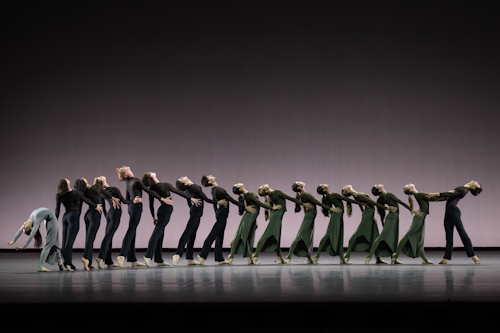
Photo The Royal Ballet School/ASH
She may have been the only overseas choreographer on the programme but Jessica Lang has long had an association with The Royal Ballet School. She was also the only guest choreographer that David Bintley invited back to create a second piece during his tenure at Birmingham Royal Ballet. Her The First Voice, danced to poems by de Valois, read by Darcey Bussell, Monica Mason and Kevin O’Hare, then music by Ludwig van Beethoven, brought a contemporary element to the afternoon. The lighting may be largely monochrome but there is a lot of colour and depth in the work as it shifts between a literal interpretation of the text and poetic movement.
The school is about classicism and nowhere was it more to the fore than in Christopher Wheeldon’s Christening Suite, made in 2008 for Norwegian National Ballet and to mark the opening of Oslo’s new opera house, hence the title. With the ladies in white tutus, the men in black, it’s everything you expect from a classical ballet, but also wonderfully light.
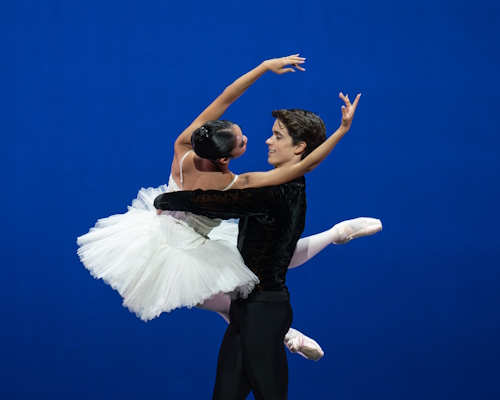
in Christening Suite by Christopher Wheeldon
Photo The Royal Ballet School/ASH
As ever, the performance closed with the Grand Défilé. The only complaint is that it’s over far too quickly. This birthday year, the final line-up was greeted with what felt a very appropriate shower of glitter.
The Royal Ballet School, the parents, many of whom make significant sacrifices so their children can pursue their dreams, and of course the young dancers themselves, should all be very proud of what they have achieved. For the graduating dancers, it is time to move on, of course. Great news is that all have obtained contracts, including six joining The Royal Ballet’s Aud Jebsen Young Dancers Programme and four off to Birmingham Royal Ballet/BRB2. But every end is also a new beginning. For them, a new adventure beckons. I’m sure we’ll be seeing and hearing a lot more about them in years to come.