
Opera Holland Park, London
July 10, 2026
2026 marks 100 years of The Royal Ballet School, making its Summer Performances in the idyllic Holland Park particularly special. As the world’s foremost centre for classical training, it is no surprise that the evening was one of impeccable professionalism. A diverse programme also reflected a focus on innovation, no doubt aided by the younger generation who continue to inspire.
Friday’s performance opened with a stripped back Class Demonstration by Years 7, 8 and 9. Almost 70 young dancers were keen and poised as they move through the beginning steps of daily ballet class, exemplifying the fundamentals of British classical ballet technique. Daily ballet training is notoriously rigorous, and the extreme discipline of these dancers, who have chosen such a challenging path, is felt in every moment.
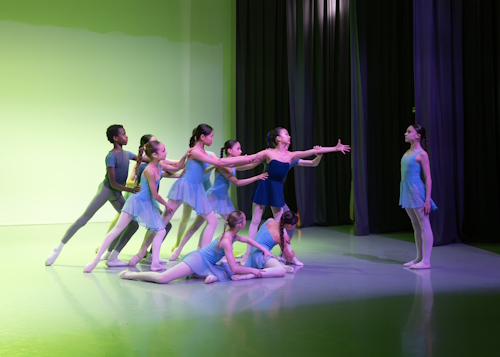
by Year 8 student, Will Florence
Photo The Royal Ballet School/ASH
Next came a lengthy excerpt of the well-known and much-loved Coppélia by Years 10 and 11, impeccably led by Anjali Dyen and Cagan Aydin as Swanilda and Franz. Though strong technique is to be expected, Dyen in particular possesses an artistry far beyond her years. In some moments it felt like watching a professional company, rather than a school. Aydin is impressively composed in his solo, while Swanilda’s friends were warm and attentive in challenging choreography. Interspersed with the bright and dynamic Mazurka group, Coppélia was a delight.
Five student choreographies were featured, young voices nurtured by The School’s Ninette de Valois Choreographic Programme which emphasises the importance of shaping not only performance talent, but creativity. Explorer by William Cooper (Year 7) makes smart use of canons and shapes as one curious dancer is swept into an ever-evolving group. Will Florence’s (Year 8) There Is No Planet B, is a brisk but emotive response to the climate crisis, embodied with urgency. Anisha Yadla’s (Year 10) Pulsation, set to one of Hans Zimmers’ dramatic scores, is flashy and fast moving, taking full advantage of the dancers’ virtuosic leaps, turns and flexibility.
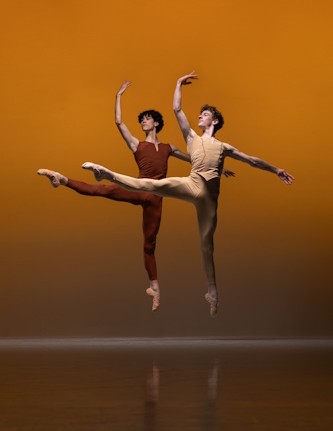
in Andrew McNicol’s Of Strength & Grace
Photo The Royal Ballet School/ASH
Andrew McNicol’s ambient new work for Years 10 and 11, Of Strength & Grace, shows off a strong cohort beautifully. The male partnering was quietly reliable while the females are put to the test of speed with off-balance arabesques and restless port de bras. Jolie Lavaux was particularly expressive, and moves with impressive precision while embodying the music entirely.
Though world leaders in classical ballet, the school continues to prioritise diversity of movement styles. Kristen McNally’s Proceedings, with its quirky gestures and garish costumes, lends itself well to the bright eyed and charming younger year groups.
Elsewhere, Donna Phillips’ Irish number, Siamsa, is a spritely and sharply rehearsed affair. Neither for this nor for August Bournonville’s Sylphide Reel do the young dancers sacrifice performance and facial projection despite nippy footwork and directional changes.
The unity and focus of this cohort is testament to world class training, but it is above all the artistry of these devoted students that offers such a joyous watching experience, and I leave with a reinvigorated respect for classical ballet.