
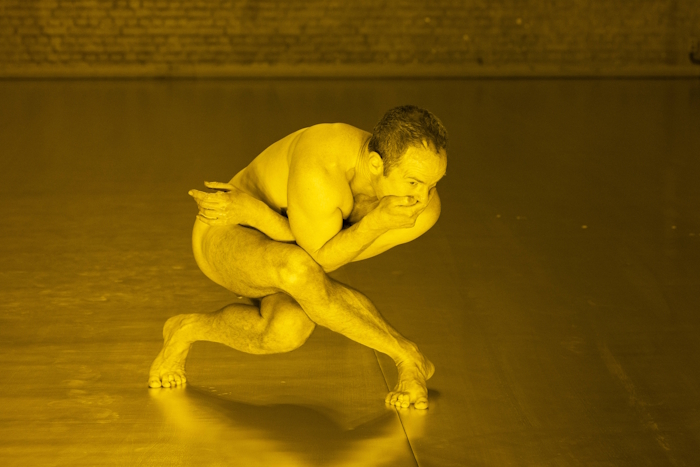
Kasino am Schwarzenbergplatz, Vienna
July 12, 2026
Premiered at Kunstenfestivaldesarts in Brussels in May, Muette is a follow-up to Boris Charmatz’ first solo, Somnole, created in 2021. That was about sleep. Muette, which translates as mute, silent or speechless, is an extraordinary, intense solo performed without accompaniment and that is remarkably alive and absorbing, especially when witnessed close-up. And nearness to Charmatz is essential if one is to experience the work fully, if one is not only to see but to truly feel what is being emoted and expressed.
The loud hubbub as we waited on the first-floor landing of the Kasino am Schwarzenbergplatz, one of the venues of Vienna’s Burgtheater since the early 1980s, was in stark contrast to the hush of the performance.
Charmatz enters, dressed all in black. Against a pillar, he drops his trousers, his pants. He strips off his T-shirt. A large heart is daubed in black on his torso. He unfolds and moves slowly into the space. For a long time, he holds a bubble on his lips. Everything is an effort. On tiptoes in a parallel fourth position you can see the effort in his quivering legs.
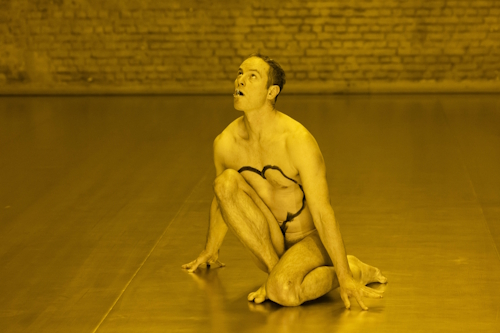
Photo Laurent Philippe
If anything, the intensity ramps up after that bubble is no more. Inner stirrings become all too visible. A hints of few classical ballet steps creep into the movement like a long-forgotten memory momentarily bubbling to the surface. In another context, you could see his dance as goofy.
It’s like some sort of very personal drama is being played out, but with the words removed. One senses frustration too. Charmatz appears to question himself, the world, who knows what. As he talks silently to himself, you find yourself trying to lip read, putting words to what is seen. And perhaps more than anything, he seems incredibly vulnerable, fragile even, his nakedness only emphasising that state.
The lack of music serves to put even more focus than usual on the body; and especially on Charmatz’s face. In this dance of inner feelings, i’s full of expression. There are moments of pain, of joy, of great effort. He moves awkwardly. Ungainly, even. He shadow boxes. Indeed, he seems to be fighting, something, someone, most likely himself throughout.
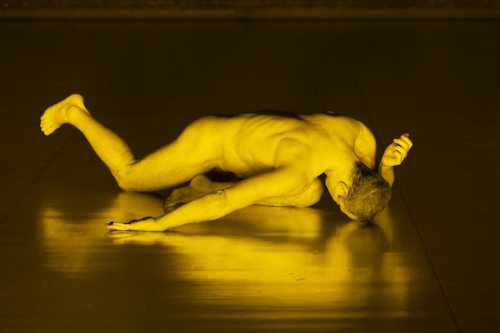
Photo Laurent Philippe
But no music does not mean silence. The ears pick up on every little sound. From the audience there’s the occasional shifting of bodies, the wafting of fans, and a cough here and there. A door opening and closing suddenly sounds very loud.
And then there’s Charmatz himself. You increasingly hear every breath, especially when his breathing starts to get slow and laboured, every contact with the floor as his body slides, rebounds and jolts. He chokes. You hear his footsteps, landings from his jumps, the sound of skin on skin as he rubs his body furiously. Sounds that are usually drowned by the music. It can be surprisingly noisy, this thing called dance.
The performance space at the Kasino is looked down upon by twelve busts between two of which is the phrase ‘Viribus Unitis’. It means ‘with united effort’. Yves Godin’s lighting is generally quite plain but, at times, Charmatz does appear like a marble statue come to life. And in Muette, there is certainly a lot of effort and, you sense, a tremendous determination to battle through and to survive.