
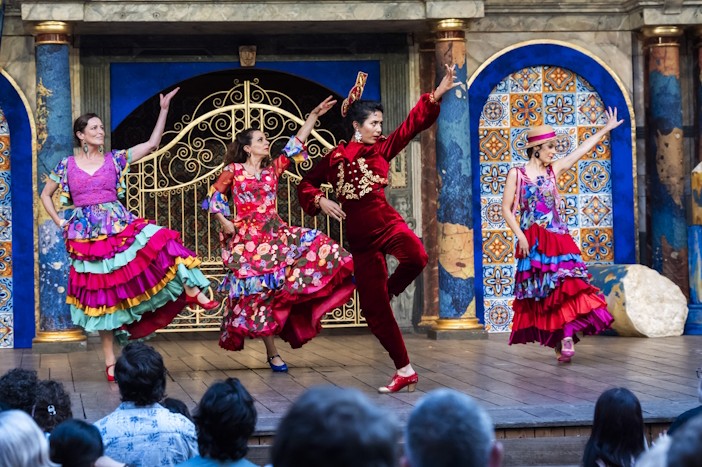
Shakespeare’s Globe, London
August 2, 2026
It was noisy.
Love is noisy. It gets into people’s heads and immediately ruins their concentration. By the interval, it had ruined mine as well.
Four young men begin Love’s Labour’s Lost by solemnly promising to devote themselves to scholarship for three years. Four women arrive. Their concentration lasts roughly another thirty seconds.
Once love gets into their heads, everything becomes louder.
Flamenco suits the damage beautifully. A phrase passes from singer to guitar, from guitar to feet, from feet to clapping hands. One person offers something and another picks it up. It feels less like accompaniment than the sound of a mind becoming overcrowded.
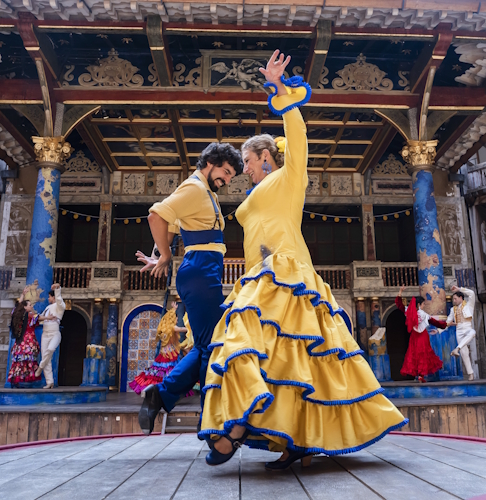
in Love’s Labour’s Lost at Shakespeare’s Globe
Photo Tristram Kenton
Another form of dance might have worked. Dance has always known how to listen and reply. But flamenco brings exactly the right kind of commotion to Indiana Lown-Collins’ production: hot, busy and impossible to keep private. These men cannot simply fall in love. They must sing about it, write terrible poetry about it, hide behind things, spy on one another and eventually expose the whole embarrassing business in public.
In choreography by Carmen Igarza, Norah Lopez Holden, already highly experienced in flamenco, gives the Princess some of the evening’s most assured and intricate footwork. Pablo Egea and Anita La Maltesa are beautiful to watch.
Egea, in particular, brings a striking sculptural quality to the flamenco posture: the pelvis pressed forward, the arms extended with force, every line proud and clearly placed. Early in the performance, he throws off an effortless multi-revolution pirouette. Later, playing the bull, he rises high on demi-pointe in attitude while holding a pair of horns, sustains the shape without a tremor, and lowers with complete control. For a moment, he steals the bullfight from the Princess.
The rest of the company have plainly put in serious work. They may not speak through flamenco with the specialists’ fluency, but they move with enough confidence for the dance to belong to the production rather than sit on top of it.
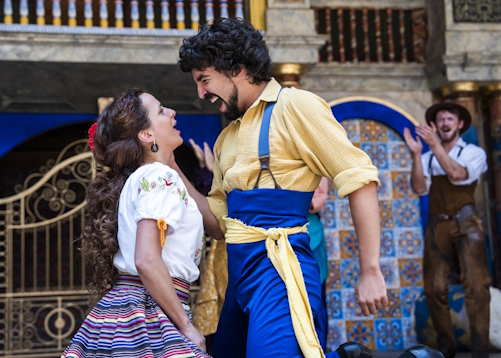
in Love’s Labour’s Lost at Shakespeare’s Globe
Photo Tristram Kenton
Even Berowne’s love poem receives a scansion lesson. Holofernes interrupts with a few emphatic “da-DUMs”, as though falling in love is unfortunate, but misreading Shakespeare is unforgivable.
A spectator sneezes during Rosaline’s speech. “Bless you,” she replies, then carries on. Berowne pushes his incriminating love poem into the hands of someone in the front row, only to hurry back and retrieve it moments later.
When Anita La Maltesa finds the steps to the stage blocked by a gentleman of strong build, she slips behind him and keeps dancing until he realises what is happening and moves aside, already red with laughter. She carries on dancing at him anyway.
Later, the men try to sing their way through love. ‘Despacito’ leads to ‘Livin’ la Vida Loca’, which somehow leads to ‘Hips Don’t Lie’, each musical confession arriving with still more feeling and still less dignity.
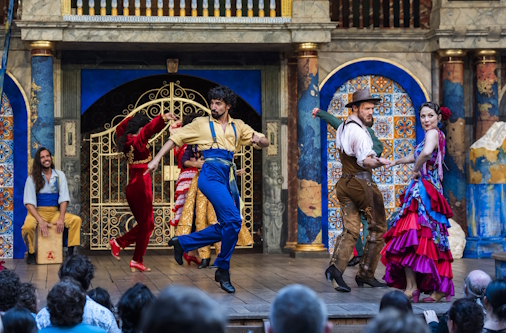
Photo Tristram Kenton
The men sing from the main stage while the women occupy the small circular arena in the Yard, previously used for the bullfight. Romantic fantasy speaks from one direction while its supposed objects dance themselves silly in another, like friends several drinks into a party, long past caring who is watching and having far too much fun to behave like anybody’s muse.
The men have discovered goddesses. The goddesses, meanwhile, appear to have found the good playlist.
Left to themselves, the men waste very little time turning women into verses, stars, heavens and assorted miracles of nature. The women seem perfectly content remaining gloriously, inconveniently human. They laugh, swap identities, mock the performances offered to them and watch four educated men make scholarship look like a brief illness.
Those men begin with an oath, break it almost at once, conceal the evidence, catch one another in the same offence, and finally hand the whole mess to Berowne, who argues so magnificently that perjury begins to resemble advanced study. If wit could absolve a man, all four would leave the stage as saints, their confidence intact even as their vow lies in ruins.
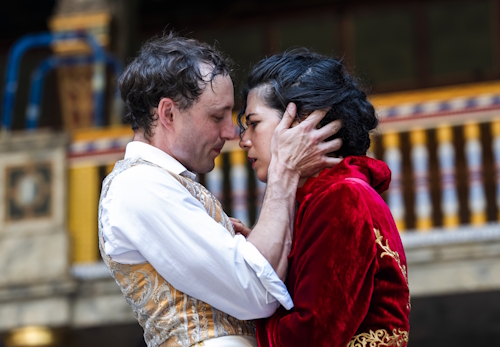
in Love’s Labour’s Lost at Shakespeare’s Globe
Photo Tristram Kenton
Then, after the Nine Worthies have strained heroically against both history and good sense, the evening changes key. Marcadé arrives with news of the Princess’s father’s death, and the noise that has filled the Globe suddenly has nowhere to go.
The silence is not absolute. This production has too much life in it for that. One young lover is told to return after growing a beard, a judgement at once romantic, practical and devastatingly concise. The laugh comes, smaller now, but it comes.
The men began the play by swearing themselves away from women, pleasure and the ordinary traffic of life. Love made short work of that. Now the women set them another trial, and this time no speech can wriggle free. A year must pass. Time must do what argument cannot.
After the women have set their lovers a year of tasks, Lopez Holden dances the Princess’s grief in a slower, more inward flamenco passage. The sharpness that drove so much of the evening softens into extended arms, curved lines and a body folding and twisting around its sorrow. Earlier, feeling burst outward through song, clapping, footwork and public foolishness; now the same form draws grief back into the body.
Rosaline gives Berowne the sharpest task. His wit, so far employed in entertaining himself, exposing his friends and making guilt sound attractive, must spend a year among the sick. Let him make them laugh, if laughter is truly his gift; let his words earn their keep. The first oath was made in company and broken in secret, while the second is spoken plainly and must be kept alone. One promised withdrawal from life; the other sends the men back into it.
Just before the news arrives, the Nine Worthies have been expanded to admit Elizabeth I, announced with all proper grandeur as Queen of England. “And Ireland,” comes the correction. By the time the joke returns, I am ready for it and fully intend to beat the actress to the line, but good behaviour proves the stronger tyrant and holds my tongue for half a second too long. She speaks first.
Never has obedience felt so ill rewarded.