
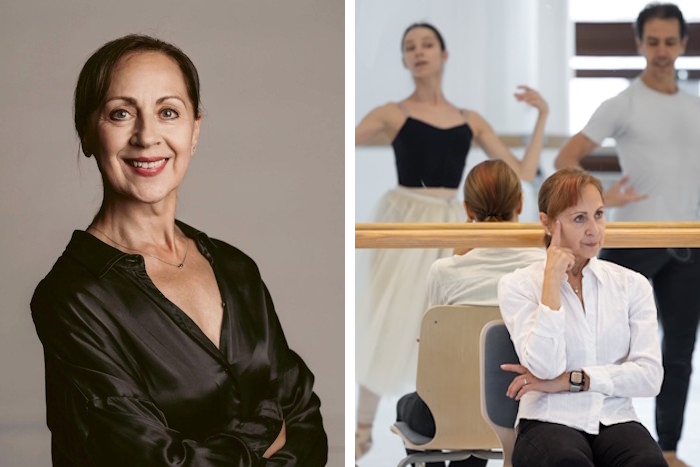
Judith Turos retired from the Bayerisches Staatsballett at the end of the 2025-26 season. It was an emotional scene in July when, following the final performance of Lady of the Camelias, one of her signature roles, the company gathered on stage and bid her farewell. A couple of days later, she talked to Jeannette Andersen about her career and the changes that have taken place in the company during her time.
Turos, of Hungarian origin but who grew up Romania, started taking ballet lessons aged seven. Although her talent was recognised early, no-one foresaw that she would go to become a prominent and celebrated principal with the Staatsballett, and then stay on as a ballet mistress when her stage career was over. Or that, in 1997, she would be the first person ever to be awarded the title Bayerische Kammertänzerin, created by the State of Bavaria in order to honour dancers with special merits.
When 16, Turos got a three-year grant to the Bolshoi Ballet Academy in Moscow. She recalls, “The system of the school was fantastic. We learned everything from character dances, repertoire, pas de deux, art, theatre, drama, and the teachers were very good.”
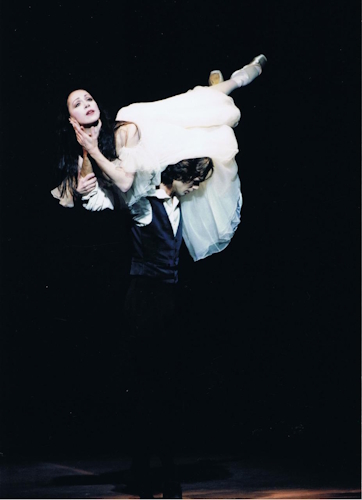
in John Cranko’s Lady of the Camelias in 1998
Photo Wilfried Hösl, courtesy Judith Turos
Her first professional engagement was with a Romanian touring company, from which she defected in 1981, because she wanted to start a new life in Western Europe. It was not easy, because the tour management kept all the dancers’ passports. Turos recalls. “I came to Munich because friends who helped me lived here. Without a passport, I had to apply for political asylum, which I was eventually granted.”
Turos explains that, “Normally, you are not allowed to work if you do not have papers, and you cannot stay if you do not work.” But she was intent on continuing her dance career. “One day, I just went to the opera house before class at ten o’clock. One of the teachers was at the door. He took me up to the studio, and I joined the class. Then he talked to the ballet director. When I explained that I had just arrived, could not go back and was basically on the street, he agreed that I could continue with the classes, which I did for six months, even though I did not have any papers. But when they saw the quality of my dancing and realised I had Russian training, I was accepted into the company at the beginning of the next season.”
That’s something unthinkable today. Present Staatsballett director Laurent Hilaire had around 700 applications for three positions next season, and each dancer had to send videos and a CV before they were even considered for an interview.
Turos worked under seven ballet directors, and the history of the company can be divided into the era before and after the directorship of Konstanze Vernon (1989-98). Before her, the company was called Ballett der Bayerischen Staatsoper and was a subdivision of the opera without its own budget. In their announcements, choreographers were non-existent. It just said ‘Swan Lake, Tchaikovsky’.
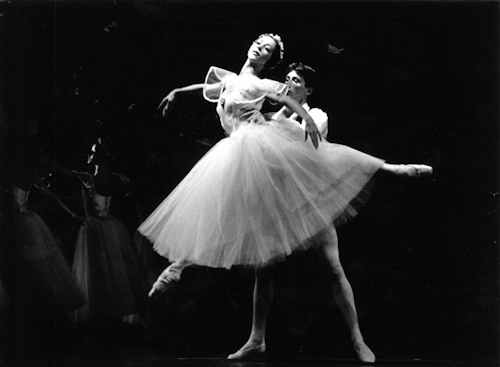
Photo Anna Kirchbach, courtesy Judith Turos
Turos remembers, “I started under Edmund Gleede (1980-84). He had good ideas, but was mostly interested in dramaturgy and performance and not in classical ballets. He was succeeded by Ronald Hynd (1984-86), and everything became very English. He left two years before his contract expired, because of problems with the administration. The next three years, we had no director. Ballet master Stefan Erle ran the company. He taught us all the Cranko ballets. I learned a lot from him but we got no new ballets, which is not good for a company. Because we were part of the opera, we also had to dance in their productions.”
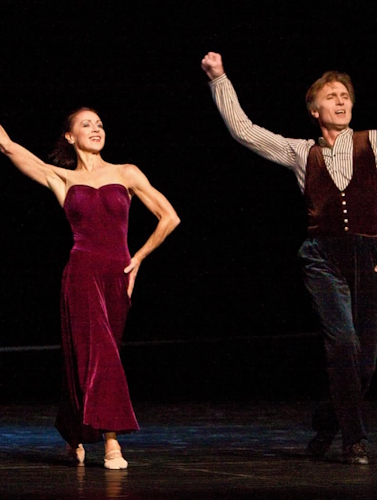
in Hans van Manen’s The Old Man and Me in 2009
Photo Thomas Kirchgraber
Konstanze Vernon had been a principal with the company from 1963-81 and in 1978 founded the Heinz-Bosl-Stiftung, which still today gives promising young dancers the opportunity to get quality dance education in Munich. When offered the directorship, she insisted that the ballet became financially independent from the opera, that the dancers were no longer obliged to perform in the operas, and renamed the company Das Bayerisches Staatsballett. These changes laid the foundations for the company to develop into the world class one it is today.
Turos was a principal from 1985-2005. To great acclaim, she danced in the new repertoire Vernon introduced including works by Jiří Kylián, Hans van Manen, Angelin Preljocaj and George Balanchine. She says, “I was lucky to dance everything. But at one point, Vernon saw me more as a dancer of dramas like in Cranko’s and Neumeier’s ballets, although I did get to do Giselle and Sleeping Beauty.”
She continues, “My first role in a Cranko ballet was Tatiana in Onegin. I grew up with this ballet and performed it almost to the end of my career. After that I was cast as Marguerite in Neumeier’s Lady of the Camelias, which made me very happy. I feel at home in this ballet, and it is my favourite at the moment. I was the first cast as Hippolyta/Titania here in Neumeier’s A Midsummer Night’s Dream. Katarina in Cranko’s Taming of the Shrew, was another favourite role. In my last performance, I danced with swollen knees. But you do not feel it when you dance, you are so full of adrenaline. You stomp and jump. But afterwards I could not walk home.”
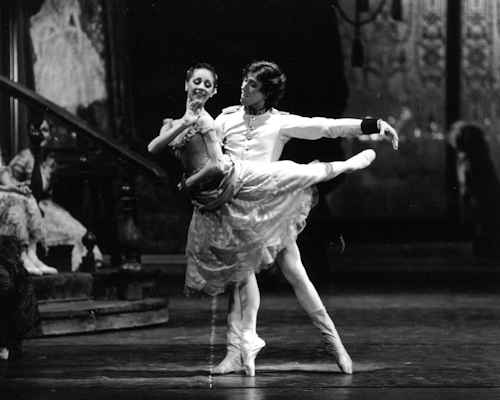
Photo Charles Tandy
She stopped dancing after operations on her knees, she explains. “I was losing cartilage; it was bone on bone. I could not even walk. So, without pointe shoes and jumping I did my farewell performance in Hans van Manen’s The Old Man and Me in 2005, with Ivan Liška, who was then ballet director.”
Turos stayed on as ballet mistress. “It was hard, because I still felt like a ballerina. I tried for a good two years. The third year was better. I figured out, when you are coaching, you cannot say do this or that, this is wrong. It does not work for the dancers. You have to forget about yourself.”
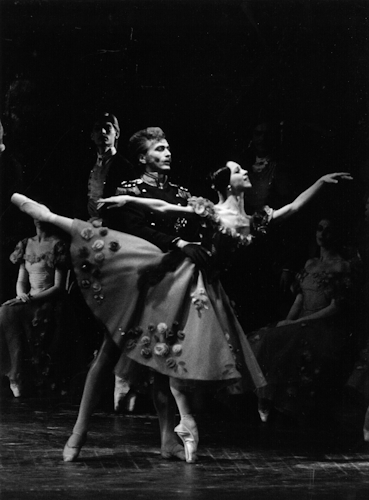
Photo Charles Tandy
Since then, Turos has coached generations of dancers in the company’s Cranko and Neumeier repertoire.
She explains, “I use my knowledge, everything I learned and figured out myself. But I try to give the dancers the freedom to first find themselves in their role. Then I try to make the dance, and the way they move, even more beautiful.”
She goes on, “Dancers today are technically much better than we were. But I wish they would not fix themselves too much on technique. Even in class, I suggest that they should always bring beauty into an exercise. When performing, it is important not to be scared, to open up, to have the courage to be ugly or to not be in this very perfect body or position. Because if you worry about that it doesn’t come, and it will never come if you don’t open your heart and let go of your thoughts.”
Working conditions for the dancers have changed too. In 1990, Turos gave birth to her daughter. Six months later she was on stage as Myrtha in Giselle on the insistence of Vernon. She remembers, “I started taking class after three months, and it took me two more months to get into the same shape I was before giving birth, and then I had to do Myrtha. It is not a good choice by a director to make a woman suffer like this, with all the jumps. It would have been better to start with something easier. But Vernon wanted a strong figure next to Giselle. She just forgot that it was very hard for the body. But somehow, I did it, although my legs were suffering a lot. I didn’t jump very high. But afterwards I got stronger. Today, some dancers stay off stage for a whole year after giving birth.”
In 1999, the Bayerisches Staatsballett opened its first childcare institution for the dancers’ children. But in 1990 the dancers had to organize their own care. Turos says, “I was very lucky, I had my mom with me. She moved into our house, so, I didn’t really have to worry, and all the days when I only had class, I spent my time with my daughter.”
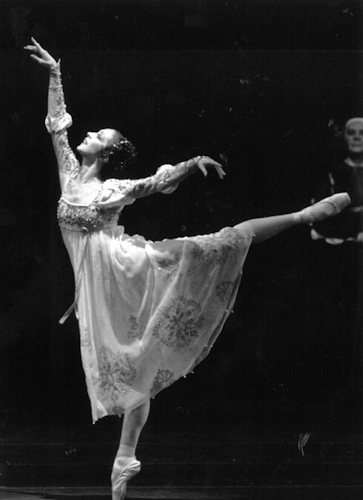
Photo courtesy Judith Turos
Looking back on her life in the theatre, Turos says, “I fell so much in love with the ballet when I was young. Then it became a part of my life to go on stage and go to class every day. For me there is no day when I am not in the theatre. Even if I don’t have rehearsals, I do my class in the morning. It is like a cup of coffee you have to drink.”
But her fondest memory is, she tells, “The feeling that went through my whole body before every show, and which I will never forget. I always came early to prepare myself before a performance. I am alone on stage with the open curtain, no audience. I am warming up. Maybe a technician is doing something. But the feeling on the empty stage, with the air and the happiness that I am going to dance Tatiana or Giselle or Marguerite… I am here, and soon people will come in. Everything went through my brain. I always got goosebumps. This memory I will take with me until my death. It is a part of my life.”
Asked if it is hard to leave now, Turos answers, “It was hard to stop dancing and to become a ballet master. But you know how the saying goes that the years heal everything and make us happy with what we do. Now I’m looking forward to be with my family and with my friends. To talk about other things than ballet, and get to know a little more about what is going on in the world. To be free, not to have to work every day. But I’m a person who cannot do nothing. So, after I have taken a bit of time for myself, I would like to do some coaching here in Munich or in other places.”