
Drawing on her own military experience, Zoë Hewitt looks at Rosie Kay’s new film.
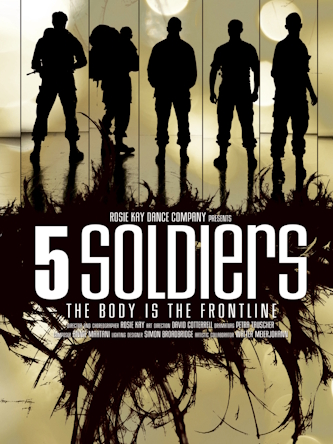
Sixteen years after 5 Soldiers first appeared, Rosie Kay’s new documentary brings its five dancing bodies together with the voices of five former soldiers: Alexandra Ball, who left the Army as a sergeant after serving in the Royal Military Police; former Royal Engineer Richard John Cutting; Lance Corporal Mark Harding, who served as a sniper in the Duke of Lancaster’s Regiment; Vicky McClennan, who spent nineteen years in the Royal Army Medical Corps; and General Sir Nick Parker, whose forty-year career began in the Royal Green Jackets. Annalise Bucher, Gregor Campbell, Chander Van Daatselaar, Frank Hickman and Christopher Vann perform the choreography, while the interviews place its physical language within individual lives.
Military life is too varied, contradictory and personal to be contained within a single work. The new 5 Soldiers documentary offers one angle, shaped by curiosity and a recognisable human generosity, allowing an audience to encounter soldiers through movement while listening to people who have lived inside the culture being represented. The choreography gives physical form to discipline, interdependence, danger and injury, while the interviews place those experiences within individual histories.
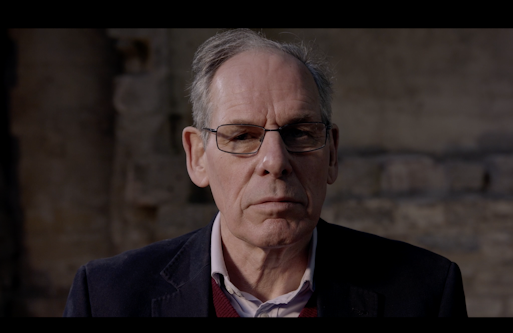
one of the five former soldiers whose voices are heard in 5 Soldiers
Photo courtesy Rosie Kay
The reasons given for joining are strikingly ordinary. Ball enjoyed the Air Training Corps as a teenager, had already fired a rifle and been on exercise, and eventually discovered, as she puts it, that she loved guns. Parker remembers the promise of activity, challenge, community and a secure existence. Cutting expected a life of adventure and comradeship. Harding followed several generations of family service and found the sense of belonging he had been looking for. That word, belonging, carries particular weight. Military identity grows through living, training and working with other people, through the daily knowledge that each person’s actions affect everyone around them, and through a trust that can eventually ask people to go far beyond what they would do for themselves. I know that belonging.
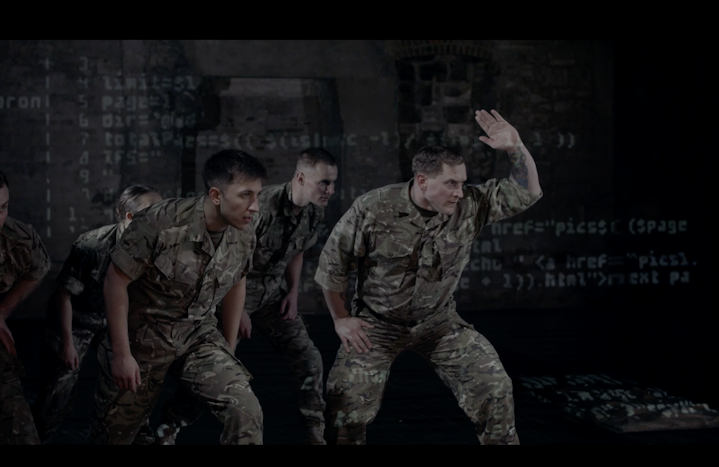
The first half of the choreography is heavily shaped by drill. Orders are barked across the space as the five dancers form lines, pivot together and drive forward at speed through the empty room, their shared timing leaving little room for individual hesitation. Elsewhere, they move through the room in small, clipped steps with their bodies held rigidly at attention, apparently without any destination. When one dancer collides with another, the encounter turns immediately into hand-to-hand combat, giving the sequence the strange logic of characters in a game responding to unseen commands.
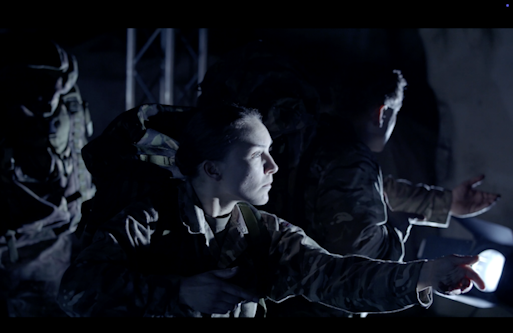
Photo courtesy Rosie Kay
The interviewees’ memories of the parade square extend something already established physically. Ball hated drill. Cutting remembers being shouted at and discovering that every improvement merely raised the standard expected next time. Another interviewee recalls the familiar principle, “train hard, fight easy”, while military training is also described as a process that reduces hesitation and prepares the body to act under pressure.
Its basic mechanism is widely shared: repetition becomes embodied knowledge, and embodied knowledge becomes available when conscious calculation is too slow. Dancers repeat movement until it can be retrieved without hesitation; martial artists and anyone who has spent years acquiring a complex physical skill build the same relationship between attention and muscle memory. Someone who plays a game for thousands of hours may send their fingers flying across a keyboard before verbally formulating the next action. Combat gives repetition an extreme purpose, while the choreography makes visible a way of learning that many bodies already know.
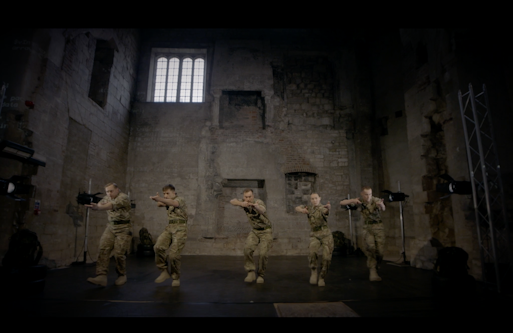
(l-r: Chris Vann, Gregor Campbell, Frank Hickman, Annelise Bucher,
Chander van Daatselaar)
Photo courtesy Rosie Kay
The discipline loosens when the four male dancers begin performing femininity to a pop song, exaggerating their gestures as they imitate women and delight in one another’s performance. It is gloriously silly, the kind of humour that grows easily among young men living and working together. Their imagined women remain safely inside the joke, created and controlled by the men themselves.
The arrival of the female soldier quietly changes the tone. Femininity is no longer something performed for amusement. A real woman now stands among them, and the play begins to carry sexual attention and desire.
McClennan’s recollection of arriving in a new unit gives that shift another context. When a man was due to arrive, people asked whether he was a decent bloke. When the incoming soldier was a woman, the first question was whether she was fit. Women are subjected to that gaze in many male-dominated environments, and a single man entering an overwhelmingly female group may also become the subject of immediate discussion about his appearance. The military setting makes the exchange more exposed, with fewer polite layers placed over it.
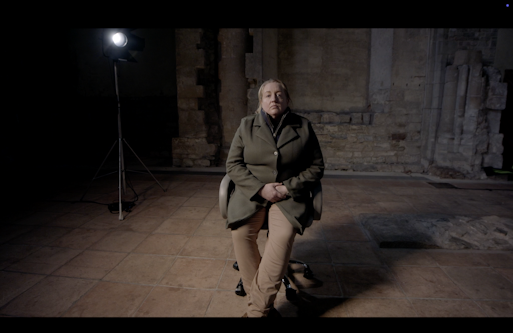
Photo courtesy Rosie Kay
The sequence also sits beside the drinking culture McClennan describes, including an initiation drink made from an appalling mixture of whatever could be found behind the bar. Drinking rituals exist in schools, universities and sports teams as well as the military, particularly in groups where newcomers are absorbed through shared ordeals and established habits. My own experience was different. I do not drink alcohol and made that clear; nobody tried to pressure me, and soft drinks were provided at social events. The culture existed, though its expression still depended on the unit and the people within it.
The pressure of serving as a woman reaches far beyond being looked at. I belonged to the first generation of women permitted to enter infantry selection after infantry roles opened to women in late 2018. Other women were entering infantry during the same period, although I was the only woman on my own Combat Infantryman course. The physical work was already demanding, and the position of a visible minority added another burden: the need to work harder to reach the same point as male colleagues, while knowing that an individual weakness could easily be read as evidence about women collectively. That pressure was immense, even while my attention remained fixed on the immediate task.
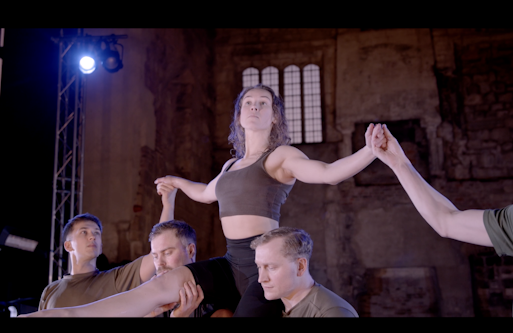
Photo courtesy Rosie Kay
The Army of 2026 has moved further from the institution represented when 5 Soldiers premiered. Female-specific body armour and improved combat clothing have now been introduced, although access to properly fitting kit remains inconsistent. Women are at least no longer treated solely as smaller men whose bodies must adapt to equipment designed around male proportions. The change is practical and bodily, which gives it particular significance within a work so concerned with bodies. Gender remains present, even when an extreme environment reduces men and women to the same struggle to continue.
The later sections give injury a name and an aftermath. Harding describes being shot in the neck by a 7.62 mm rifle round in Afghanistan on 20 May 2010, the damage to his spinal cord, the first aid given on the ground, the evacuation flight during which he was placed in an induced coma, and the moment consultants told him that he would not walk again. Before telling this story, he walks into the frame and sits down. That simple entrance carries the knowledge of everything that followed the injury without requiring the film to announce it.
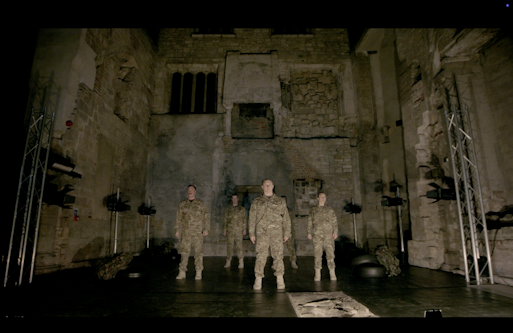
Photo courtesy Rosie Kay
Parker’s account carries military experience into the family. His son Harry, then a captain in the Rifles, stepped on an improvised explosive device while on foot patrol in Helmand in July 2009 and lost both legs. Parker was on holiday with his family when the call came. Something in his mind clicked into place, and he began organising the journey home with extraordinary calm. The practical work came first. On seeing his son in intensive care, surrounded by breathing equipment and wires, he was no longer speaking as a senior officer.
“I was just a dad.”
His description of moving calmly through the practical decisions carried a familiar logic: under shock, the mind can become unusually efficient until the urgent work is done.
I remember a corporal whose tears I saw on 11 November after he had lost his entire section in Afghanistan. Much later, I asked him what Afghanistan had been like.
“It’s hot,” he said.
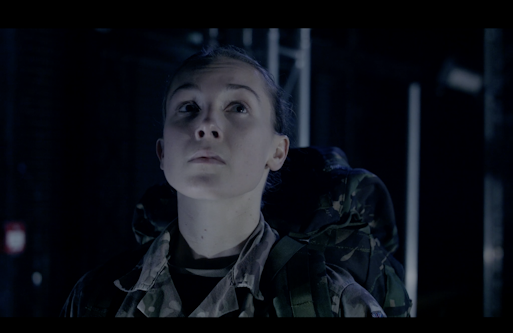
Photo courtesy Rosie Kay
The closing text records that 454 British servicemen and women lost their lives during the Afghanistan conflict, and that 202 members of the British Armed Forces received full or partial amputations and recovered. Harry Parker was treated at Selly Oak Hospital, underwent rehabilitation and returned to civilian life. The Army Benevolent Fund, the Army’s national charity for serving soldiers, veterans and their families, also appears in the credits. These references allow treatment, rehabilitation and continued support to remain within the frame, although the film can only touch the surface of recovery and life after service.
The documentary offers military life through stories that do not settle neatly into a single political response. Greater sympathy and understanding may sit beside anger at the cost of conflict; the physical vulnerability of the soldiers may intensify anti-war feeling; their attachment to service may also become more comprehensible. Ball can love guns and hate drill. McClennan can describe belonging and sexism within the same institution. Harding can say that the Army made him who he is after recounting an injury that changed his body permanently. Parker speaks with the knowledge of a general and the helplessness of a father.
5 Soldiers presents one substantial view of military life while acknowledging, through the differences between its own interviewees, how many other versions remain outside the frame. I watched their accounts alongside my own memories, including the women who entered infantry when the door had only just opened to us, the men who trained beside me, and the individuals who remain more vivid than the exercises we completed together.
Someone else will carry away different memories. There is room for those too.
5 Soldiers will be screened at:
Hereford Military Festival
The Courtyard, Hereford
Sunday, September 27, 2026, 2.30pm
Post-screening conversation: Rosie Kay with Andrew Fox
Chelsea History Festival
Chelsea Theatre, London
Saturday, October 3, 2026, 4.00pm
Post-screening conversation: Rosie Kay with General Sir Nick Parker KCB CBE