
Staatstheater Nürnberg Ballet of Difference, Staatstheater Nürnberg
July 09, 2026
During his first season as baller director at the Staatstheater Nürnberg, where he took over from Goyo Montero, American choreographer Richard Siegal has mostly presented his own works. Amongst them have been two premiers. One in this New Ballets Russes programme, which opened in February, and with which he closed the season.
Siegal has worked in Germany for many years, where he in 2016 founded his own company, Ballet of Difference, based first in Munich, and from 2019-2024 in Köln. In Nürnberg (Nuremberg), he merged the Staatstheater’s existing company with his own. His tenure may have so far been short but he has already managed to create a homogeneous group of twenty dancers, all of whom have mastered his distinct style, a mix of ballet and jazzy movements often performed at breakneck speed.
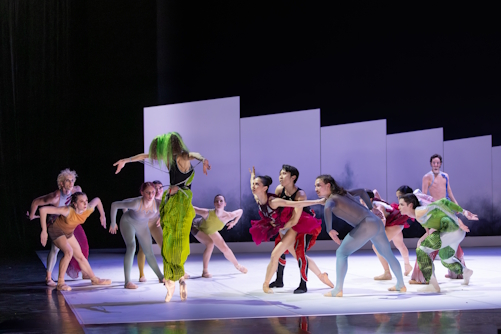
(pictured: Pier-Loup Lacour in the title role (centre) and ensemble)
Photo Pedro Malinowski
For the New Ballets Russes evening, Siegal wanted to investigate, as he explained in the programme book, the spirit of Serge Diaghilev’s Ballets Russes (1909-1929), in its time the most innovative and controversial ballet company, and how it holds up today. For this purpose, he chose two of the ballets created for the company, Pulcinella and Petrushka.
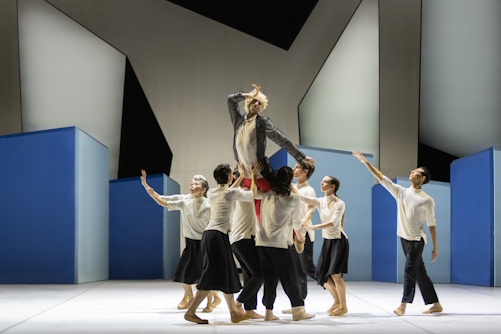
Pulcinella had its premiere in 1920 with choreography by Léonide Massine, music by Stravinsky and sets by Picasso. The storyline was taken from Four Identical Pulcinellas, one of several 18th-century commedia dell‘arte stories involving the character, and which sees three characters dress up as Pulcinella in a complicated story of mistaken identity and light-hearted revenge, but with a happy ending. Almost nothing is left of Massine‘s choreography, so Siegal, like choreographers before him, created his own and story. He did, however, follow Stravinsky’s stage directions, which were written in the score.
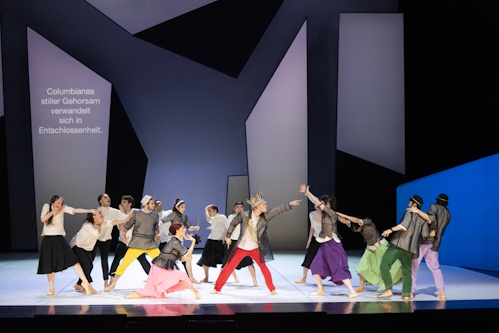
Photo Pedro Malinowski
Perhaps to add a little flavour from Diaghilev’s era, Siegal uses the insertion of text, an element from silent movies. Through the words, we are introduced to Pulcinella, a ruthless King with a queen; a daughter who has a relationship with her girl-friend; a charwoman and an array of other characters. They whirl around creating a confusing, but funny and entertaining story.
The King, Seu Kim, terrorizes his subjects. His daughter, Abigail Weber, lives out her relationship with her girlfriend, Benedetta Musso, in secret as do two men, Avery Rainers and Guiseppe Schilaci, because same gender relations are forbidden the text tells us. The charwoman with her duster observes everything, however. The King is shot, but in the midst of mourning he resurrects. They all rejoice until a woman takes his crown and puts it on her own head. Whom it was I did not gather in the chaos.
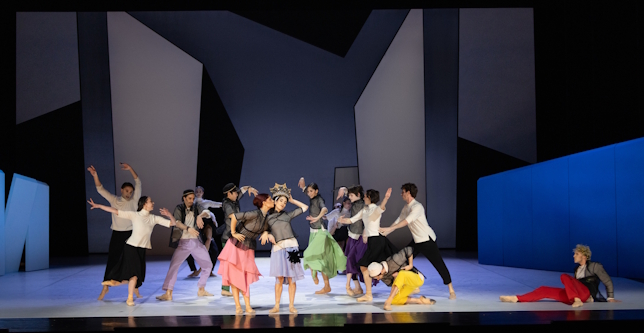
Photo Pedro Malinowski
The Royal household is dressed in Jean-Marc Puissant’s colourful costumes, with the commoners in white T-shirts and black skirts for the women, trousers for the men. Puissant also designed the sets, consisting of movable walls.
It all added up to a colourful, fun and very entertaining ballet.
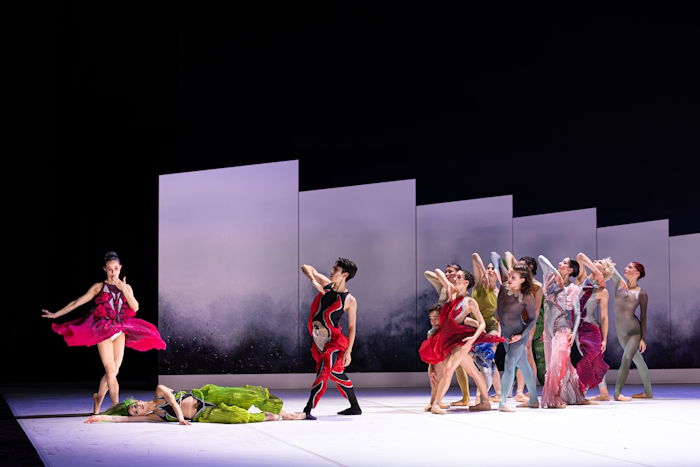
Siegal created his Petrushka in 2022 for his Ballet of Difference. Based on Fokine’s version from 1911, to music by Stravinsky and sets by Alexandre Benois, it is an unhappy love story between three puppets: Petrushka, Roberta Inghilterra; the Ballerina, Livia Gil; and the Soldier, Avery Reiners. They are all led by the Magician, Samuele Ninci, who also seems to manipulate the crowd of nine people, watching the spectacle. It is as if he makes them act with undulating, bewitching arm movements.
here with Margarida Neto in the title role (in green)
Photo Pedro Malinowski
Petrushka has been turned into a woman with a green hairdo and green pants. Inghilterra brings her to life in the most amazing way. Throughout she morphs between being human- and puppet-like. When the latter, she moves as if every single limb is made of wood and tied together with strings. At one point, the Magician lifts her at her midriff. When he lets go, it is as if you hear the clattering sound of her wooden limps hitting the floor.
The marionettes have no stage, the sets of bare walls are again by Jean-Marc Puissant. The Ballerina and the Soldier are lowered from the ceiling in harnesses like puppets on strings of which they are freed, and then the story unfolds amongst the crowd at the beginning in black hoodies, later in fanciful costumes by Flora Miranda. The Soldier demonstrates his manliness, the Ballerina shows off with some crystal clear fouettés. But who wants who is somewhat unclear, except that Petrushka is definitely not interested in the Magician. This makes him so upset, that he takes Petrushka behind the walls. We only see their oversized shadows, when he strangles her.
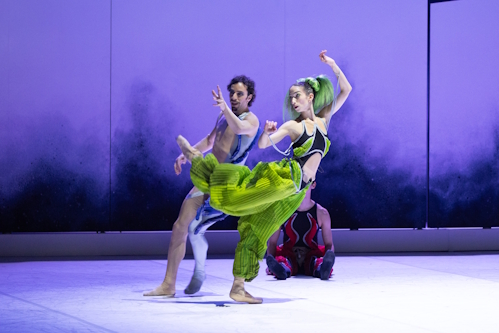
(pictured: Òscar Alonso (Magician) and Margarida Neto (Petrushka))
Photo Pedro Malinowski
Siegal’s ballets are not as radical as those Serge Diaghilev presented with his Ballets Russes. But his new approach made me hear Stravinsky’s music in a new way. It was empathetically played by Staatsphilharmonie Nürnberg, conducted by Jan Croonenbroeck. But the stories hold up even when taken out of their original context, because they are universal ones, which we can all relate to.
Next season Siegal continues his investigation with the program More New Ballets Russes in which he reflects on Diaghilev’s legacy in a reinvention of Jean Cocteau’s Le bœuf, inspired by the legendary Parisian cabaret of the same name and with music by Darius Milhaud, a ballet that the Russian impresario declined. Also on the programme are new pieces by Rachelle Scott, who reinterprets Debussy’s L’après-midi d’un faune; and Mthuthuzell November, who will offer a fresh approach to Stravinsky’s The Rite of Spring.