
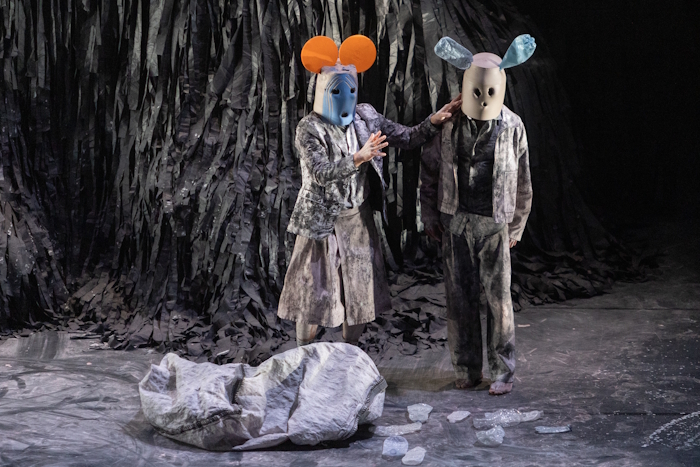
Queen Elizabeth Hall, Southbank Centre, London
October 14, 2026
There are occasions in theatre when, despite the evident skills of the performers and the enthusiasm of the audience, a production simply fails to communicate. For me, Who Are We?, presented by the French company Baro d’evel, was one such occasion.
Directed by Camille Decourtye and Blai Mateu Trias, the company brings together artists from a variety of disciplines, including dance, acting, singing, acrobatics and, somewhat unexpectedly, ceramics. Describing its work as 21st-century circus, Baro d’evel promises a labyrinthine, dreamlike journey exploring the realities of human existence, with humour and joy at its heart. Unfortunately, I found precious little of either.
Perhaps something was lost in cultural translation. The French concept of contemporary circus seems rather different from what British audiences might ordinarily associate with the genre. Certainly, there was little here resembling traditional circus, or even Cirque du Soleil. Instead, the performance comprised a succession of surreal scenarios combining physical theatre, acrobatics, song and increasingly frenetic movement.
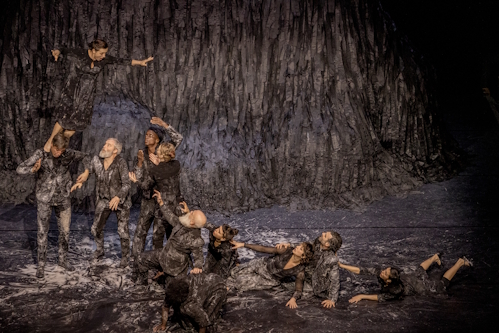
Photo Pete Woodhead
The opening sequence established much of what was to follow. On an apparently slippery stage, the performers slid, stumbled and collapsed into one another in an elaborate display of controlled disorder. It was skilfully executed, but the same physical vocabulary returned repeatedly throughout the evening, whatever the scenario or props introduced.
Indeed, repetition dominates Who Are We?. Episodes frequently begin quietly, accompanied by slow, mournful singing, then gradually gather momentum and volume until they explode into a frenzy of movement, noise and apparent chaos. Everything then subsides, only for the process to begin again. The variations are insufficient to disguise the increasingly familiar pattern. But perhaps pattern was the whole point. It was impossible to know.
There are nevertheless moments of theatrical ingenuity. Particularly striking is a sequence towards the end in which enormous quantities of what appears to be plastic rubbish accumulates across the stage. The visual effect is remarkable, although it suggests a bleak commentary on human consumption and destruction, rather than the joyful celebration of humanity promised by the production.
The music, while often melodious, beautifully harmonised, and sung superbly, reinforces this melancholy. It’s frequently accompanied by heavy drumming, which offers little contrast to the repetitive physical action.
Although some English is incorporated, much of the spoken material is in French. Moments of linguistic clowning, including playful references to familiar announcements such as ‘Please mind the gap between the train and the platform edge’, raised considerable laughter. Indeed, it should be noted that many in the audience appeared thoroughly absorbed, and the performance concluded with rapturous applause and even a partial standing ovation.
Clearly, Who Are We? communicated something meaningful to a substantial proportion of those present. But, for me, the absence of a discernible narrative or developing dramatic thread made engagement increasingly difficult. Theatre of the absurd need not follow conventional storytelling, but it must surely provide some means of connecting its audience with the ideas or emotions being explored. Two hours felt long for material that seemed to have little new to offer as the evening progressed.
Having said that, the performers are unquestionably skilled, physically accomplished and were wholly committed. The precise orchestration of apparently spontaneous chaos demands exceptional coordination, skill in movement and control. The difficulty was one of communication. What was this happening? What was the piece hoping to say?
Perhaps an understanding of a particular French tradition of contemporary circus would have revealed more. Perhaps the production’s artistic language simply did not speak to me. Whatever the explanation, despite appreciating the imagination and considerable skill involved, I left feeling that Who Are We? had passed me by almost entirely.