
Korean Cultural Center, New York City
October 9, 2026
This evening brought together three voices in contemporary dance: Andamiro Art Company and choreographer Lee Dongha from Korea, and White Wave Dance, Brooklyn-based but led by Korean artistic director Young Soon Kim, who co-presented the evening. It certainly proved an evening of different choreographic approaches and styles.
In its original iteration, Moon, choreographed by Junghwan Kim for Andamiro Art Company is a sixty-minute work for ten dancers. Here, it was cut to just twenty minutes and just three performers.
The programme revealed that Moon is a narrative work that follows the Andamiro Expedition as they set out to find a legendary door said to be hidden somewhere inside the moon and capable of granting wishes. There were certainly elements of each of the multiple meanings of the work’s Korean title, Mun, including moon, door, gateway and question. That was most obvious when the cast (Jieun Kim, Hyerin Moon, Sojeong Park) donned astronaut-style white jumpsuits and danced as if weightless with that sort of slow motion, heavy gait many might remember from the Apollo missions of 1969 to 1972.
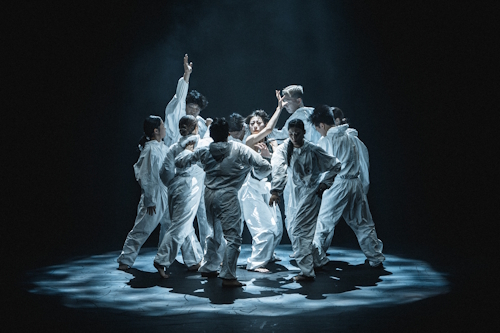
Photo Jung Yun Kyo
But there was little sense of narrative; of the difficult, the unpredictable or unfamiliar, of overcoming obstacles. The movement vocabulary felt rather safe and conservative. Photographs of the complete work paint pictures of something altogether more interesting. I fear a lot got lost in the editing.
Things perked up enormously with Guernica Again, created and performed by Lee Dongha. Although also performed as a 16-member group work, Lee’s solo version came with a lot of strength.
The choreographer’s starting point is Picasso’s famous painting, Guernica, which reflects the horrors of war, specifically the indiscriminate bombing of civilians. Lee suggests that events in which innocents suffer penetrate history, repeating in parallel. In his notes, he refers specifically to the 2010 Cheonanham incident, when a South Korean corvette sank with the loss of 46 lives following a surprise attack by a North Korean submarine, and the capsizing and sinking of the MV Sewol, a ferry, in 2014, which resulted in 304 deaths.
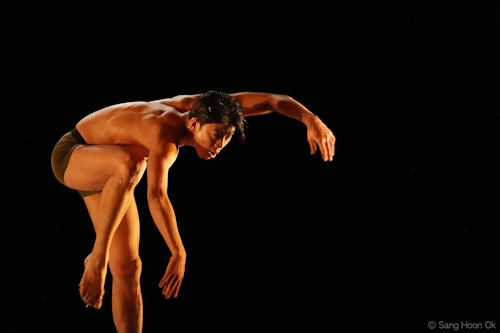
Photo Sang Hoon Ok
The work takes place on a floor of could be ash, remains. Lee rolls in it, gathers it up. Later he salutes and marches before stripping to his underpants. He uses his discarded trousers and top to clean part of the floor, before carefully arranging them as they would be worn, but with the body within gone. Most intriguingly, he draws the outline of himself on board in a frame before throwing himself at it time and again. It ends with him running round and round to what sounds like a hymn.
It was very powerful, very intense. It was also a lot to take in, a fair bit of it unclear, although one did increasingly sense the suggestion of human resilience and vigour in the face of adversity.
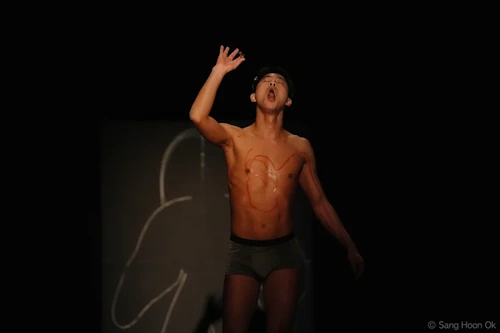
Photo Sang Hoon Ok
The evening closed with forty minutes of excerpts from Here NOW So Long by Young Soon Kim, founder and artistic director of White Wave Dance.
Again presented as excerpts from the complete work (seven out of either twelve or sixteen depending whether you read the programme or the company website), it purports to explore the turbulence of human emotion, including through scenes of love, longing, and inner conflict. I didn’t get much of any of that, which I suspect had been smoothed out by the choreography. What I did get was a series of sections, each appealing in its own way, some decidedly curious, all well-danced, but where the connection wasn’t always particularly apparent.
Still from Instagram video
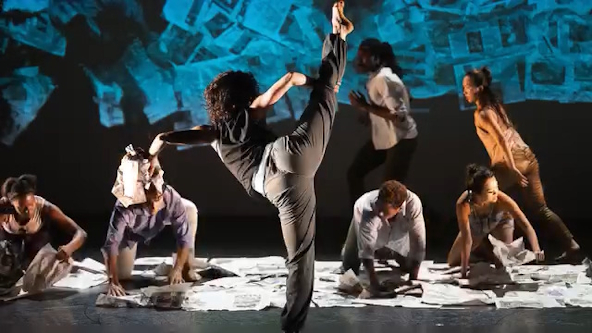
Here NOW So Long opened with a scene involving copies of the New York Times. As Michael Bishop sat reading the newspaper, others took pages from him, dancing with them in multifarious ways. They tore them, up, scrunched them up, tossed them and much more. All in front of excellent projections of pages from the paper layered with live action by Justin Dormitzer after David Tirosh.
A trio from Bella Donatelli, Kaylan Bradford and Soomin Eum was pleasing but the movement vocabulary veered very much towards the academic American modern dance stable. Whether you regard something as “breaking the boundaries of contemporary dance,” as the programme claimed depends on your starting point. But, for me, as eminently watchable as it was, it never got close.
Another great projection saw a room being drawn by Marissa Chen while Bradford (who stood out in every scene she was in) and Shujung Kim danced a duet happened in front of it. A table, chairs, a staircase, even a houseplant, were all slowly added. It was rather impressive, even if it was difficult to watch both the live dance and the live drawing simultaneously. There was certainly a feeling that Bradford and Kim were somehow actually in that room.
Still from Instagram video
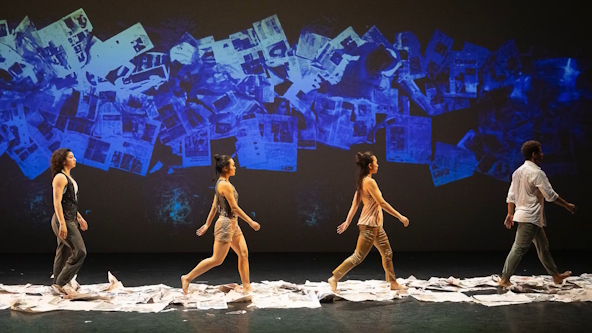
More scenes come and go, newspapers return and there are more excellent projections, including a few minutes seeing the action from overhead. The dancing continued in fine vein with the complex penultimate section full of great partnering, flowing lifts and a fair bit of floorwork. It all called for excellent timing and got it.
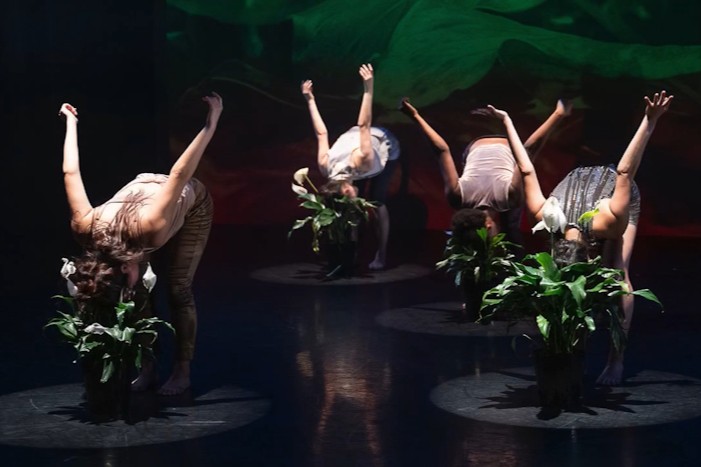
The end provided a link back to that drawing as the cast appeared with, and buried their heads in, pot plants. It was curious, rather surreal and oddly appealing.
Waves of Korean Contemporary Dance was a pleasant evening, but also one that slightly disappointed. Lee’s work hit the mark, even if it did leave me unsure at times, but I didn’t really find myself looking through a different cultural lens as one might expect with the others. I didn’t get the intensity that tends to be a feature of works seen in the UK’s annual Festival of Korean Dance, or indeed that I have seen in Korean works in Asia.