The Australian Ballet at City Center, New York City
October 10, 2026
As the curtain came down on the interval, I was glad that I’d had the foresight to read the synopsis in the programme for Christopher Wheeldon’s Oscar. While some of the first act is clear, some could easily be confusing. Isn’t one of the hallmarks of a good narrative ballet that it should be clear?
Then again, Oscar is not a narrative ballet in the usual sense. The two-act work is also not a biography. And it does not set out to be. Rather, starting with Wilde’s conviction for gross indecency, it looks back at key moments in his life and relationships, revisiting the glittering world he once inhabited, and then at the effects of his time in Reading Gaol. As it does so, past and present, illusion and reality, life and art, all collide.
It’s a ballet of believable characters and compelling performances. Add in some terrific designs by Jean-Marc Puissant that evoke period, and a super score by Jody Talbot, and you have a very good whole. But those collisions do cause a few issues here and there.
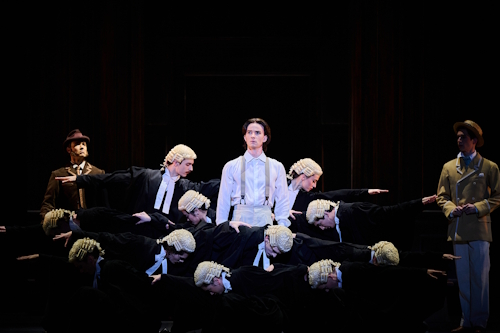
Photo Christopher Rodgers-Wilson
Wilde spent much of his prison sentence in solitary confinement. Largely deprived of human contact, although his wife, Constance, was allowed to visit, it’s hardly surprising that his mind became a place where video memories of his past scrolled again and again.
Oscar has an unusual start, Wheeldon employing a narrator, Sean O’Shea, who introduces the leading characters. The idea works well, as does Shea’s return later in the ballet.
Having established who is who, Wheeldon takes us back to a society ball where Wilde is the centre of attention; and where Constance introduces him to Robbie Ross, with whom he would have an affair. He recalls the good times had in London’s underground gay bars, and a picnic in the park with his family, where he read his story, The Nightingale and the Rose, to his two children. That tale is then woven through the ballet, reappearing again and again.
(pictured: Ako Kondo)
Photo Daniel Boud
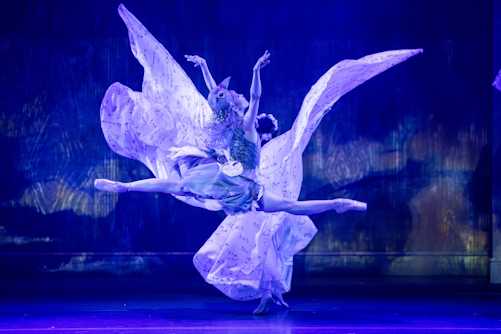
Jill Ogai was captivating as the Nightingale. Wheeldon makes her fly by having her held aloft by the male corps de ballet, or rolling across their shoulders and backs, almost as if weightless. Ogai was both graceful and strong. Her downfall, which can be read as paralleling Wilde’s, is shattering.
Oscar is very much a ballet for the men, though. The only other female role of note is that of his wife. Dressed in the soft, ‘aesthetic’ style with a loose-fitting blouse that she helped to make fashionable, Benedicte Bemet portrayed Constance as the perfect spouse. But there’s little hint of any romance between her and her husband, reflecting the fact that it had cooled by the time the ballet opened, although they were still contently married.
It feels a shame that we only really see Constance dance in one pas de trois for her, her husband, and Robbie Ross. Even there, and although playing a full part, it feels like she’s on the periphery, the dance very much one of telling glances for the two men. She doesn’t appear at all surprised when her husband reciprocates Ross’ interest. We also don’t see any sense of distress at her husband’s jailing.
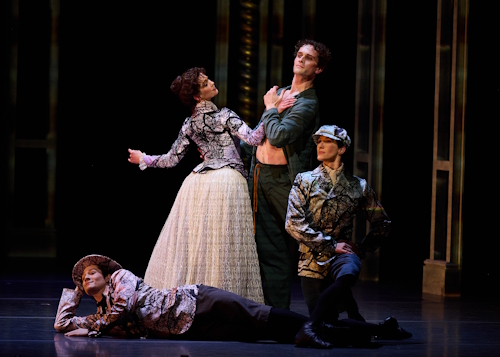
Christopher Wheeldon’s Oscar for The Australian Ballet
Photo Christopher Rodgers-Wilson
Jarryd Madden paints a believable portrait of Wilde himself, although, and perhaps surprisingly, he doesn’t get a solo dance. This is a ballet where others dance with him or around him, but perhaps that’s appropriate given what we see largely happens in his mind.
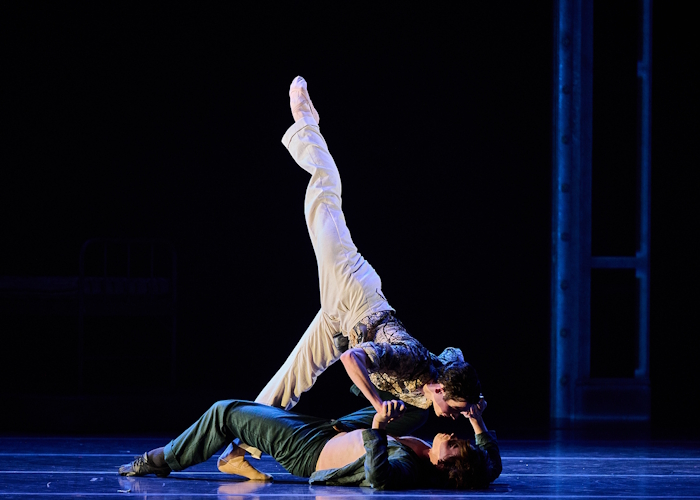
Madden certainly establishes a powerful presence, though. His duet with Joseph Caley as Ross was wonderful right from the moment on the sofa when Ross first lounges at the opposite end from Wilde, then shifts right up close. After a whisky there’s a gorgeously gentle pas de deux, which cleverly continues around a desk and a chair.
Here as almost elsewhere, Wheeldon does not go in for virtuoso choreography, preferring something altogether more sensuously intense and realistic.
The one exception to that come in a ‘Molly House’ scene, Molly House being an 18th and 19th-century term used to describe underground bars and clubs where gay and bisexual men met. There’s a great rumbustious ensemble dance for the men, all of whom wear the green carnation that was a symbol of Wilde and his group, although there his no definitive historical link that it was some sort of secret symbol of homosexuality.
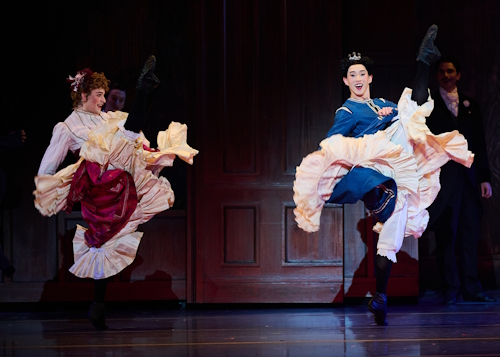
(pictured: Elijah Trevitt and Yipeng Xu)
Photo Christopher Rodgers-Wilson
And then there’s Harri and Zella, two drag queens, one in vivid pink, the other in blue, danced by Yichuan Wang and Elijah Trevitt respectively. In lace dresses of the period, both played it for all they were worth. Technically impressive too, they leapt and pirouetted wonderfully.
Act Two is more psychologically taut as Wheeldon explores Wilde’s incarceration in Reading Gaol, his destructive relationship with Lord Alfred ‘Bosie’ Douglas and the collapse of his marriage. We also sense the satisfaction of Bosie’s father, Lord Queensberry, who made sure Wilde was tried, although one has to remember that Wilde was in many ways the architect of his own downfall, having tried unsuccessfully to sue Queensbury for libel.
Wheeldon shows us Wilde tortured and broken. Out of his loneliness come memories of Bosie, danced by Adam Elmes, and it’s an intimate, desperately heartfelt pas de deux for the two men that is at the centre of the act. It starts delicately. A duet of small steps, stolen glances. Knowing glances. Soon, they come together almost playfully, lifting and supporting each other. It grows and grows, Wheeldon even slotting in a few elation-filled big jumps, before it climaxes in a passionate kiss.
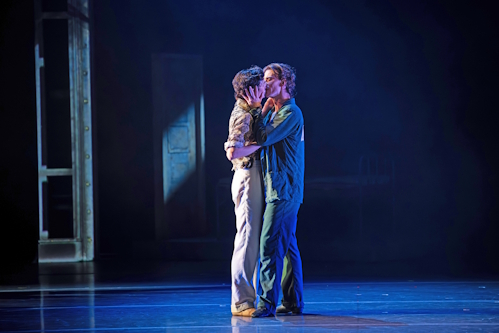
Photo Daniel Boud
Increasingly, Wilde’s mind is also taken over with images from his novel, The Picture of Dorian Gray. We him imagining himself as Gray and taking his place in the frame. The ballet truly gets very dark.
Jean-Marc Puissant’s stage and costume design is fabulous throughout. His costumes speak loudly of the elegance of Victorian society, one where so much was superficial. As the story moves on, he transports the audience easily from the 19th-century courthouse to a high society ball where he is the centre of attention, to Wilde’s home, that bar and the Reading Gaol. The stage is never cluttered. Wilde’s depressingly grey cell is illustrated with just a door and a bed. I’m not sure about the digital moon that earlier rises over the stage, though, especially the way the face on it blinked. It is most disconcerting.
Joby Talbot’s score doesn’t have memorable tunes that you go away humming but supports everything wonderfully and is so, so sensitive to the ebbs and flows of the story.
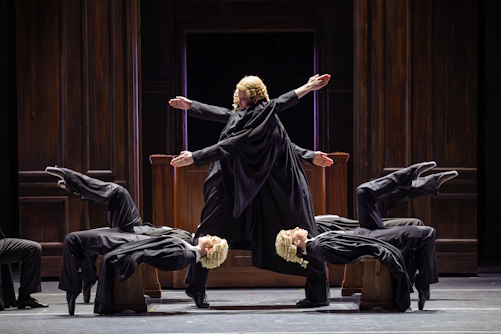
Photo Daniel Boud
The noisy, uproarious end sees us back in the courtroom where it all started. All very different to the respectful court scene of the opening, it’s a cacophony of noise and movement, reflecting where Wilde’s mind now it.
Translating the story of a man whose life revolved around words into dance was always going to be tricky, but probably no tricker than translating a long novel into two hours of ballet. Oscar is not perfect, but Wheeldon’s approach gets round many of the issues.
At different times dark and unsettling, light and humorous, but always visually stunning, Oscar is a great watch. It’s a production that will appeal as much to non-balletomanes as ballet regulars as Wheeldon’s storytelling blends West End theatre and opera house ballet, the choreography a fusion of the classical, contemporary and everyday. It’s also a ballet that I suspect strong really requires at least a second viewing to pick up on everything in it. Let’s hope we can see it London before too long.