
Royal Ballet & Opera, London
October 13, 2026
The Royal Ballet opened its 2026/27 season with Kenneth MacMillan’s Manon, a ballet in which time seems to move at two different speeds. The story advances rapidly, yet the choreography repeatedly slows the action, holding a body in an arabesque, suspending a lift, or allowing a moment of stillness to linger before movement resumes. The effect is almost cinematic, like slow motion extending an instant to reveal a character’s state of mind. It makes an already substantial ballet feel remarkably long.
Created in 1974, Manon brings a morally complicated heroine to classical ballet. She wants love, money and everything money can buy, with little inclination to apologise. MacMillan gives a strikingly modern perspective to a story set in eighteenth-century France, where a woman’s beauty offers opportunities but little lasting protection. The ballet’s frank treatment of sexuality, greed and exploitation caused considerable discomfort at its premiere.
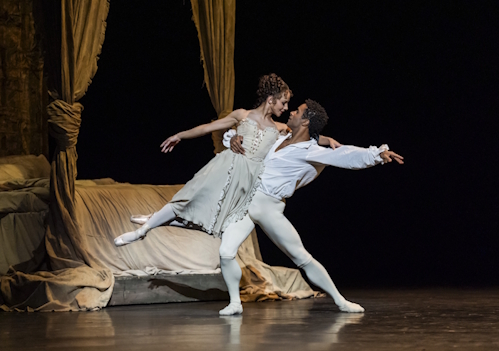
Photo Foteini Christofilopoulou
Watching Manon choose Monsieur G.M.’s wealth over Des Grieux’s declarations of eternal love, I cannot help thinking of Marilyn Monroe in Gentlemen Prefer Blondes. Lorelei Lee cheerfully asks why a woman should be criticised for wanting a wealthy husband when any father would wish financial security for his daughter. And, of course, diamonds are a girl’s best friend. Francesca Hayward’s Manon appears to appreciate the sentiment.
MacMillan gives Des Grieux plenty of time to declare his love through movement, although the relationship itself seems to develop in rather more of a hurry. His devotion is almost comically unquestioning, and his decisions have an unfortunate tendency to make matters worse. His early encounters with Manon offer little sense of how such overwhelming passion has taken hold. Hayward is considerably more convincing in the bedroom duet, where she looks ready to swallow Marcelino Sambé whole. Des Grieux has plenty of devotion to offer but little prospect of supporting the life she wants. Perhaps Lorelei would advise Manon to keep looking.
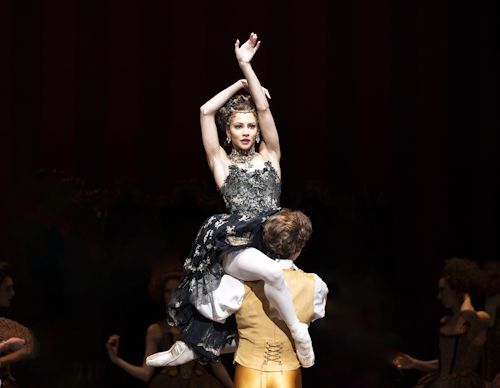
Photo Foteini Christofilopoulou
MacMillan makes the exchange between beauty and wealth wonderfully physical. In the first act’s pas de trois, Manon is lifted, inverted and passed between her brother Lescaut (Joseph Sissens) and the wealthy Monsieur G.M. (Bennet Gartside). Hayward’s extraordinary suppleness allows the partnering to flow through ever-changing shapes. She joins the display willingly, enjoying the attention and discovering its value. In the second act, a succession of admirers keeps her almost constantly off the floor. The sequence goes on for an astonishing length of time, yet Hayward introduces a trace of bewilderment. Surrounded by men eager to possess her beauty, Manon seems uncertain about what she has gained.
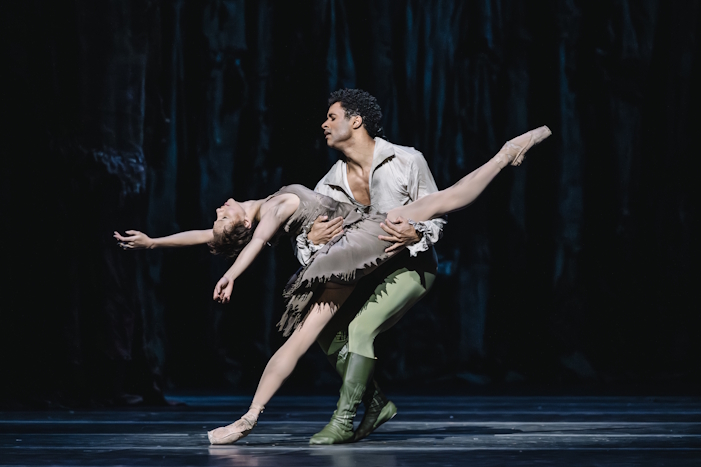
Jewellery accompanies her changing fortunes. Monsieur G.M. presents Manon with a bracelet, which Des Grieux later removes and throws away. In the final act, the Gaoler offers another, clasping it around her wrist. When Manon raises her arm, the glittering ornament looks disturbingly like a shackle. The Gaoler soon makes the violence of this transaction brutally clear. Dropping onto one knee, with his other foot planted on the ground, he drags Manon beneath his raised thigh, grips her body and drives her against the back of it. Hayward hangs loose and helpless, like a broken rag doll, almost ready to snap under the force. The physical manipulation recalls the brutality of MacMillan’s Mayerling. Her beautiful flexibility has become a terrifying expression of powerlessness.

Photo Foteini Christofilopoulou
MacMillan’s use of tempo also gives his characters distinctive personalities. The adagios are demanding, especially Des Grieux’s first-act solo, where sustained turns and balances require exceptional control. Sambé brings elegance to the choreography, with just a few less secure balances interrupting an otherwise impressive performance. Sissens’ Lescaut operates at a different speed altogether. His quick, restless turns are almost like eyes rolling around in someone’s head as a wicked idea takes shape. Similar classical movements acquire different characters through their timing.
Anna Rose O’Sullivan is a delight to watch technically, although her Lescaut’s Mistress seems almost too well behaved for the seductress she is playing. Every balance is secure, every movement beautifully finished. Even her seductive solo feels remarkably proper. She loosens up in the drunken duet with Sissens, allowing some welcome mischief into the dancing, although moments still look carefully rehearsed. Sissens brings plenty of energy and humour to Lescaut, but his drunken solo occasionally loses its underlying intoxication. For a few moments, he looks suspiciously sober.
In the final swamp scene, figures from Manon’s past pass before her one by one, like fragments of a life resurfacing in her fading consciousness. Des Grieux continues lifting and turning her when she can barely stand, raising the practical question of whether the poor woman might prefer to be left lying down. Hayward makes her decline devastatingly believable, her body gradually losing even the ability to respond.
The score, drawn from works by Massenet and arranged by Leighton Lucas and Hilda Gaunt, is especially memorable in the final act. Lyrical cello passages and prominent wind instruments accompany the descent into exhaustion and violence. As the deported women disembark in Louisiana, circling musical phrases evoke both despair and the lingering dizziness of a long voyage, as though the ground itself has yet to stop moving.
MacMillan gives his characters room to behave foolishly, selfishly, passionately and sometimes with startling cruelty, all within the discipline of classical ballet. For all their failings, he shows remarkably little interest in telling us whom we should forgive.