
Northington Grange, Arlesford, Hampshire
July 8, 2026
There is something unmistakably English about The Grange Festival on a summer evening: marquees with tables and chairs, wicker picnic baskets, champagne, ham and potato salad, Panama hats and summer dresses, all before anyone has even entered the theatre.
Ballet Black brought its 25th anniversary touring programme to this very English summer setting: Hope Boykin’s …all towards hope and Mthuthuzeli November’s Ingoma. Plus, less obviously to some of us in the audience, a short appearance from M22 Collective.
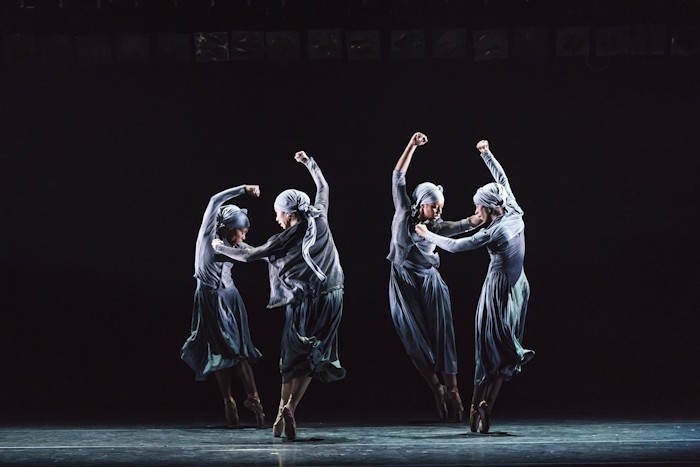
Boykin’s …all towards hope remains a work I admire in moments more than as a whole. It is built from separate encounters, each section offering its own relationship before the lights go down, almost prompting the audience to applaud before the next begins. The dancers give it warmth and individuality, but the piece still feels interrupted by its own structure. It speaks often of moving towards hope; the clearest glimpse of it came, for me, in the final moments when the dancers gathered into a looser, freer shared energy.
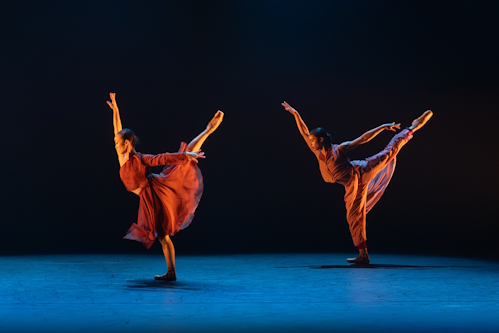
Photo ASH
November’s Ingoma has lost none of its force. Its stamping feet, driving rhythms and bodies pushing through labour and exhaustion still land with real weight. When the dancers drive forward in those heavy, urgent steps, the stage seems to carry both labour and resistance. It remains the stronger work of the evening, one that gives Ballet Black’s dancers something solid to inhabit and resist.
Programmes are useful things, provided one has actually noticed everything in them. After Boykin’s work ended, a number of audience members clearly believed the interval had arrived. Bags were lifted, bodies shifted, and then the stage lights came back up.
What followed was an appearance by Mthuthuzeli November’s recently formed M22 Collective and the premiere of Spirit Dances. Although listed in the programme, its arrival in the theatre still seemed to catch many by surprise. A lone dancer, Jasmina Patel, sat cross-legged, her upper body folded close to the floor. She wore a black top and trousers trimmed with long green fringes, which flickered around her legs as she moved, at times suggesting seaweed or grass caught in a current.
Set to African-inflected drums, her solo began with fast, sharp, grounded movement. Patel was technically assured: turns, drops and recoveries were cleanly placed, the movement flowing without losing attack. Midway through, she returned to the opening folded position and removed her black top. Underneath was a white sports top, and the exposed line of her back caught the light beautifully. After that, the movement slowed and opened out, becoming broader and more expansive.
Whatever its exact framing, Spirit Dances brought the freshest moment of the evening. It had rhythm, texture, and a striking physical image, and it made M22 Collective feel less like a note in the programme than something beginning to make itself visible.
At The Grange, Ballet Black stood inside a very English summer ritual without being absorbed by it. The company has spent twenty-five years making its own space in British ballet. On this evening, the more interesting question was where that space might lead next.