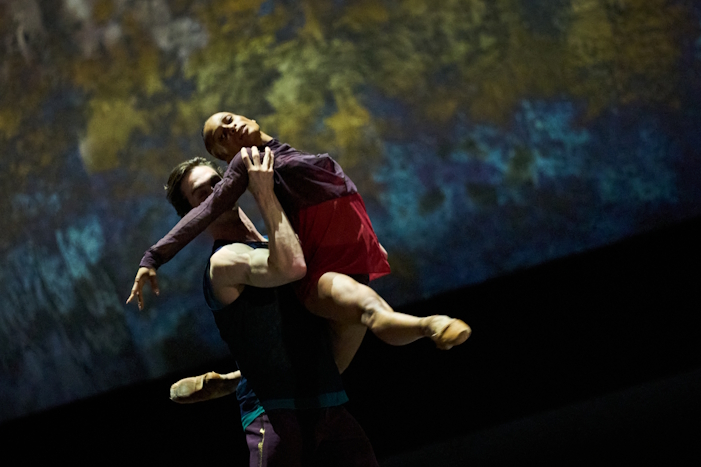
Staatsoper Unter den Linden, Berlin
July 6, 2026
Staatsballett Berlin’s new double bill of George Balanchine’s Symphony in C and the company artistic director Christian Spuck’s Fearful Symmetries, the latter to music by John Adams, at the Opera House on Berlin’s Unter den Linden is a joy; an absolute experience of beauty and perfection.
Balanchine’s intention to create a dance of formal beauty, purity and technical virtuosity was realised superbly by the Staatsballett. His choreography both challenges and showcases the dancers’ extraordinary skill. The Staatsballett rose to the occasion in the best possible way. Combing force, velocity, precision and balance, their performance was impeccable, bringing to life a world of harmony, elegance and grace. They shone against the azure backdrop: the women, in beautiful white tutus resembling swans; the men, dressed in black like crows
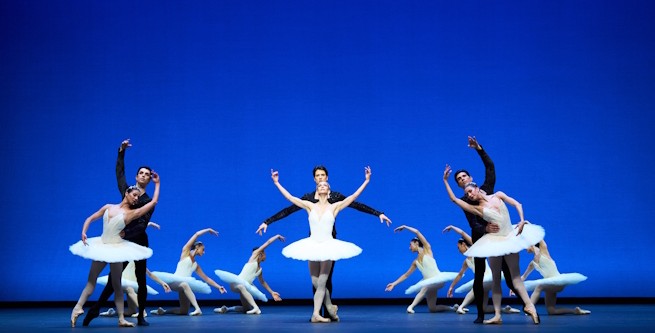
Photo Carlos Quezada
The ballet’s many group and duet combinations, all full of fast, fluid dance that inhabits the entire stage, are exquisite in their pure artistry. Among the many highlights were the duets featuring Harusa Sassa and Kalle Wigle, Polina Semionova and Cohen Aitchison-Dugas, and Leroy Mokgatle and Shuailun Wu, all remarkable for their superb execution.
After an interval, the evening continued with Spuck’s Fearful Symmetries.
John Adams describes his score as ‘traveling music’. It certainly conveys the impression of continuous movement through an ever-changing soundscape, that incorporates synthesisers, keyboard samples and wind instruments. It was highly innovative for its time. The title, Fearful Symmetries, was drawn from William Blake’s poem The Tyger, published in 1794.
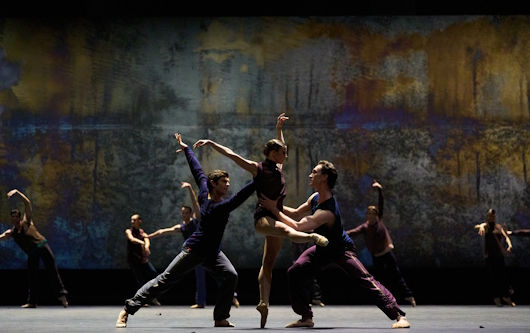
in Fearful Symmetries
Photo Carlos Quezada
Spuck chose the score to develop an interpretation of the music that builds on symmetry while exploring disruption and displacement, order and chaos, and the apparent perfection that reveals its cracks. What first seems clear and stable begins to waver, offering a sense of vitality and truth.
He notes that what is perfectly symmetric is often not truly so. Taking that idea, his choreography has only a few symmetries as compositions are repeatedly interrupted by others. The dance is in a constant state of flux. With so many dancers moving simultaneously in different formations across the stage, it can be difficult to take in the whole. It is somewhat overwhelming, yet there is pleasure in surrendering to this harmonious chaos.
In addition to the many dancers who enter and exit, there are four figures in nineteenth-century costumes: a queen embodying power; a lover suggesting the emotional realm; a scientist representing rationality; and an art clown standing for anarchy and distraction.
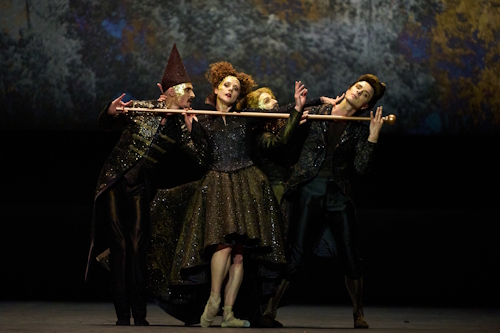
Photo Carlos Quezada
Together, these figures epitomise aspects of life within Western social structures. Weronika Frodyma’s queen tries to impose rules. She appears authoritarian and severe, yet often moves with fractured, scattered gestures, as though doubting her role and feeling insecure amidst the power of the mass dancing around her. She is surrounded by the jester, Wolf Hoeyberghs, the lover, Jan Casier, and the alchemist, Dominik White Slavkovsky. They also evoke recognisable human behaviours and personalities, drawing attention to the dynamics at play in the social milieu in which we live and perform.
It is fascinating to observe these four characters who move with sovereignty yet simultaneously appear powerless among the multitude of dancers, each driven by their own directions, phrases and inner identities. This calls to mind the structures in which we move and act day after day, seemingly given and rigid, yet able to shift and waver through the movements and decisions of the people, in this case marvellously brought to life by the dancers.
The work can also be read as an allegory of the Industrial Revolution: the queen, with her court, sets the rules for the masses while consolidating power and economic strength, suggested throughout by small golden spheres. The dancers represent labour, initially ordered to obey the queen’s wishes, then, piece by piece, gaining their own power. Ultimately, when the queen metaphorically ‘dies’ at the side of the stage, the force of the working class, fighting for its rights, emerges and wins its freedom.
The costumes by Emma Ryott, the lighting by Irene Selka and the all-enveloping stage design by Rufus Didwiszus all contribute significantly to the success of the evening.