
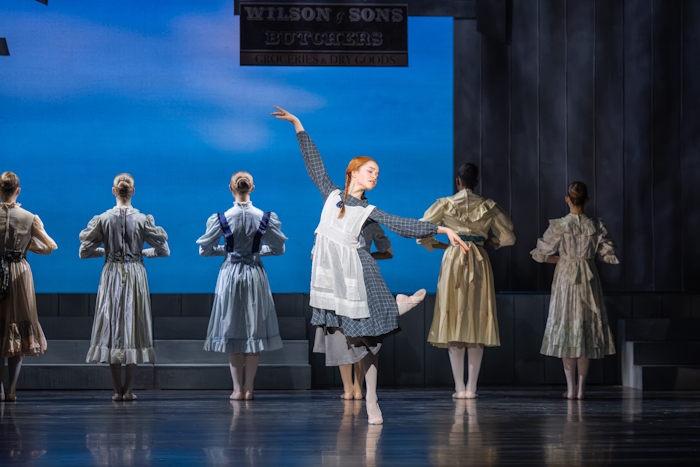
Peacock Theatre, London
July 5, 2026
London Children’s Ballet has long had a reputation for doing rather more than simply giving young dancers a chance to perform. It offers them a genuine theatrical experience: a proper stage, a live orchestra, an original narrative ballet, and choreography that asks them to dance not as children pretending to be professionals, but as young artists discovering what professional performance demands. Anne of Green Gables was one of those occasions when that ambition was abundantly justified.
Based on Lucy Maud Montgomery’s much-loved story, with original scenario by Zoe Vickerman, choreography by Jenna Lee and music by Gus Nicholson, the ballet follows Anne Shirley, the imaginative orphan who arrives at Green Gables by mistake and gradually wins over Matthew and Marilla Cuthbert, her schoolfellows and the wider Avonlea community.
First staged in 2022, the production does not attempt to tell the whole novel. Wisely, it finds a natural stopping point after Matthew’s death, Anne’s discovery of his gift of a dress, and her reconciliation with Gilbert Blythe, the school bully. It is enough. More would have risked dilution.
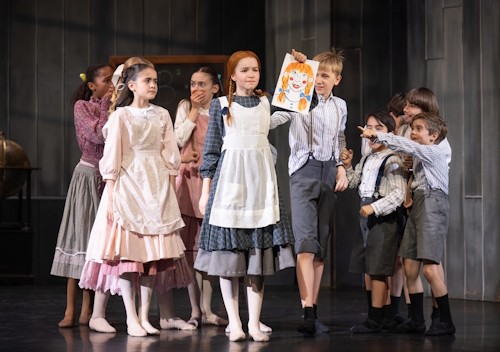
Photo ASH
What was most striking was not that the performers were ‘good for their age’, although that is true, but that they were simply good. The cast, selected from young dancers ranging from seven to seventeen years old, danced with discipline, musicality and commitment. The entire production was danced in soft shoes, with no pointe work, and that proved a highly intelligent choreographic choice. It created a visual and technical unity across the company, allowed the younger dancers to sit comfortably within the same world as the older ones, and removed any sense that something was missing.
At the centre was Amelie French as Anne Shirley. Hers was a performance of remarkable grace, warmth and dramatic presence. Her arms had an extraordinary softness and expressiveness, at moments recalling the liquid phrasing associated with the great Romantic and early twentieth-century ballerinas. More importantly, she understood how to make movement speak. Anne’s impulsiveness, vulnerability, imagination and stubbornness were all present in her dancing. French already has the look of a dancer with a future: not because she can do impressive things, although technically she is clearly advanced, but because she knows how to inhabit choreography from within.
Seventeen-year-old John Holden, appearing as a guest artist in the role of Matthew Cuthbert, gave an equally notable dramatic performance. To suggest an older man convincingly is difficult for any young dancer; to do so without caricature is harder still. Holden found Matthew’s gentleness, reserve and increasing frailty with real maturity. His dancing was controlled and generous, but it was the quietness of the acting that made the role so affecting. His final scenes were handled with unusual emotional intelligence.
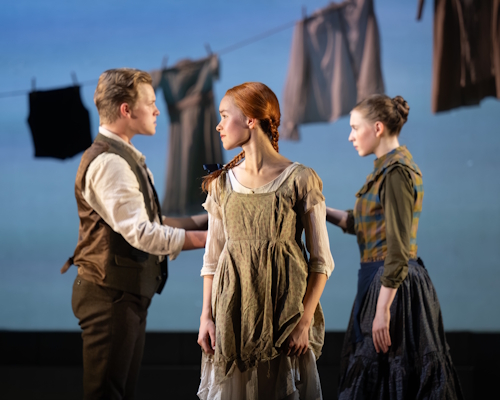
and Phoebe Smart (Marilla Cuthbert) in Anne of Green Gables
Photo ASH
Phoebe Smart made a strong impression as Marilla Cuthbert. Much of the role depends on dramatic clarity rather than dancing display, and Smart caught Marilla’s severity, alarm and eventual thawing with assurance. Her reaction to Matthew bringing home a girl rather than the expected boy was sharply drawn, but never overplayed. When dancing was required, she showed control and composure, with a line and finish that served the character rather than distracting from it.
There were many others who deserved mention in a large and impressively committed cast. Berta Lesmes brought charm and ease to Diana Barry, Anne’s first true friend at school. Chloe Mackintosh gave Mrs Barry a clear dramatic outline, initially suspicious of Anne before softening as the story unfolded. Folashade Marah (aged only 7), as Bluebird, showed lovely comic timing and an instinctive sense of theatrical character, displaying a musical awareness, élan and a willingness to act through the body, not simply execute steps.
Indeed, the company’s dramatic ability was one of the evening’s great pleasures. Young dancers are often taught to smile, present and count; these dancers had clearly been encouraged to listen, react and belong to each scene. There was a striking sense of interaction across the stage. Whoever was responsible for developing that dramatic side deserves considerable credit. Many professional companies could take note. Technical polish is one thing; the ability to make an audience believe in a character is another.
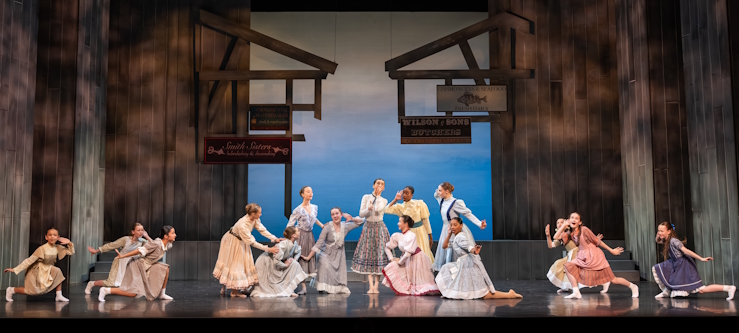
Photo ASH
Lee’s choreography is exemplary in its understanding of what young dancers can do and, just as importantly, what they can do beautifully. It is not flashy, nor does it chase difficulty for its own sake. Instead, it provides for elegant, characterful, musically clear dancing that allows the performers to succeed fully. The best choreography for young dancers is not choreography that patronises them, but choreography that trusts them while never pushing them beyond truth or security. Lee achieves that balance superbly. In French’s case, the choreography did more than frame the performance; it gave her space to expand it.
The production values were more uneven, however. Mark Jonathan’s lighting is clear if a little short on atmosphere in places but always supportive of the dancers. The costumes, by Emma Tubiermont assisted by Kaia Strange, are excellent: period-appropriate, attractive and, crucially, danceable. They create the world without restricting movement.
The staging was weaker in places. Scenes are divided by a scenic curtain descending to ‘hide’ a scene change, while asides on the front strip of stage fill the time. It’s not uncommon, but while once is acceptable, when repeated many times it becomes intrusive. It announced the mechanics of the production rather than concealing or integrating them, and interrupts the narrative flow. In a production otherwise so theatrically assured, it seemed an oddly unimaginative approach. Much of the setting could have been shifted in view, perhaps by the dancers, with chairs, desks and smaller props incorporated into the action.
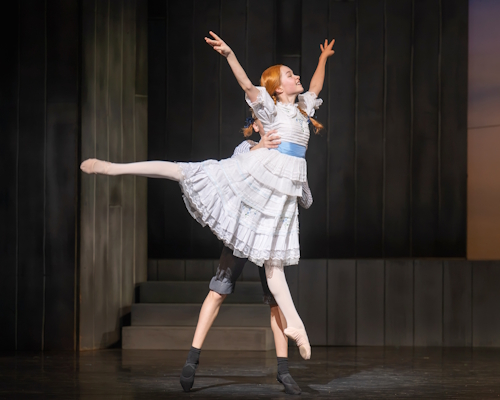
Photo ASH
Musically, the orchestra under Philip Hesketh served the production admirably. Nicholson’s score is attractive, rhythmically accessible and easy on the ear, if occasionally similar in tone across the evening. More importantly, the playing supported the dancers with sensitivity. There was a clear understanding that young performers need musical breathing room and alert accompaniment. The result was secure, warm and generous.
London Children’s Ballet was founded in 1994 by Lucille Briance to offer talented young dancers a professional performance opportunity, free of charge and without financial barrier. That mission remains important. But Anne of Green Gables also showed something beyond access and opportunity. It showed a company capable of producing young dancers who understand theatre, musicality, character and ensemble. The production has the potential to stand proudly beside professional family ballet. The dancers already did. Many former London Children’s Ballet dancers can be found in major companies. It will be a joy to watch these young dancers as they too progress their careers.