
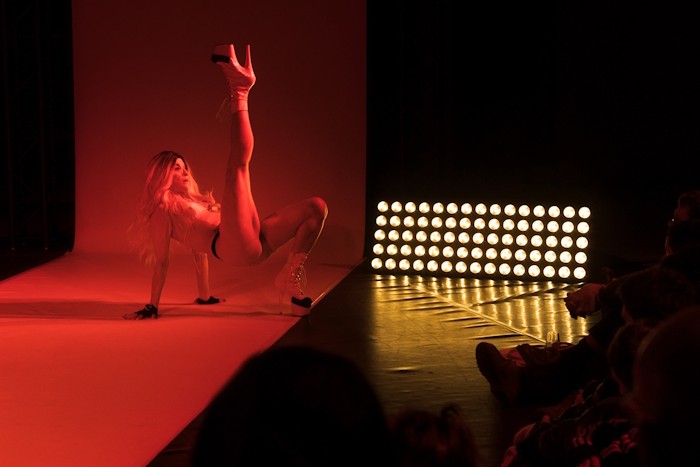
Odeon, Vienna
July 11, 2026
She sits astride a large black trunk, dressed in dark khaki waders and a tight-fitting black unitard. And a long red wig. That’s merely the start. Alexandra Bachzetsis later dons turquoise boots with 3-inch platforms and 6-inch stilettos, followed by gleaming white ones. She offers the audience food and takes selfies. There are more wigs. She sings Brian Hyland’s song ‘Sealed With A Kiss’. Badly. Although the fact she’s wearing a white poodle mask probably isn’t helping. In her unitard only, she adopts what so some might regard as provocative poses.
As Bachzetsis crawls across the white strip of floor that runs between two banks of seats, with more seats at one end, a white screen at the other, she sometimes reaches for a leg and pulls it into position. She takes up a frog pose, a yoga-style cat-cow, all demonstrating her flexibility. Those wader and wig very effectively hide form and face, though. They stop the viewer reading anything much about her.
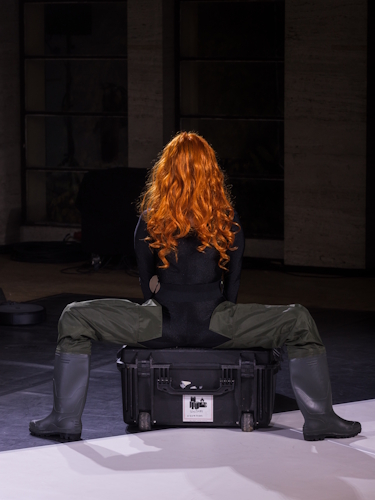
Photo Olivier Lovey
Rush(es) the programme note explains, incorporates “elements of autofiction, self-documentation and autoeroticism,” using pop-culture material for “expressivity, identification and desire.” All that is undoubtedly there. And it certainly provokes a response, although just what is very personal. Anonymity and then finding oneself is something of a running theme, though.
Having put on her first pair of stilettos, some might describe them as kinky, or the way she takes her time doing up the laces as suggestive, she introduces a robot vacuum cleaner. At the time, the intent is unclear. Rather amusingly, it motors off, approach the feet of audience members sat on cushions. With the white poodle mask, we’re back to concealing features.
A few small round speakers are handed out. Unfortunately, what they broadcast is almost inaudible save for a few words about identity.
Greater meaning starts to take hold in the mind when she offers food to the audience: a giant bag of crisps is passed around, a tube of Pringles, a bag of popcorn. She takes a lot of selfies. “I do like your cap,” she says to one. “Can I have a picture with you in your cap?” Having been largely ignored by her pet robot, is she trying to ingratiate herself with those watching? Or perhaps somehow seek validation of who she is?
When she puts on one of those white body-skin beauty facemasks, one wonders if she is still trying to hide something. Or perhaps she’s still afraid of revealing. Or perhaps she really does just want to improve looks. But signs of confidence are there. When she exchanges her turquoise boots for gleaming white ones, the choice of colour feels very important.
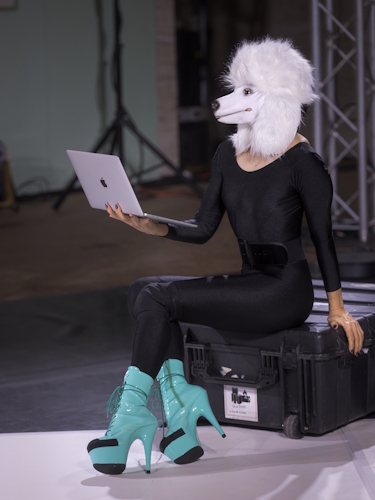
Photo Olivier Lovey
There’s even some of what most people might regard as dance. Drawing on vogueing, it’s accompanied by lights that spell out word by word, “I am not so far way out.” I also spotted ‘shy’ and ‘act’ amongst the others, all words that might describe not so much the performance as the woman we see.
Another scene sees Bachzetsis drag a box to the centre and lay over it in a vaguely suggestive manner. It’s clichéd more than shocking, though. Certainly not erotic. And neither is a later section on the floor that sees her bathed in a red light. For some reason, both reminded me of things I’d seen Barry Foster’s world-weary Commissaris Piet Van der Valk run across and dismiss pithily a few times in the 1970s TV series.
After a dance in which she uses her arms mechanically, rather effectively reproduced in shadow form behind her, the end sees Bachzetsis stride very confidently down the white floor, towards the camera. There’s something quite meaningful about her gait. It certainly has a power and energy. Have we seen the real person at last? Or is this just an act? Indeed, did we ever see the real her or was it all role-play? It was impossible to tell.
Rush(es) is certainly strange. And it’s certainly an experience. Reflecting afterwards, I couldn’t help feeling that, as with Christos Papadopoulos’ My Fierce Ignorant Step two evening’s earlier, Rush(es) is in no small part about finding yourself, freeing yourself, albeit in a very different way. But does it challenge taboos? Is it confrontational, disturbing, erotic…? Not really.
Also at Odeon, there was the chance to look at Photo/Copy/Archive by American-born, London-based choreographer, performer, and visual artist, Christopher Matthews. For the exhibition, he looked at eighty years of performance posters from Sadler’s Wells in London, segmenting and reassembling them into wholly different beings. The result is a personal and alternative look at the dancing body.