
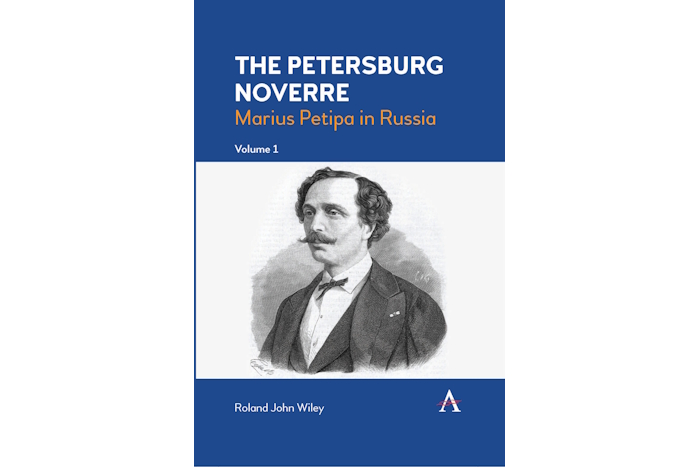
By Roland John Wiley; Anthem Press
Roland John Wiley’s The Petersburg Noverre, an account of Marius Petipa’s career in Russia that focuses on the description and reception of his ballets, is a mighty tome published in two volumes, each running to over 1,000 pages. Many years in research and writing, the American musicologist went back to a vast amount of primary source material: Petipa’s unreliable 1906 autobiography, his choreographic notes, libretti, letters and contemporary accounts and journalism amongst others.
The result is a magnificent effort, Wiley adding Petipa to his previous studies of Tchaikovsky and Ivanov. Now 84, Wiley has curated the output of a lifetime’s study. But while the books are packed with interest, they are not exactly fireside reading for the casual balletomane. They are physically challenging to handle, the binding straining against the weight of the volume, each of which also threatens to slam shut unless the utmost vigilance is undertaken!
The first three chapters cover the early years, Petipa arriving in St Petersburg as a dancer in 1847 before the advent of the railway. Language difficulties were apparent from the outset. Although French was the chosen language of the Russian middle and upper classes as well as the ballet world (literally a lingua franca), Russian French was not idiomatic. On announcing himself to his new employer, Petipa thought that he was being told to ‘go to hell’ whereas, in fact, he was being invited to undertake four months of paid sightseeing before commencing his duties as the season was not due to open until the autumn.
He not quite the parvenu that this might suggest though. In fact, today he would be regarded more as a nepo baby. He arrived in St Petersburg at the suggestion of his elder brother Lucien (creator of the role of Albrecht) but also perhaps because he had fled Spain after an unwise elopement and was less likely to be recalled than if he had stayed in France. Although Lucien never worked in Russia, Jean-Antoin, Petipa’s father, was also a ballet master for the imperial theatres, arriving a few months after his youngest son. Marius’ first ballet was Paquita, his last, The Romance of the Rosebud and the Butterfly, which was not performed, was created 60 years later.
Thereafter, the chapters in Volume 1 cover a year apiece until 1888. They cover a spell in Moscow, partnering Austrian star Fanny Elssler during a guest appearance in St Petersburg, the creation of his first full length ballet, the birth of his children (illegitimate and otherwise) and his first marriage to a Russian soloist in 1854.
They detail the creation of Le Corsaire, Perrot’s last ballet, Arthur St. Léon’s arrival, The Little Humpbacked Horse, The Pharaoh’s Daughter, Petipa’s revival of Perrot’s Faust, his last performance as a dancer in Le Corsaire in 1868, Don Quixote, Pugni’s death, La Bayadère. There’s Swan Lake and its revivals, Coppélia, the arrival of Virginia Zucchini, and Carlotta Brianza’s début followed by that of Pierina Legnani’s. The list is almost endless. There are many other productions detailed, some now long forgotten or altered beyond recognition from their origins.
Volume 2 continues in the same vein, incorporating The Sleeping Beauty, Kshesinskaya, a revival of La Sylphide, The Nutcracker, Tchaikovsky’s memorial, Rayamonda, Pavlova, Fokine, the Legat brothers, Lydia Kyaksht, Russian-British ballerina and dance teacher, Nijinsky and Karsavina.
Wiley also writes of the 1905 ballet strike, Bloody Sunday and the first Revolution. Petipa wrote “It’s too much. Here they are dancing and in the streets they are killing.” It is the cri de coeur of an old, ill man soon to depart for the relative calm of the Crimea, long favoured as a balmy retreat from northern climes.
Each year is amply illustrated with choreographic notes and sketches, musical quotations, illustrations of sets and costumes, libretti and a wealth of detail about theatre politics, financial squabbles and the myriad of minutiae that go to make up life in any company.
The second volume takes advantage of the availability of photography which provides a tantalising static glimpse of a plastic art. Some are familiar, others less so, the product of many hours of archival diggings.
The Petersburg Noverre is an invaluable resource for the dance student and should certainly be housed in the stacks of universities. Whether it will be have broader appeal is in doubt, but this is a pity. It is easy to consider what we see on stage today as being ‘gospel’ but Wiley reminds us that “Petipa’s Odile was short and chunky and had bad teeth.”
In his adopted country, with his poor Russian, Petipa lived through momentous times on and off stage. Just surviving for so long in the notoriously competitive imperial theatres wreathed in intrigues and conspiracies was no doubt partly due to his discretion, not so much self-effacing as a self-serving sense of preservation. Time has coated his surviving ballets in a false patina of authenticity which he would not have recognised nor regarded as necessary.
Ballet is both ephemeral and dynamic, whether abstract or narrative. We only see versions that can override their origins, or that we can view with a wry amusement that would leave those first audiences bemused, for instance the Bolshoi’s delightfully camp revival of The Pharaoh’s Daughter. Wiley’s comprehensive research does however provide a tantalising glimpse of what they might have been even if we are limited to regarding them through the prism of 21st-century sensibilities.
The Petersburg Noverre: Marius Petipa in Russia
Author: Roland John Wiley
Publisher: Anthem Press
Pages: 1010 (Volume 1), 1050 (Volume 2)
Hardback
ISBN: 9781839984167 (Volume 1), 9781839990762 (Volume 2)
Published: February 2026
Cover price (per volume): £200, ebook £100.