
Coronet Theatre, London
July 10, 2026
I walk onto the stage of The Coronet because I have been invited there.
A small group of audience members sits around the edge while four female dancers trace a circle in blue powder. Their turning hands create lines like vines or traditional Chinese cloud motifs. At the centre, a male dancer twists close to the floor, curled like an embryo or some unfamiliar creature still searching for its final form.
Kuik Swee Boon’s Searching Blue (寻蓝), created with T.H.E Dance Company from Singapore, explores community and the possibility of oneness. Before inviting anyone into a shared experience, it draws a boundary.
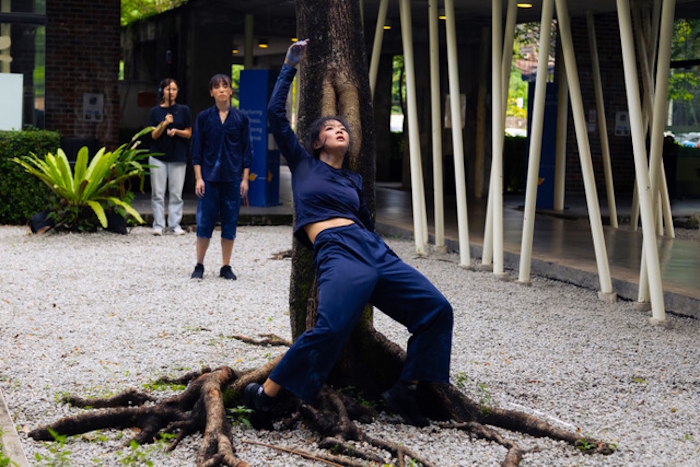
From where I sit, the dancers’ feet become impossible to ignore. Their toes spread, curl and grip the floor. Bodies remain low, their joints spiralling through movements that appear reptilian one moment and infant-like the next. Their strong, rough feet retain the freedom often seen in young children, before shoes and habit gradually reshape the toes.
(pictured at Geylang Park Connector, Singapore)
Photo Crispian Chan
The women’s fingers, stained blue by the lines they draw, touch their faces and necks, leaving colour across the skin. Sweat gradually washes some of it away. Later, as the dancers roll along the boundary, the powder transfers onto their costumes.
For almost half an hour, the dance unfolds inside the circle. Parts of the line disappear beneath skin, sweat and weight, while much of it remains visible. The boundary is altered rather than erased, although the work soon begins drawing others.
The dancers extend their hands to a few audience members seated onstage and lead them out of the theatre.
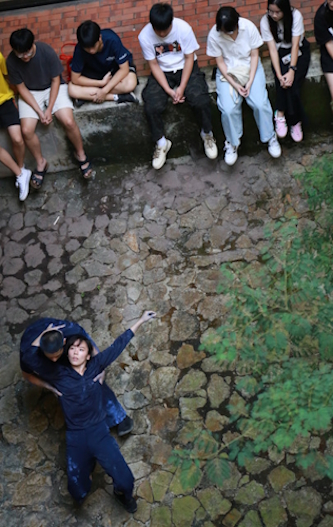
After a short walk, we arrive at the work’s second location, Holland Park School. Fiona Thng moves around a tree, folding herself towards it and responding to its shape with something close to reverence. From there, the audience is led through a series of spaces across the grounds.
(at Chinese High School, Batu Pahat, Malaysia)
Photo Jay Jen
Moving from the Coronet to Holland Park School makes clear how deeply the work depends on its location. Another theatre, landscape or route would inevitably produce a different Searching Blue. Here, The Coronet’s stage, the walk between venues and the school grounds become part of the choreography.
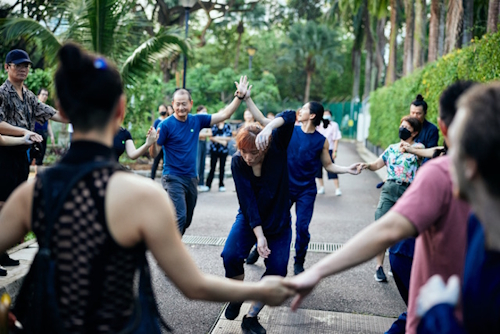
At one location, each dancer invites two audience members into a large circle. Holding hands, they guide the group through gentle rising and falling movements.
The audience becomes as interesting as the choreography. Many participants assume immediately that they are now performers, adding gestures and moving with confidence. One or two look uncertain and take longer to join. When the dancers release their hands and leave the participants connected to one another, the confident movers continue almost automatically. The hesitant ones become hesitant again.
The circle exposes different negotiations with participation: some begin performing at once, while others wait for instruction or reassurance.
The programme invokes Jill Bolte Taylor’s experience of losing the perceived boundary between herself and the surrounding world during a stroke, alongside the idea of the extended mind. Onstage, however, the boundaries prove more persistent.
The work does not dissolve boundaries so much as redistribute them. The blue circle separates dancers from audience, then becomes partially blurred beneath their bodies. Outside, selection creates a new division. The dancers decide whom to approach, whose hand to take and who becomes part of the next action. Participation draws some people into a closer relationship with the performers while making the distance of everyone else more apparent.
I move between several reactions. Why have they not chosen me? What will I do if someone does? Perhaps I would rather stay where I am. Nearby, someone admits that they do not want to be selected at all.
Eventually, a dancer takes my hand and leads me through part of a transition. Yet physical contact does not amount to structural inclusion. Once the brief exchange ends, I return to where I was before, watching decisions made by the performers.
Several selected audience members appear to know the dancers already, making the division more visible. The performers blur the line on the floor, then begin drawing new lines through human relationships. The power to determine who comes closer remains firmly in their hands.
The large communal circle feels like the work’s clearest emotional and structural point. Those inside rise and fall together, responding to a shared physical impulse. For them, the distinction between performing and watching loosens. The rest of us remain observers.
In later group dances, shared breath, weight and rhythmic expansion carry echoes of tai chi and martial arts. Against the trees and open ground, the movement acquires a ceremonial quality. Each location changes the work’s visual and atmospheric character, although the participatory structure remains largely unchanged. The dancers continue to choose, lead and release, while the audience responds within terms they control.
By then, the work has already exhausted its strongest participatory device. Further transitions relocate the action without developing the relationships within it.
In the final outdoor space, Thng folds herself into the grass during a solo. She reaches towards Klievert Jon Mendoza. He hesitates, glances towards the others and runs away. Her companions leave too. She looks towards the audience, then follows them. The musician remains alone to complete the performance.
The ending disperses the dancers and returns the audience fully to watching. It feels less like a development of the communal experience than an abandonment of it.
Earlier, as we prepare to leave the stage, I notice blue powder on the soles of my white socks. I look down and trace through what remains with my toes.
The dancers begin by drawing the circle with their hands.
Before I leave, I draw through it with my own feet.