Theaterhaus, Stuttgart
July 3, 2026
Can abstract concepts like luck and unluck be translated into physical expression? Eric Gauthier, director of Gauthier Dance, is convinced that it is possible, so commissioned two of his three artists in residence, Hofesh Shechter (since 2021) and Aszure Barton (since 2025) to each create a work embodying one of the two. Would I have guessed that that was the theme of the two works, had I not read the programme? No. Would I have guessed that the first piece embodied unluck, the second luck? No. But it did not matter, because the company’s sixteen dancers were fabulous and mesmerising, and sucked us into two strange worlds almost devoid of references to reality, but full of emotions, and surprisingly not all too different.
Shechter opens the evening. Having chosen unluck as his theme, his piece for eleven dancers is titled Any Way the Wind Blows. Perhaps a reference to the fact that you cannot control everything that happens in your life.
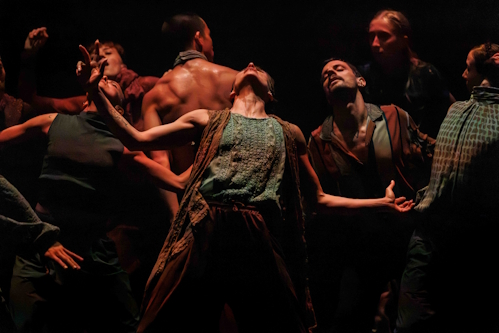
Photo Jeanette Bak
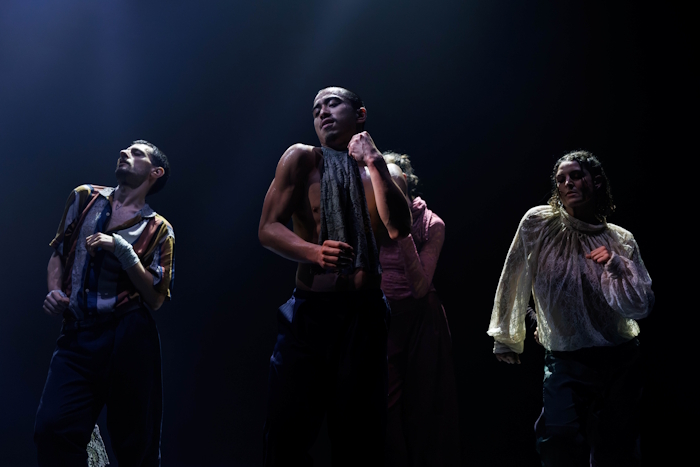
It opens with four dancers looking at seven moving around. Soon they mingle in every thinkable constellation, filling the stage, Shechter‘s soft undulating movement sometimes interrupted by jagged actions, as if chopping the air. At times the dancers reach for the sky, at times they fold onto the floor and rise again. It was as if there were no bones in their bodies.
They looked like atoms bumping into each other, never able to find their right place in the chain. Occasionally they come together in unison, only to veer off into their own space. Their dance is mixed with expressions of grief, lamentation or anger, they beat their hands on their hearts, fold their hands or raise their arms as if in prayer, bring a hand to the forehead, hammer fists into the air. At the end they seemed like in a trance, or perhaps it was the other way round, they made me feel like I was in a trance.
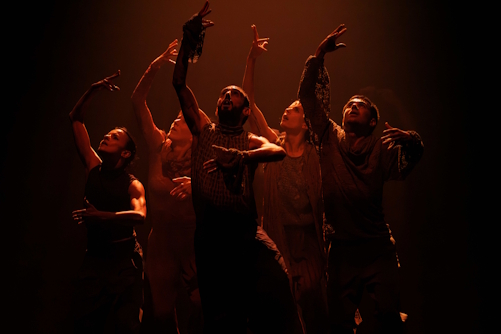
Photo Jeanette Bak
That the performers are a group of individuals is underscored by the fact that they all wear different street-like clothes, the costume designs also by Shechter. The music too was created by him, a mix of hard, hammering beats, classical-like tunes and passages with a celestial flair. It is evocative, creates different kinds of ambience throughout the piece and leaves plenty of room for associations.
Created for the whole company, Barton simply called her piece, Luck. She defies every cliché connected to the concept. The music by eight up-and-coming DJs, five females and three males, for long stretches sounds like rough, drumming beats overlayed by a distorted childish, female voice. The sixteen dancers are clad in school uniform-like costumes of black pleated skirts and shirts.
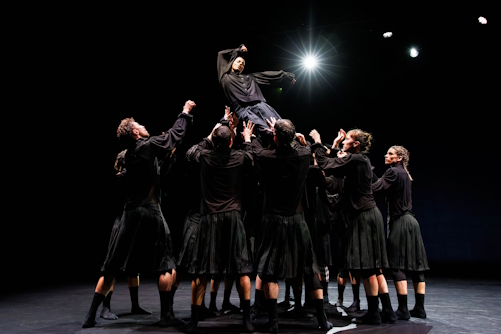
Photo Jeanette Bak
All the movement derives from an expression of joy, often initiated by one person and then elaborated on by the group. They throw their arms to the sides or up in the air, fists are raised, chests slapped. In a moment of exuberant joy, the group throw a woman into the air repeatedly, in every thinkable way. The dancers meander in and out, perform in solos, duets and groups, Barton’s choreography flowing and including many pliés in first position.
Early in the piece a machinegun-like sound splits the air causing some of the dancers to literally fall off the stage into the pit as the rest vanish into the wings. A lonely man is left, for a short moment enjoying his luck, then the stage fills again. A very intense and intimate scene sees a woman cling to a man, her legs around his waist. He walks diagonally downstage with her, sometimes bending in plié. It looked as if they were having sex. It was explicit and almost cartoon-like, an instant without a before or after.
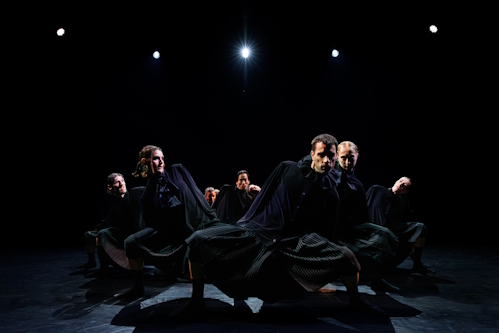
Photo Jeanette Bak
Any Way the Wind Blows and Luck are astonishingly similar in many ways: dark stages in which the dancers move in round or square spots of light, flowing movement mixing many styles. So are the expressions of luck and unluck: raised fists, a hand touching the face or slapping the heart. Both works also suggest that luck and unluck are rarely expressed as individual feelings or happenings in a relationship, but are mostly related to the group; sometimes even turned into a ritual-like expression.
Throughout the evening, the dancers made the emotions spill off the stage and hit our hearts. The only unlucky ones, as Eric Gauthier said in his introductory speech before the curtain rose, are those who miss out on the performance.
Gauthier seems to be on a streak of luck, although perhaps there’s something in the saying that you make your own. He certainly works hard. His company, Gauthier Dance, has struck up a strong relationship with the Orsolina28 Art Foundation in Moncalvo, Italy, which invites internationally renowned choreographers and dance companies for residencies dedicated to creation and artistic research. Luck/Unluck was developed during a second residency there. And on July 17, he will be awarded the Bürgermedallie der Landeshauptstadt Stuttgart, an award given to people who have done extraordinary things for the Stuttgart community.