Linbury Theatre, Royal Ballet & Opera, London
June 30, 2026
In line with other Next Generation presentations the combination of English National Ballet School and John Cranko School in Stuttgart was a mixed bill of dancers and choreographers, this time with outstanding works bookending the programme.
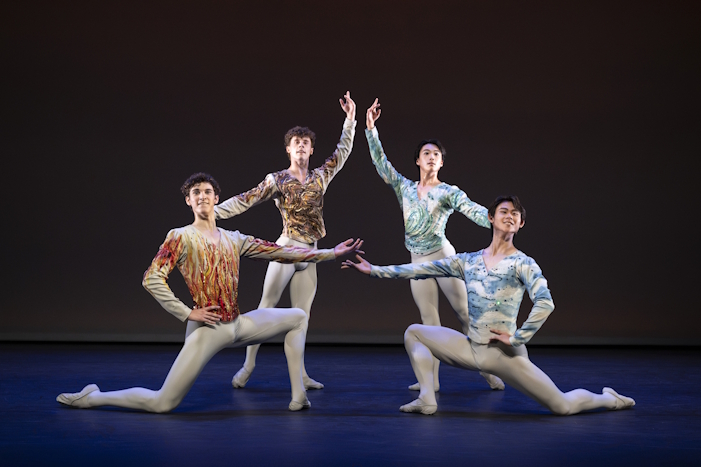
Variations for Four (1957) choreographed by Anton Dolin opened the show in dramatic fashion as four robed figures, Cameron Cinnamond-Bland, Kenshin Kimura, Keisuke Miyazaki and Simon Tischler from the Cranko School take to the stage, drop their cloaks and reveal classical attire. It’s a beautifully crafted show piece with a purity similar to Bournonville’s class variations and also a challenging work of the highest level. But if you have the technique, as these four had, then it’s a winning number. Particularly noticeable was the excellent control into soft landings amongst the dazzling display of virtuosity. The work covers the full ballet vocabulary; adage, pirouettes, tours, batterie, petit allegro and grand allegro and all executed with great aplomb and obvious enjoyment.
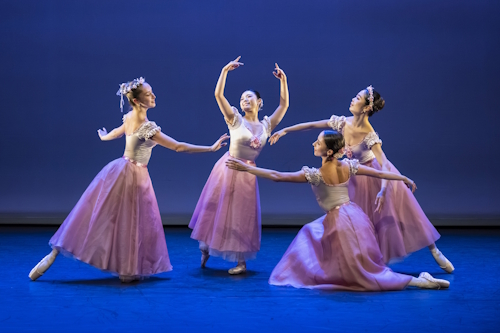
(pictured: Annabel Foster, Hana Toyama, Mei Abe, Lyla Ireland)
Photo Foteini Christofilopoulou
Anton Dolin was also the man who founded London’s Festival Ballet in 1950 so it was fitting that his reconstruction of Jules Perrot’s nineteenth century divertissement for four ballerinas, Pas de Quatre should be performed by English National Ballet School. Annabel Foster, Hana Toyama, Mei Abe and Lyla Ireland did the honours, but it certainly doesn’t offer the opportunities that the male variations did. It was performed with charm and neat pointework, although the Linbury stage always seems to amplify the sound of pointe shoes. I felt structured bodices rather than lycra tops would have helped to give authenticity to the style.
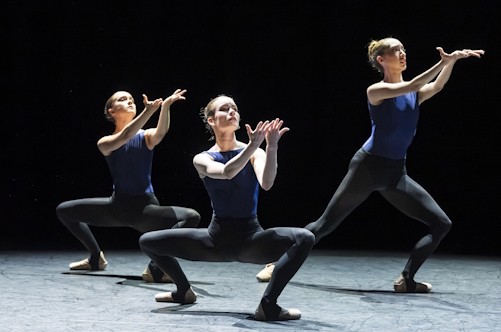
in Fleeting by Bridget Breiner
Photo Foteini Christofilopoulou
The female dancers from ENBS did however get something very special in Bridget Breiner’s beautiful work, Fleeting. Set to Anton Rubenstein music and Mirza Shafl’s text sung by Boris Shtokolov, it’s a melancholic ballet that takes us to quite another world. Choreographed in neo-classical style it was performed with strength and maturity by Elizabeth Schemel, Katie Betz and Viviana Guemez.
Demis Volpi’s Winter to Vivaldi’s music, also for ENBS gave the opportunity to see three male/female duets and a solid quality of partnering. The dynamics moved from the harshness of a frozen landscape to the softening that comes with spring in Volpi’s innovative choreography.
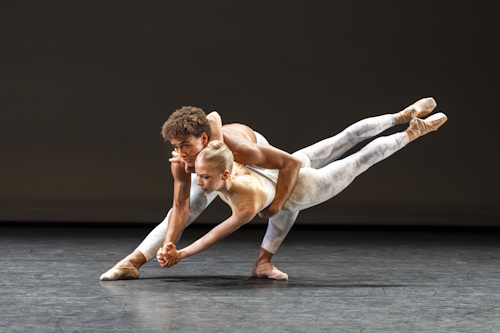
in Demis Volpi’s Winter
Photo Foteini Christofilopoulou
Two impressive and interesting solos came from the Cranko School. When Light and Dark Meet, choreographed by Jordan Pellitari to Handel’s music had a striking costume dominated by long scarlet gloves which gave definition to the bold expansive moves, in a confident performance by Macie Miersch.
At Last choreographed by Xenia Wiest to music by Etta James delved deep into emotions of loss and rediscovering hope. Wiktoria Kielbasinska expressed the extremes in powerful, at times, acrobatic moves and floor work in another strong modern work.
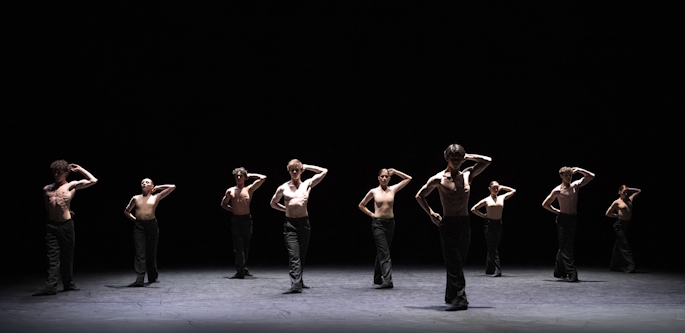
Photo Foteini Christofilopoulou
The highlight of the evening was All Long Dem Day from Marco Goecke by students from the Cranko School. We see far too little of Goecke’s work in the UK. It has extraordinary dynamics and, in this work, his level of intensity is perfectly matched to Nina Simone’s fierce delivery. As the song builds to a climax the dancers’ arms move at a speed where they become a blur and the frenetic movement shares the anguish in Simone’s voice.
The dancers were magnificent giving their all in a fully professional showing. It was particularly impressive to see the young men who had danced with such classical purity now offering the same level of performance in a totally different style. These were dancers, both male and female, ready for the profession.
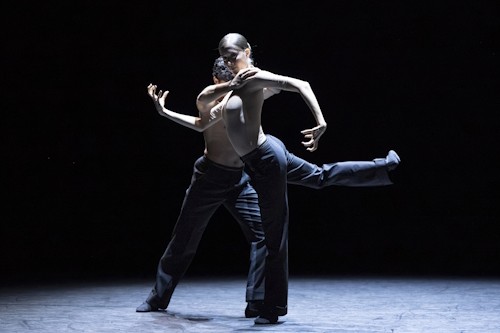
Photo Foteini Christofilopoulou.