
Curve, Leicester
July 3, 2026
Twenty-five, now almost twenty-six years ago, two talented young dancers at The Royal Ballet had an idea. The Royal Opera House was about to close for two years for renovation and refurbishment. Given that a dancer’s time on stage is short enough anyway, why not start a company. Combining their two middle names, Michael Nunn and William Trevitt founded George Piper Dances, which later became the BalletBoyz, a title used by Channel 4 for a documentary film they had made about Covent Garden and the turmoil in the company at the time.
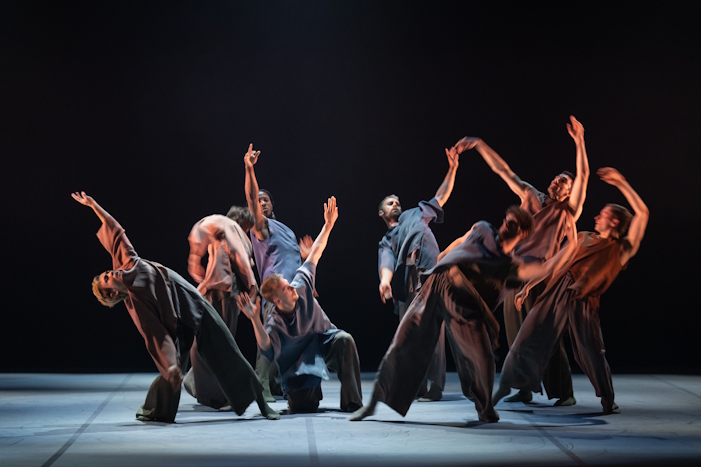
Still Pointless opens with documentary footage of the lead up to their first programme, Pointless, at Camden’s Roundhouse. Nunn and Trevitt speak as if they are not taking things too seriously, although I’m sure that underneath things were rather different. Finances were tricky but that debut performance and what followed was successful. Things really took off when the ensemble became an all-male company. All-male companies or works are now not the unusual occurrence they once were, but twenty-five years on from that first show, the BalletBoyz are still going great guns, commissioning and presenting high-quality work.
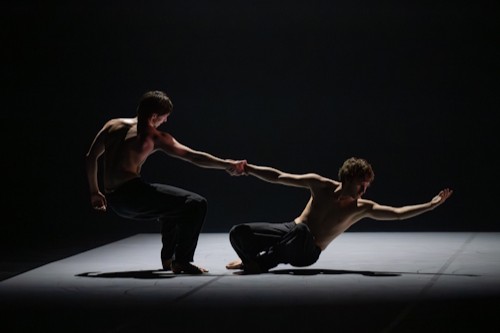
Photo Amber Hunt
Short films between works have become something of a BalletBoyz trademark. Those in Still Pointless offer casual asides from choreographers and glimpses of rehearsals and stages. They’re all long enough to do their job, short enough to hold the interest from start to finish. And when it comes to the dance, it is quite simply terrific, whatever style or movement vocabulary the choreographer demands.
Retrospective programmes tend to be heavy on duets and solos, but while individuals do get their moments in the spotlight, Still Pointless emphasises the ensemble. The one exception to that is exceptional and turns out to be the highlight of the show. Christopher Wheeldon’s Us, the penultimate piece of the evening, danced to music by Keaton Henson, is a moving duet about a relationship, seen both through emotions and physicality. Dylan Jones and Paris Fitzpatrick were strong but tender, deeply expressive but restrained.
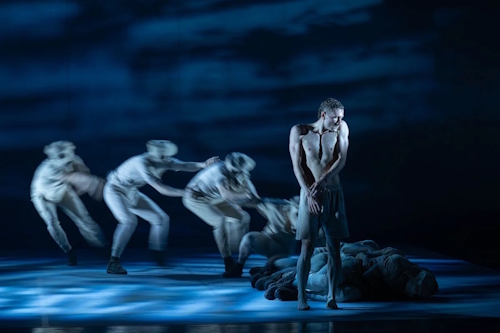
Photo Amber Hunt
Talking ‘expressive’, Benji Knapper gave a startlingly potent portrayal of a victim of shell-shock in Iván Pérez’ Young Men, which closed Act 1. Conceived originally a BBC feature-length dance film to mark the centenary of World War 1, its stage dance version loses none of its punch. Knapper moved with an almost brutal energy as he was assaulted psychologically by his experiences in the trenches. The supporting cast were excellent to, their choreography demonstrating support and care for each other while also suggesting weariness of never-ending conflict.
Also in the first half, and in very different vein, Ripple is classic Xie Xin (谢欣), drawing as it does on the Chinese choreographer’s trademark movement vocabulary that reflects the movement of a body of water. Right from the opening compelling solo by Seirian Griffiths, danced as JJ James stands intriguingly upstage with his back to him, the dance has a lovely continuous flow. One gorgeous moment sees an attitude turn shift seamlessly into a roll on the floor, a move even more impressive when it is reversed later. The softness is occasionally interrupted by more dramatic moments, though, as if waves are crashing against rocks. Jiang Shaofeng’s score, a mix of traditional Chinese instrumentation and electronica fits everything perfectly.
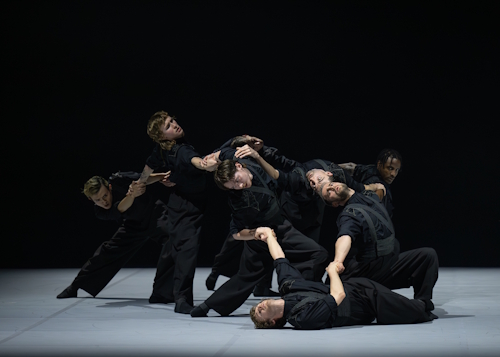
Photo Amber Hunt
Still Pointless opens with Motor Cortex by company dancer Griffiths. The black shirts and trousers worn give the piece a vaguely militaristic air, although what really sticks in the memory is the clever use of lighting to make dancers appear and disappear.
Another highly physical, tense piece comes in the shape of Russell Maliphant’s Fallen. It’s full of fluid transitions into formations and easy-looking supports and lifts, things there are lots of through the evening. The choreographer and his long-time collaborator, lighting designer Michael Hulls, are known for the way they make lighting become part of the choreography. Nunn and Trevitt make no secret of the influence Maliphant has had on the company, so perhaps it’s no surprise that the lighting in Still Pointless is never simply illumination but rather always adds perfectly to the atmosphere.
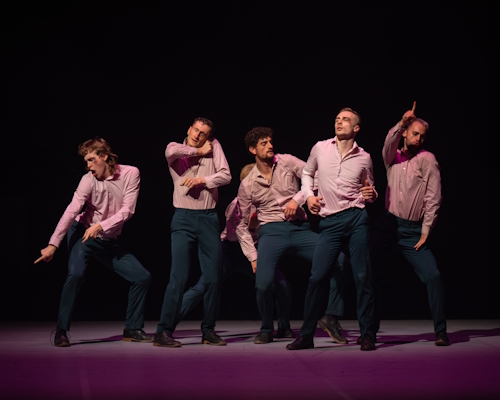
Photo Amber Hunt
There’s more muscular grace in Liam Scarlett’s Serpent, which opened Act 2. Dressed only in nude leggings, bodies twist and turn, undulate and ripple, the beauty combining superbly with a hint of underlying tension. A long duet towards the end is quite sublime, before hands and arms briefly mimic the snake of the title. The dance, and Scarlett’s brief appearance talking to the camera, reminded one of just what a loss to British dance his too early death was.
Based on a poem by Kae Tempest and a conversation about how a more mature woman sees a group of men, Maxine Doyle’s Bradley 4:18 portrays them resorting to violence as they struggle to deal with their emotions. Quite raw, it didn’t connect with me at all, although I couldn’t help seeing a hint of Jerome Robbins, Leonard Bernstein and West Side Story in both the dance and music.
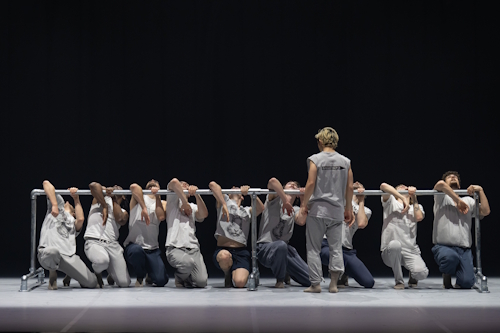
Photo Amber Hunt
Still Pointless closes with Javier de Frutos’ irreverent Fiction, whose imaginary scenario is that he dies before the premiere of his latest work. As Ismene Brown’s obituary is read by Imelda Staunton and Jim Carter, the words looping and repeating, the dance similarly rewinds from time to time. It’s all typical of the apparent chaotic, but in reality cleverly structured choreography that de Frutos does so well. Set around a ballet barre, on which the dancers swing and more, the mood is light and entertaining. Kai Tomioka stood out in particular.
Still Pointless? Anything but. In their introduction to the evening, Nunn and Trevitt talk about how they enjoy finding talent, and giving dancers and choreographers opportunities, then watching them develop. They already have quite a legacy. Long may they continue.