
Sadler’s Wells, London
May 25, 2026
South African choreographer Dada Masilo, who passed away in 2024, is known for her reinterpretations of Western European dance classics including Giselle, Swan Lake and The Rite of Spring. With Hamlet, attention shifts to one Shakespeare’s longest play, and one with a reputation for being difficult.
Masilo once said “I want people to understand the narrative without having to be told in words.” But while she may have cut down on the text, there is still a significant amount of speech. Hamlet is performed by both actor Aphiwe Dike and dancer Tumelo Lekana, each in black tie and tailcoat, the former voicing Shakespeare’s words and opening the piece with the famous ‘To be or not to be’ soliloquy. Stripped of its context, it seems an odd start although, given that some of follows happens before it in time, such as Hamlet meeting Ophelia, presumably Masilo is inviting the viewer to see at least some things in flashback.
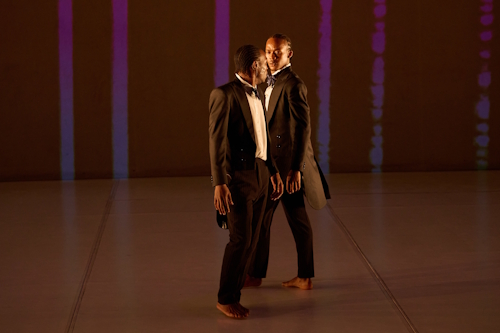
in Dada Masilo’s Hamlet
Photo Lauge Sorensen
Whatever, as Hamlet, Dike already seems agitated and it is little surprise when the character turns violent towards girlfriend and mother. But partly because he is already such a mess, the work doesn’t really show how he spirals downwards. In fact, he is not a particularly compelling figure, unlike Lehlohonolo Madise’s Ophelia, who most to the fore.
I also found the Dike very difficult to hear with any clarity. But Masilo feeling the need to use text perhaps just serves to highlight what a difficult play to translate into dance it is. And despite condensing and simplifying matters, some knowledge of the narrative is more than useful in understanding what is going on.
This Hamlet is set in urban South Africa, but while the movement music and costumes suggest that, projections of a castle seen through a fence are decidedly European. Those projections are all the set there is, and elsewhere include a Perpendicular-style religious building window, to depict the nunnery and shadow images of the old King Hamlet.
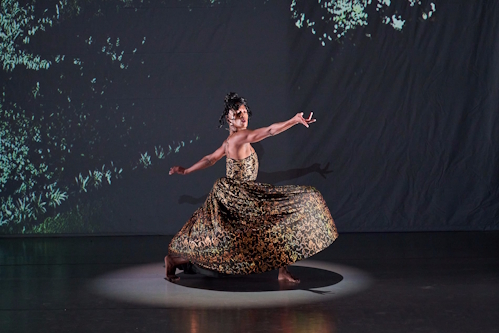
Photo Lauge Sorensen
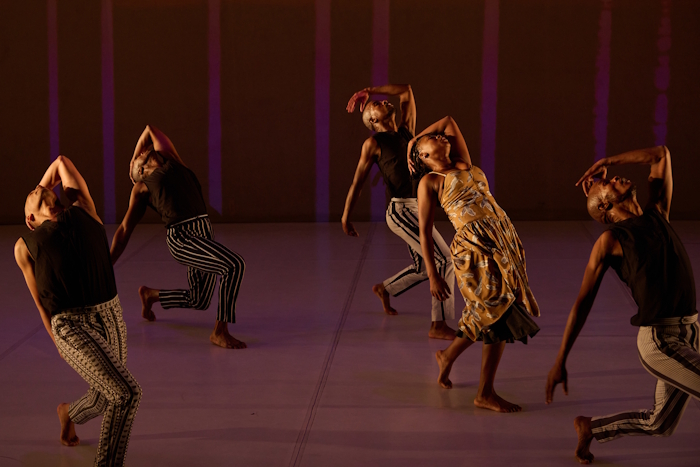
As always with Masilo’s choreography, the dance is a fusion of ballet and traditional South African forms. Limbs in particular move at lightning speed. Of most interest however is the way she incorporates courtly elements and a degree of elegance and formality into some of the ensemble numbers.
The work is led by long-time collaborator Llewellyn Mnguni, who also restaged it, and who performs Gertrude, a regal and commanding presence in a golden gown that contrasts sharply with everything else we see. Alongside her, most of the rest of the cast are from Joburg Ballet and Dance Factory.
Like the choreography, the music is a fusion of classical influences and African rhythms. Created by Thuthuka Sibisi and collaborators Ann Masina, Leroy Mapholo and Mpho Mothiba, it has an acoustic, percussive feel that certainly drives the action ever forward.
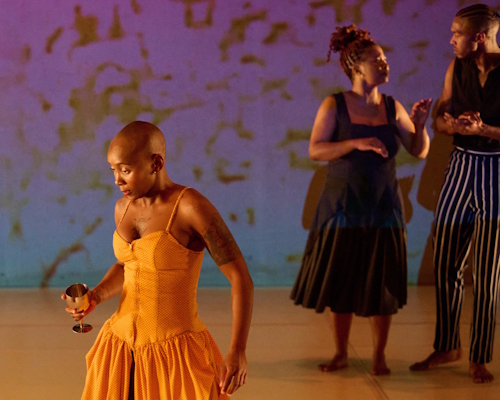
Photo Lauge Sorensen
Masilo condenses the play down into the important moments and takes some liberties with Shakespeare’s narrative. Hamlet meets Ophelia at a ball, for example, the couple stealing little moments in the manner of Romeo and Juliet. Full of thrusting movement, the meeting is not obviously romantic, however.
A new scene shows Gertrude’s despair upon receiving news of the late King Hamlet’s death. Hamlet meanwhile learns of his father’s murder through the ingenious device of a sequence of projected silhouettes. Both repulsed by and drawn to the images, Lekana’s dance is a whirlwind of movement that captures his dilemma.
Among other well-known scenes depicted are Gertrude being wooed by Claudius; Hamlet’s “Get thee to a nunnery” confrontation with Ophelia; Claudius’ chapel confession, a dance that shows him seriously racked with guilt; and the striking down of all by collective sickness in the climax.
Hardest hitting is Ophelia’s descent into madness, however, which sets in after Hamlet murders Polonius. Madise simmered beautifully before boiling over in a tremendously expressive solo that references moments from the dances that have gone before. Walking slowly across the stage, clutching flowers, which she later drops (I couldn’t help but see Albrecht in Giselle), she seems taken over by a force she cannot stop, her body convulsing as it is engulfed by manic movement and laughter. It is the work’s best moment by some distance.
But did I feel for her? Indeed, did I feel for any of the characters. The answer is, not really. While an interesting production, this is a Hamlet that only very occasionally gets close to the depth of the original. It simply did not connect, despite the best efforts of the cast, who gave their all. Some of the scenes are hard-hitting, but as a whole, it is a retelling that too often misses its mark.