
Linbury Theatre, Royal Ballet & Opera, London
July 4, 2026
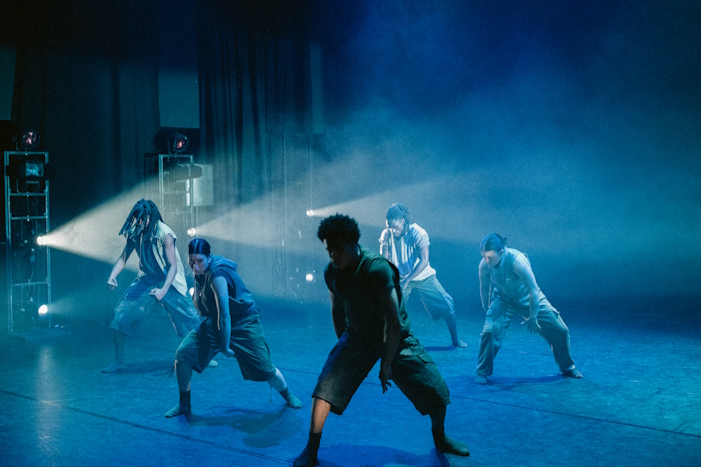
The Just Us Dance Theatre Apprenticeship Company’s A Night of Hip Hop Theatre marked the culmination of a 12-week apprenticeship for five young dancers: Tyler Archer, Emmanuel Isingoma, Melissa Mason, Dejohn McTernan and Rebecca Winter. Following a short tour, the two performances at the Linbury Theatre felt very much like a final sharing; a chance for the dancers to bring together what they had learned and to test it on a notably unforgiving stage.
Before the main programme came M.A.S.H, billed as a curtain-raiser and performed by a group of young dancers from the Ergonomikz Dance Group. Choreographed by Bismarck Anobah and the cast, it was short, energetic and technically accomplished. There was no obvious narrative thread, but that hardly mattered. The dancers were engaged, lively and clearly enjoying the opportunity to perform. It did what a curtain-raiser should do: opened the evening with commitment, confidence and just enough appetite for what was to follow.
The main programme comprised three live works, Between, It’s Us, Not I and Clash, interspersed with two very short films. The latter were less successful. Perspective was over almost before it had begun and made little impact. The Journey, in which some of the apprentices reflected on their 12 weeks, had more reason to be there, but needed to be fuller. Had all five dancers been heard from, and had there been a little more detail about their development and involvement in the making of the work, it might have added useful context. As it stood, both films felt underdeveloped.
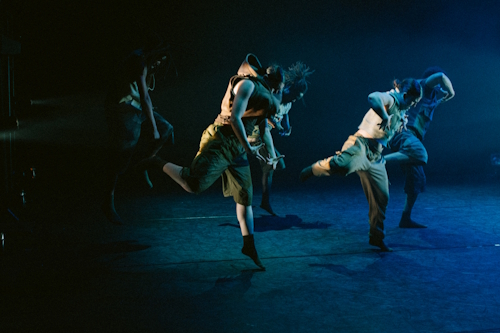
Photo Harrison (Danteslens)
The dancing itself was another matter. Across the three works, the five performers showed strong technical ability, energy and stage presence. They filled the Linbury with ease, not through scale of numbers or theatrical effects, but through concentration and sheer enjoyment in performance. All had clear individual strengths. One dancer brought a fluid, sweeping quality, with deep backbends and a legato use of the upper body. Another was especially at home in floor work, rolls and jumps that began from or collapsed back into the ground. Another had a particular command of detailed arm and hand gestures. Each had a distinct physical signature.
That individuality was both the evening’s strength and, occasionally, its limitation. Hip hop theatre has its own power, but across a full programme its vocabulary can begin to feel narrow. Repetition is, of course, part of the form: rhythm, insistence and return are central to its impact. But there is another sort of repetition too, one that comes from drawing repeatedly on the same pool of movement. By the second piece, and certainly by the third, one became increasingly aware of solos returning to similar shapes, emphases and personal specialisms.
The dancers who appeared to have broader training were able to widen the physical language, bringing in echoes of other dance forms and giving their movement a larger range. Those whose training seemed more concentrated within hip hop occasionally became more repetitive. Even so, there was no doubting their commitment, nor the seriousness with which they inhabited the work.
Clash, choreographed by Joseph Toonga and Kenrick ‘H2O’ Sandy, was the most theatrically developed of the three pieces and the strongest in its dramatic intention. Exploring the collision between internal and external battles, it allowed the dancers to shift between antagonism, isolation, connection and renewed friendship. At its best, those changing relationships were clear and genuinely felt. The audience could sense the tension between the performers, and then the softening as they found their way back towards one another.
Coming last after Chandenie Gobardhan and Shawn Aimey’s Between and It’s Us!! Not ‘i’ by Toonga, it was also the longest work, which made its demands very visible, however. In the middle section, the dancers looked tired, the energy dipped, and things became a little ragged. Whether a brief clearing of the stage by most of the cast was choreographed or practical was hard to tell, but the work lost focus for a while. To their credit, they recovered. The final section found renewed energy and purpose, and the ending had the lift and drive the piece needed.
Musically, the evening was less varied. The scores and tracks generally served the choreography well, and the dancers were finely attuned to them. But while dance and music fitted together closely throughout, there was a sameness in soundworld across the programme. Clash, with an original score by Michael ‘Mikey J’ Asante MBE, stood out most clearly, not least because its music had a sharper theatrical identity.
The staging was simple: everyday clothes, no scenery, and lighting that did much of the atmospheric work. Whoever designed and operated it was unnamed but deserves credit. It shaped the space, gave texture to the pieces and, importantly, allowed the dancers to be properly seen. In Clash especially, it added considerably to the mood.
As a whole, A Night of Hip Hop Theatre was a little patchy, but also engaging, generous and impressive. The films could usefully be reconsidered, and the programme would benefit from greater variety in choreographic texture. Yet the evening succeeded where it mattered most: in showing five young dancers of considerable promise taking ownership of a stage, of a form, and of their next steps. It will be interesting to see where each of them goes from here.