
Royal Ballet & Opera, London
May 23, 2026
Frederick Ashton’s La Fille mal gardée opens with a dancing cockerel and ends with Alain chasing after his beloved umbrella. That tells you quite a lot about the kind of evening it is. This is a ballet that is never embarrassed by its own silliness. In fact, it depends on it. Yet for all the comic business, the chickens, the clog dance and the runaway umbrella, it is also one of the most carefully made works in The Royal Ballet’s repertory.
The story itself is simple. Lise loves Colas but her mother, Widow Simone, wants her to marry the wealthy but hopelessly unsuitable Alain. Everyone has to pass through a good deal of plotting, hiding and comic misunderstanding before love wins. The ballet goes back to Jean Dauberval’s eighteenth-century French original, but Ashton’s 1960 version feels very much part of The Royal Ballet’s own identity. It turns the story into an affectionate fantasy of English rural life: sunny, innocent, orderly, and just absurd enough to keep it from becoming sentimental.
What makes the ballet so pleasurable is that Ashton’s comedy is choreographed, not merely acted. His style is everywhere: the quick, neat footwork, the pliant upper body, the soft but precise épaulement, and the way a head tilt or a tiny delay can land a joke as clearly as a line of dialogue. The humour rarely feels pasted on. It comes from rhythm, from musical timing, from the custom and from the way a character moves before they even appear to be doing anything funny.
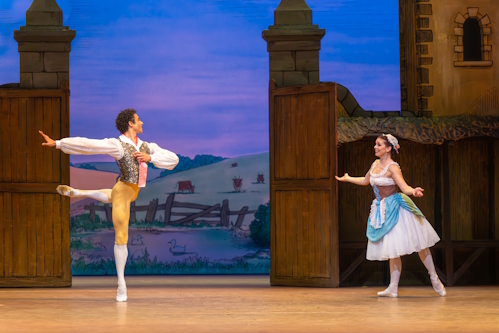
Photo Mihaela Bodlovic
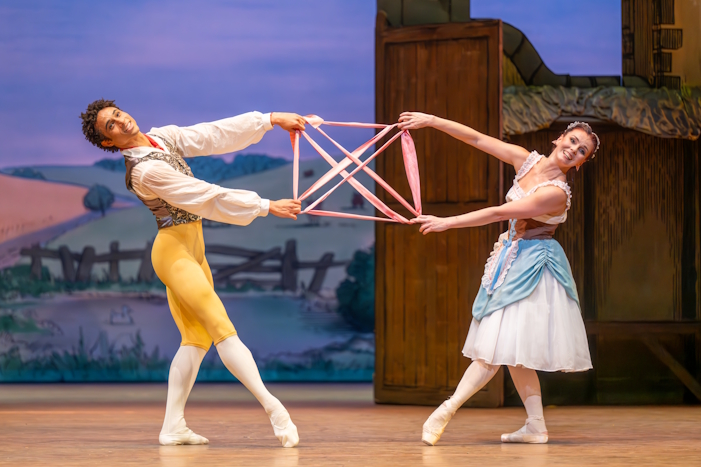
Natalia Osipova’s Lise brought plenty of spirit to the centre of the evening. She was not a sweet village girl waiting to be rescued, but a young woman who knows exactly what she wants and is already planning how to get it. Osipova gave her a lively impatience and a sharp sense of mischief. There was a dramatic vividness to the way she used her face and upper body. She made rebellion feel personal rather than merely pretty.
Patricio Revé’s Colas was also of particular interest. Trained in the famously athletic and virtuosic Cuban tradition, he was previously a principal with Cuban National Ballet before moving to Queensland Ballet, where he broadened his repertory and adapted to a wider range of choreographic styles. Now preparing to join The Royal Ballet as a principal, his Ashton debut carried a certain curiosity: how would a dancer formed by such a different school respond to a style built on musical ease, soft upper body, intricate footwork and understated English charm?
On the whole, Revé answered that question with warmth and generosity. His jumps were easy, his line elegant, and his partnering of Osipova attentive. Some of the finer Ashton details may still deepen with time, but his Colas already had the open-hearted sincerity the role needs.
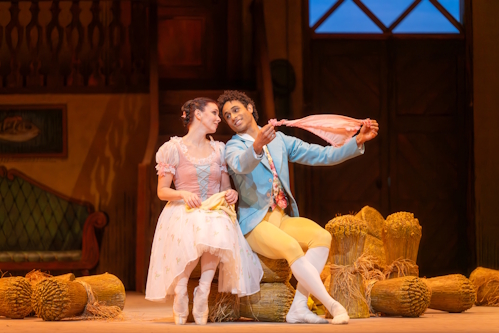
Photo Mihaela Bodlovic
The ribbon pas de deux remains one of the ballet’s loveliest inventions. The ribbons could easily be a charming prop and nothing more. In Ashton’s hands, they become a way of showing the relationship itself. Lise and Colas pull away, return, circle, bind and release. Courtship becomes visible as pattern. It is light, but it is not casual; the delicacy of the structure is part of why the scene still works so well.
But the performance really belonged to the comic characters. Bennet Gartside’s Widow Simone was a delight. It was a big, theatrical performance, full of suspicious looks, sudden indignation and maternal bossiness, but it never felt empty. Widow Simone is ridiculous, of course, yet Gartside kept her recognisably human. She is controlling, fussy and often absurd, but she also loves her daughter. That balance is what keeps the role from becoming only a pantomime turn, even though the English pantomime tradition is clearly part of its appeal.
The clog dance was one of the evening’s best moments. Gartside made the footwear part of Widow Simone’s personality. The rhythm of the feet, the proud little displays, the pauses before a reaction, the sense that Simone is enjoying her own authority far too much, all of it was sharply judged. It was exactly the kind of humour Ashton does so well: broad enough to make the whole house laugh, but precise enough to remain dancing.
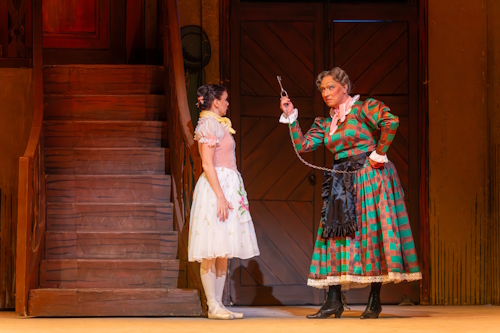
Photo Mihaela Bodlovic
Taisuke Nakao’s Alain was not merely the “simple son of a rich neighbouring landowner,” but one of the evening’s most effective comic presences. With his awkward body, innocent expression and obsessive attachment to his umbrella, he became funny without ever seeming cruelly mocked. Nakao allowed Alain to be ridiculous, but also oddly endearing. He was the unsuitable suitor, certainly, but also a small comic world of his own. In his scenes with Widow Simone, the ballet’s English humour came through most clearly: broad, exaggerated and immediately readable, yet shaped with enough warmth that the audience laughed with pleasure rather than contempt.
That, perhaps, is the real charm of La Fille mal gardée. For a couple of hours, it lets the audience forget their troubles. There is no darkness to push through, no heavy psychological concept to decode. Instead, there is a world where a mother can be defeated by young love, where a boy can be happier with an umbrella than with a bride, and where the whole village seems to dance because it has nothing better, or more necessary, to do. In the wrong hands, that could feel thin. Here, it felt refreshing.
The opening cockerel and hens set the tone beautifully. A dancing chicken might sound like a joke that has gone too far before the ballet has even begun, but the sequence was sharp, bright and very funny. It immediately told us what sort of world we were entering: one where animal behaviour, village life and classical form can all sit together without embarrassment. The group dancing in the harvest scenes added to that sense of communal cheerfulness, giving the ballet its easy pastoral glow.
Osbert Lancaster’s designs continue to do a great deal of the work in creating that glow. The farmyard, fields and interiors are not realistic countryside so much as a cheerful memory of it: colourful, ordered and warmly comic. One detail, though, slightly changes the texture of the stage world. The pony is now animatronic rather than live, which is completely understandable given current concern for animal welfare. Still, a real pony once brought a little unpredictability and immediacy to the scene. The present version does what it needs to do, but it cannot quite replace that sudden sense of real life entering the theatre.
John Lanchbery’s arrangement of Ferdinand Hérold’s score supports all this with buoyancy and charm. It gives the dancers space for both the broad comic episodes and the more lyrical moments, and Ashton’s choreography seems to listen to it at every turn. In this ballet, even the jokes are musical.
More than anything, La Fille mal gardée is a masterclass in how to build humour through movement. Widow Simone’s suspicion, Alain’s awkwardness, Lise’s impatience, Colas’s sincerity, even the cockerel’s strutting confidence, all of them are written through the body.
By the end, when Lise and Colas are discovered together and Widow Simone finally gives in, the happiness feels earned. Then Alain runs after his umbrella, and the ballet gives us one last joke instead of a neat moral. No one is really punished. No one is humiliated for long. Even the rejected suitor gets to chase the thing he loves most.
At a time when much of the repertory leans towards darkness, concept or psychological weight, La Fille mal gardée feels almost radical in its cheerfulness. It begins with a dancing cockerel, ends with a boy chasing an umbrella, and sends the audience out smiling. Ashton makes that look easy. Of course, it is not.