
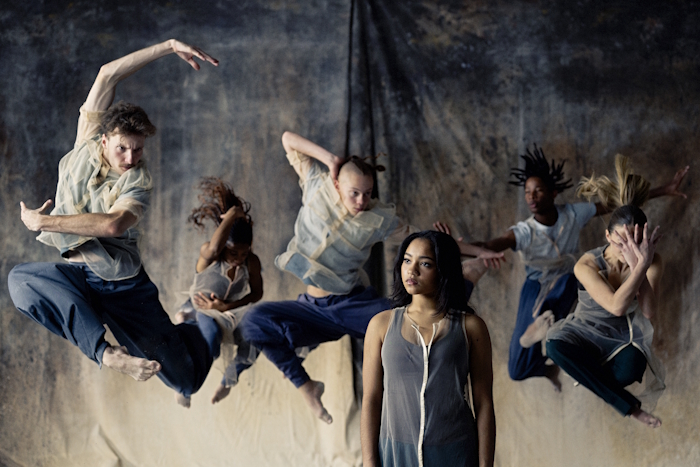
Sadler’s Wells, London
May 30, 2026
There are youth dance performances that impress because of their promise. Then there are those that impress because, quite simply, they are already working at a strikingly high level. Memory Keepers, created by Kristina and Sadé Alleyne with the National Youth Dance Company, belongs firmly in the latter category.
Memory Keepers is a wonderfully inventive piece of dance theatre, and one of the most creatively choreographed works I have seen in a long time. The Alleyne sisters’ choreographic imagination is exceptional: detailed, rhythmically alert, physically demanding and constantly alive. Over approximately seventy minutes, without an interval, they ask the dancers to use every part of the body, almost without pause. The result is not just energetic but intensely articulate.
Inspired by the dancers’ own memories and experiences, Memory Keepers explores how memories are held, shared, triggered and passed on. The idea could easily have become vague or sentimental. Instead, the choreography gives it shape. Memories arrive as flashes, pulses, fragments and accumulations. Sometimes they seem individual; sometimes communal. Sometimes they appear to be carried by one dancer, only to ripple through the whole group.
What is most remarkable is that the piece was created with the company’s 31 young dancers over only four intensive residencies, totalling just 28 days. The ensemble work is outstanding. When the full company moves together, the timing is astonishingly precise. Not once did the group appear loose or unfocused; even in the most complex sections, there was a shared pulse, a collective intelligence, and a real sense of dancers listening to one another through the body.
The choreography draws on a wide range of movement languages: West African and Caribbean influences, hip hop, kathak, contemporary dance and classical traces all appear within the texture. On paper, that sounds like too much. On stage, it works surprisingly and often magnificently well. Nothing feels bolted on. The styles are absorbed into a single choreographic language: athletic, fluid, percussive, grounded and lyrical by turns.
There are several images that linger. One recurring motif sees a single dancer seem to pull or activate the others, who hold different static positions before being set into motion. It might suggest a train, a chain of memory, a force passing through bodies, or something else entirely. Its strength lies in that openness. Elsewhere, still tableaux suddenly unlock into motion after a touch, brush or impulse from another dancer. Again and again, the choreography captures memory as something stored in the body, waiting to be released.
The inclusive casting is also handled with rare naturalness. One wheelchair-using dancer is fully part of the choreographic world, not presented as an exception to it. Her upper-body movement is fluid, expressive and beautifully integrated with the ensemble. In group sections, her phrasing chimed exactly with the dancers around her; in more focused moments, she held the eye with real presence. At times, one almost stopped registering the wheelchair at all, not because it was hidden, but because the dancing itself was so complete.
Giuliano Modarelli’s original score fits the work superbly. It does not merely accompany the movement; it sharpens it, deepens it and occasionally throws it into relief. His musical language, like the choreography drawing on wide cultural and rhythmic influences, sits well with the movement vocabulary. A passage of silence towards the end is startling, but absolutely right. It allows the choreography to breathe and briefly exposes the dancers’ bodies as the central instruments of the work.
Salvatore Scollo’s lighting is atmospheric and closely aligned with the choreography’s emotional landscape. The palette of greys, muted whites, shadowed blacks and low light creates a memory-like space: half-seen, shifting, at times deliberately indistinct. Occasionally, though, it could have been a little brighter. There were moments when dancers disappeared slightly into the gloom, and a small lift in intensity would have allowed the audience to read the movement more clearly without sacrificing the mood.
Ryan Dawson Laight’s costumes appear, at first glance, close to everyday wear: T-shirts, trousers and varied tops that look almost as if the dancers have walked in from the street. That simplicity is part of their effectiveness. The dancers look individual, comfortable and unforced. The costumes do not make a large visual statement, but nor do they need to. They support the work’s sense of lived experience without distracting from the choreography.
There is little in the way of conventional scenery, although projected and lit surfaces at the back of the stage help create atmosphere and texture. The production elements are restrained, but they gather around the choreography effectively. Music, lighting, costume and staging all serve the central idea: young people carrying, sharing and releasing their memories through movement.
Above all, Memory Keepers is a testament to what young dancers can achieve when given ambitious material and serious artistic trust. The physical discipline is impressive, but so is the maturity of performance. These dancers are not simply executing steps. They are sustaining a long-form work of real choreographic complexity, emotional range and stylistic variety.
For the National Youth Dance Company, Memory Keepers is a major achievement. For Kristina and Sadé Alleyne, it confirms again their ability to create work that is demanding, inclusive, rhythmically alive and deeply human. Memory Keepers is not just an excellent youth dance production. It is an excellent dance production, full stop.