Birmingham Hippodrome
June 19, 2026
Back in Sir Peter Wright’s days as artistic director, appealing triple bills were a regular feature of Birmingham Royal Ballet programming. But, over the years, they’ve been presented less and less, largely replaced by a diet of familiar full-length works. One a year is now the most that is seen. So, it was a huge welcome to this programme of masterpieces from the last century, an epithet it’s impossible to take issue with.
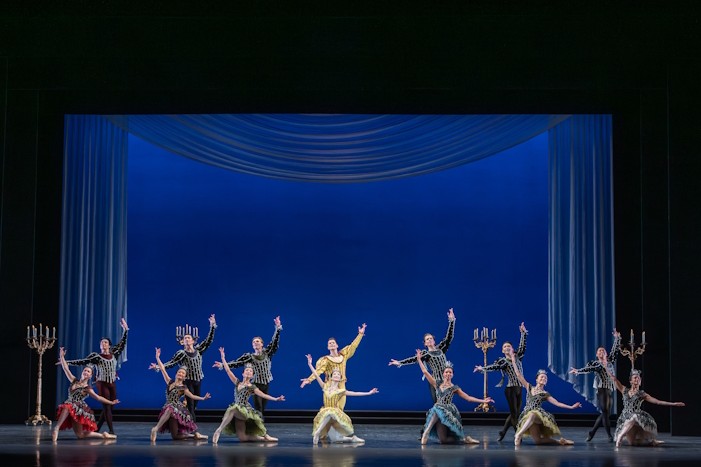
Sir Frederick Ashton’s Birthday Offering was created in 1956 to celebrate the 25th anniversary of the then Sadler’s Wells Ballet. Set to an arrangement of music by Alexander Glazunov, it’s a celebration of ballet, but especially of the ballerina, the work centred around its solos for six women, which range from wistfully dreamy to wickedly playful, and a pas de deux, here dance by Momoko Hirata and Mathias Dingman.
It is a glorious piece of choreography but some of it is also very fast and very fiddly. It’s technically very exacting and calls for a lot of precision. There were a couple of mis-steps, but it was sterlingly-well danced on the whole. Samara Downs, who will now take up a new role as repetiteur with the company, and Rosanna Ely, particularly stood out among the soloists. Downs is now taking up Yaoqian Shang and Lachlan Monaghan were transcendent in the pas de deux, Shang giving us some wonderfully sharp petit allegro.
For this revival, artistic director Carlos Acosta chose to return to André Levasseur’s costumes. They are certainly lavish, but overly so. Peter Farmer’s lighter creations, commissioned by Sir Peter Wright for the company’s 1995 revival, give the dance a much greater sense of freedom.
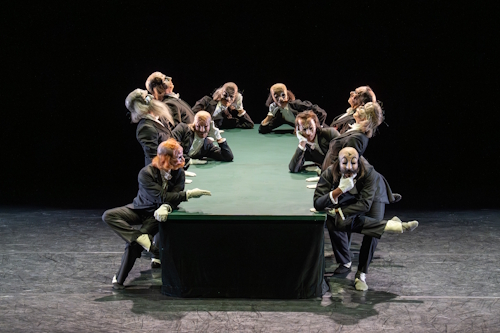
Photo Johan Persson
Unusually, Kurt Jooss’ The Green Table appeared in the middle of the bill. It’s only recently that the custodians of the work have allowed this, it previously being a strict condition that it was danced last, so sending the audience away with its themes in their minds.
As on the previous evening, it looked in great shape. Ryan Felix was commanding as the ever-present, hovering figure of Death, not actually doing any killing, humankind is quite capable enough of that on their own, just collecting the bodies one by one, sometimes with a considerable sense of compassion. Speaking of which, it is striking how sensitively Jooss treats the lead women in the piece. Here, Sofia Liñares as the Young Girl, Samara Downs as The Old Mother and Lucy Waine as The Woman, were all excellent. A super performance too from Tzu-Chao Chou as The Profiteer was the personification of the sleazy, greedy spiv, who derives pleasure and money from the misfortunes of others
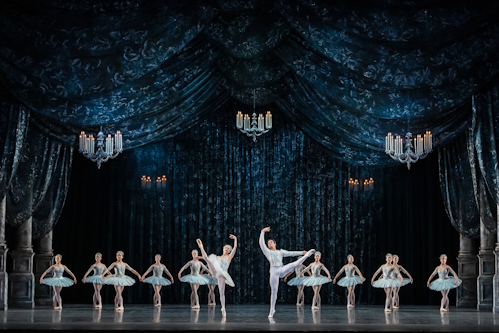
Photo Johan Persson
Closing the evening, George Balanchine’s uplifting Theme and Variations looked in fine shape. Set amidst Peter Farmer’s equally glorious set, it’s a celebration of Russian classicism albeit with the occasional Balanchine modern twist.
Beatrice Parma and Max Maslen sparkled as the lead couple. Indeed, Parma looked like she was having as much fun dancing it as we were watching it. She looked totally at home with the choreography, and was precise and sharp throughout. Maslen was equally excellent as her partner, showing some top-notch leaps and turns when his time came. The supporting four couples and corps were equally impressive, as were The Royal Ballet Sinfonia, conductor Paul Murphy taking the Tchaikovsky at a suitably cracking pace.