
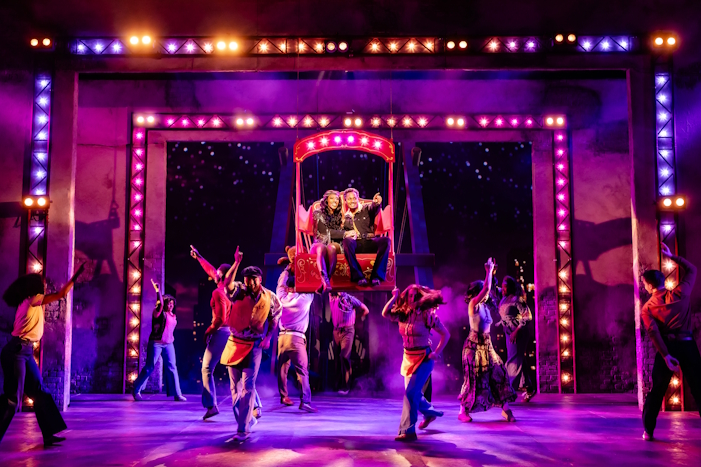
Troubadour Wembley Park, London
August 4, 2026
Before the performance had even begun, the evening acquired an unusual electricity. With the audience already seated, Chaka Khan entered the auditorium to a spontaneous standing ovation. Her presence charged the theatre, giving this account of her life an immediacy that no amount of theatrical invention could have manufactured.
I’m Every Woman is a roller-coaster journey through the artist’s life, incorporating many of her greatest hits alongside some less familiar material. Beginning with her childhood in a large and troubled family, the musical passes through her father’s departure, difficult personal relationships, motherhood, professional success, addiction and, eventually, reconciliation with her daughter, Milini.
At its centre is Alexandra Burke, playing Khan with formidable vocal assurance. Burke has an extraordinary voice of her own: rich, expansive and capable of moving effortlessly between delicacy and considerable power. Rather than offering a simple imitation, she meets Khan’s demanding catalogue with confidence, intelligence and tremendous technical skill. It is an outstanding performance that holds the production together even when the writing beneath it begins to falter.
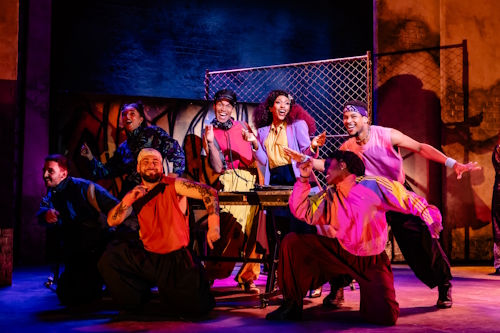
Photo Danny Kaan
Burke is supported by an unusually strong company. Several cast members are making their London debuts, but there is no discernible weak link. Those given solo opportunities possess eloquent, powerful voices, while the ensemble brings an infectious energy to the production.
There is frustrating little dance in the evening, however. But, when Ebony Clarke’s choreography is finally allowed to take command of the stage, it is exhilarating. The ensemble passages are exceptionally clean, sharp and unified. Dancers hit the half-beat with remarkable exactitude, combining precision with an energy that makes it almost impossible to look elsewhere.
Clarke draws on modern dance, jazz, hip-hop, street and popular movement genres without allowing things to become a collection of disconnected references. The styles are integrated into a coherent movement language that responds directly to the music. These sequences are among the strongest moments of the evening and demonstrate Clarke’s considerable choreographic imagination. Their brevity is therefore a genuine disappointment. A little more dancing and rather less dialogue would have strengthened the production enormously.
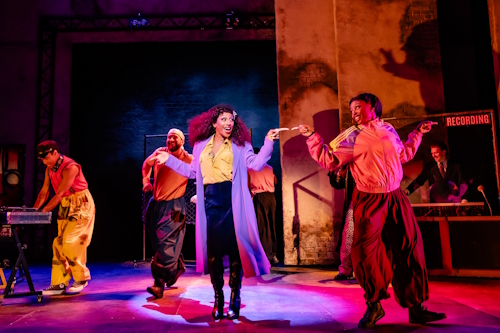
Photo Danny Kaan
The principal problem lies with director Nia T. Hill’s biography of Khan that features in the show. Although Khan’s life provides material of extraordinary dramatic potential, the script is frequently banal and, particularly during the second half, becomes self-congratulatory. It appears to want to communicate the fight, determination and sheer single-mindedness required for Chaka not only to reach the top of her profession, but to remain there. Yet it does not examine the cost of that determination with sufficient honesty or depth.
Chaka made choices that damaged her relationships with her mother and eldest daughter, and returned her to drug use despite understanding where that path might lead. These contradictions could have formed the dramatic heart of the musical. Instead, the darker periods are too often glossed over or converted into another stage on an ultimately triumphant journey.
The use of her alter-ego as a character in the play, while interesting, ultimately doesn’t work as, by the time the alter-ego personality is revealed, we have accepted the character as a bone-fide person, tenuously connected to Chaka and continuously giving bad advice. It’s one of those concepts that works well in a book, it is hard to translate to live theatre. The result is not that Khan appears admirably resilient, as the production presumably intends, but that some of her most consequential decisions seem insufficiently questioned.
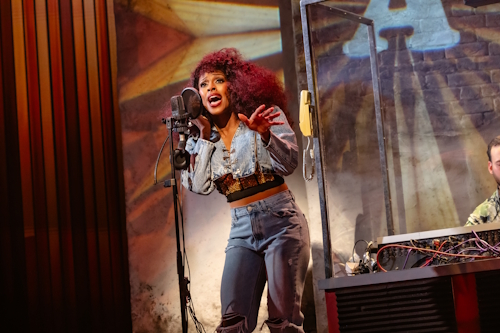
Photo Danny Kaan
It’s unfortunate because there is a fascinating story here about ambition, addiction, sacrifice and the particular pressures placed upon a successful Black woman in the music industry. The writing repeatedly approaches that story, but then retreats from its complexity.
It is greatly to the performers’ credit that they manage to preserve a sense of emotional reality. Burke and her fellow actors frequently find truth in scenes that the dialogue itself does not fully earn.
The production is far more successful visually. Sara Perks has created an impressive, fluid and highly adaptable set. Locations shift repeatedly, sometimes several times during a single song, yet these transitions seldom feel cumbersome or mechanically imposed. The design produces an almost immersive journey through Khan’s life and changing times without simply piling one visual effect on top of another.
Zoe Spurr’s lighting complements Perks’ work beautifully. Changes of tone, colour and focus support each new environment while helping the production move between public performance and private memory. Together, set and lighting contribute substantially to the show’s momentum, and its considerable feel-good appeal.
Natalie Pryce’s costume design also negotiates the musical’s long historical span effectively. The action covers approximately five decades, during which both everyday clothing and performance fashion changed dramatically. The costumes move convincingly through those periods without becoming either a parade of fashion history or a collection of visual anomalies.
Musically, I’m Every Woman is consistently impressive. Under musical director Aaron Sood and musical supervisor Mark Crossland, Khan’s songs retain their power without being allowed to overwhelm the singers or audience. The amplification is strong but controlled, and the excellent band gives the score weight, colour and rhythmic vitality. Even without their lyrics, these songs possess enormous emotional and musical force.
There is, then, a great deal to enjoy. I’m Every Woman is frequently uplifting, occasionally thought-provoking and always entertaining. Burke is outstanding, the company is accomplished, the musicians excellent, and Clarke’s limited but exceptional choreographic contributions provide some of the evening’s most exciting theatrical moments.
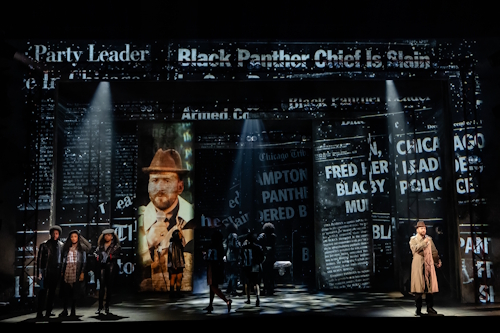
Photo Danny Kaan
And yet something remains absent.
The production is full of affection for Khan, but it lacks a sufficiently strong dramatic core. It has plenty of heart on display, but not quite the heartbeat required to bind its many episodes into a compelling whole. Perhaps the closeness of Khan and her representatives to the development process made it difficult for the creative team to acquire the distance necessary to examine her story from a more challenging perspective.
The programme, unusually, provides more insight and context than much of the musical itself. It is informative, thoughtfully assembled and filled with excellent photography. On stage, however, Khan’s extraordinary and often painful life is rendered a little too smoothly.
You leave humming the songs and remembering Burke’s voice, the visual spectacle and the exhilarating precision of the dancers. What does not linger is the woman’s story. This is a thoroughly enjoyable night out, but the deeper, darker and more complex musical, a black woman’s successful, but too often heartbreaking struggle, to the top of the music industry that Chaka Khan’s life deserves, is still waiting to be made.