
Hamburg State Opera
June 20, 2026
Opening this year’s 50th Hamburg Ballet Days season, and the company’s first narrative ballet since John Neumeier retired as artistic director almost two years ago, Wunderland begins simply. A small grassy mound. Alice’s sister reading a book while butterflies flutter. It’s rather idyllic. When Alice appears, she’s carefree and happy. A white rabbit complete with pocket watch piques her interest through. And when he quite literally disappears down a rabbit hole, she follows, and the adventure begins. And what an adventure it turns out to be.
Ukrainian choreographer Alexei Ratmansky’s new ballet certainly packs it in. Act One is based on Lewis Carroll’s familiar Alice in Wonderland. Act Two then follows the somewhat less well-known Alice Through the Looking Glass. Two books in one ballet of around two hours dancing. It’s a lot.
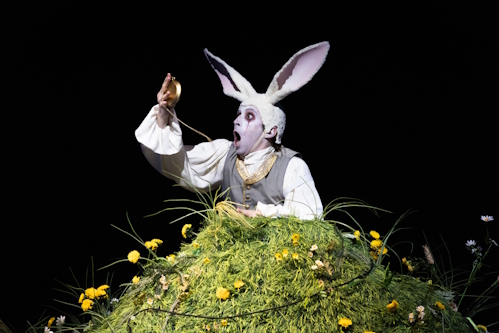
Photo Kiran West
But pack it in Ratmansky does. Almost nothing is omitted as he, set designer Sebastian Hannak and costume designer David Szauder approach the stories in the same fantastical manner as the author. Presented as if seen through a child’s eyes, all of the better-known characters are here: the Mad Hatter, the Cheshire Cat (though Ratmansky gives us seven of them, led by Daniele Bonelli), the Knave and Queen of Hearts, and so on. But this is also a world filled with dancing, guitar-playing lizards, mushrooms, insects and lobsters. Colourful doesn’t even start to describe it.
We see very little of the frantic, harried White Rabbit (Aleix Martinez) after that opening scene, a little surprising as he is a figure of some importance. But, tumbling down the hole, Alice finds herself suspended in mid-air, which combined with the graphics behind really does give a sense of falling. Not quite Dr. Who time tunnel but heading that way. The intent behind the ensemble dancing below is unclear, however. An illustration of her having a conversation with herself as in the book, maybe.
Thereafter scenes come thick and fast. Among the early characters are a rather cute guitar-playing, dungaree-wearing lizard (Filipe Rettore) and three guinea pigs. Strikingly attractive in their gorgeous long qipao-style dresses are twelve brightly coloured dancing mushrooms, although their headpieces do make them look more like tropical jellyfish.
and Daniele Bonelli as The Cheshire Cat in Wunderland
Photo Kiran West
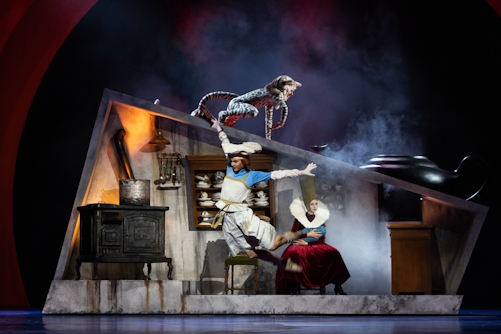
The kitchen scene is a hoot. You can hear the madness in the music as the Cook (Almudena Izquierdo) throws and smashes plates. And, in a neat piece of stage magic, the baby really does turn into a piglet. Next, not one Cheshire Cat but seven, their dance remarkably feline, the music again fitting the choreography a treat.
That score is eclectic to say the list, comprising excerpts from nearly forty pieces by thirty composers ranging from Eric Satie and Frédéric Chopin, through György Ligeti and John Cage, to the electronic sounds of Paul Lansky.
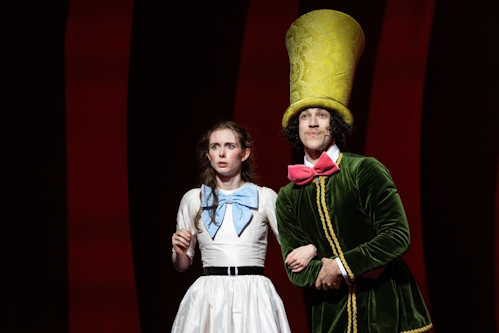
Photo Kiran West
Like everything else, the Mad Hatter’s Tea Party is over in a flash although there is time to admire the cleverly designed table, vertical and all on a steeply inclined platform that is climbed upon. Everything is giant size. A slice of cake is half a metre long, and the giant smoking teapot is easily big enough to hold the dormouse.
Later, the Queen of Hearts (Ida Praetorius) is a real whirlwind of an individual, self-absorbed and somewhat narcissistic, but hardly scary.
The croquet game, and especially the lead up to it is very amusing. I defy anyone not to at least smile at the sight of a bunch of pink flamingos (they are soft toys) being carried on then hurled madly at the ensemble. The game itself is pretty clever too.
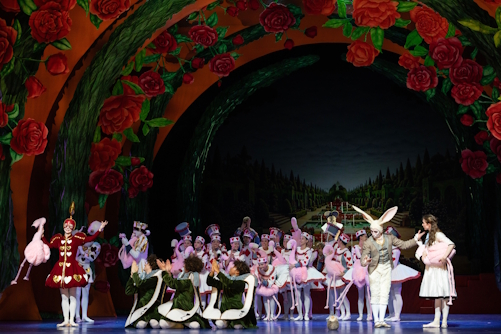
Hamburg Ballet in Alexei Ratmansky’s new Wunderland
Photo Kiran West
One of the few ensemble moments in the first half, the lobster quadrille is full of energy.
There is a huge amount to like. But, at the same time, getting through the Act’s eighteen scenes in just sixty minutes brings issues. Wunderland is a ballet of briefly painted scenes, almost entirely about whimsy pure and simple. There is very little depth to anything, and not a lot of classical dance either, much of the story being told through mime.
On stage for almost the whole act, indeed the whole ballet, Olivia Betteridge does portray a picture-perfect image of Alice, though. She is nicely childlike and innocent but gets little chance to project her inquisitive nature, or indeed the forceful side of her personality. And there’s certainly no sense that she finds herself in dangerous situations where death lurks just around the corner, a fate that never manifests itself but a feeling that is sensed by the reader and Alice in the book. Here, there’s not even much sense of anyone being unfriendly let alone real hostility.
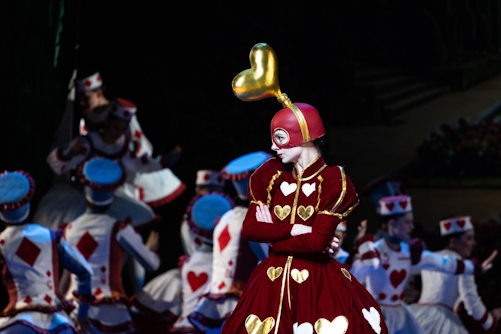
Photo Kiran West
While Act One may have been little more than a romp short on meaning or philosophical parable, Act Two, like Alice Through the Looking Glass, is altogether more thoughtful, more poetic, and full of symbolism. While there are still thirteen scenes, many are much longer and allowed to develop. There’s more overtly classical choreography too, including a super pas de deux for Alice and The White Knight. The constant presence of the sets four tall, blue arched walls that move around also helps provide a sense of continuity and linear narrative missing from Act One.
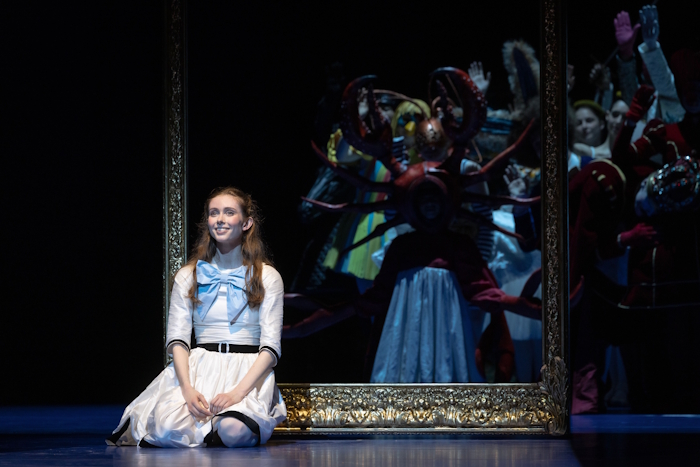
The opening mirror sequence is very clever. Could that be a nod to Onegin in the way Alice sees her reflection? Maybe, although the mood is very different and this reflection comes with a glimpse of personality and twinkle in the eye. There’s a lovely moment when Alice prepares for a pirouette, then stops to glance over her shoulder. Her reflection smiles, shrugs her shoulders. Not laugh out loud but I think the who audience smiled.
A dance for a group of insects is very enjoyable, with lots of fast, intricate footwork as they really do buzz around. And you hear that buzzing in the music too.
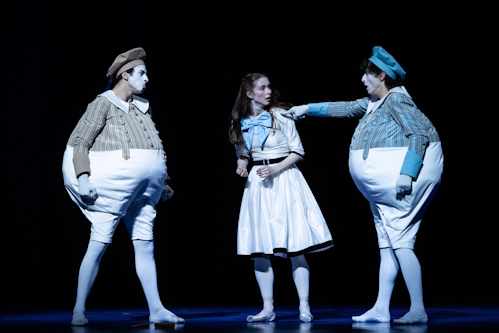
and Francesco Cortese (Tweedledum) in Wunderland
Photo Kiran West
A real highlight is the appearance of Tweedledum and Tweedledee (Francesco Cortese and Louis Musin). In one of the longest scenes of the evening, their dance together is quite jazzy, with their two subsequent solos an equal delight. One is full of fast footwork, the other features what would be an impressive menage in any event. But in those well-padded suits? Amazing. But the fun comes to a halt when they argue over a broken rattle. The message is all too clear. How quickly can friendship break down.
The ephemerality of things is also to the fore in a scene in a rowing boat. Seated in it are a knitting sheep, once the White Queen and Alice. The latter is picking flowers, which immediately die and turn to dust.
Humpty Dumpty (Caspar Sasse) is very enjoyable too. After he has fallen off the wall, the Kings Horses and Kings Men do indeed arrive, carrying him off on a cart, complete with very obvious, very yellow yolk seeping from his body.
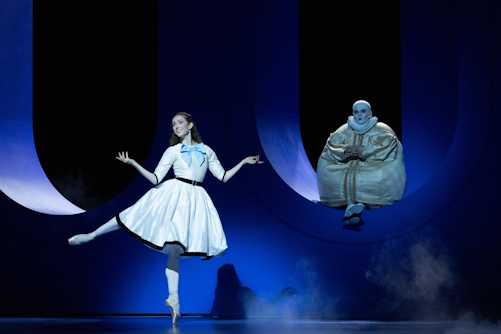
Photo Kiran West
But in all of this, Alice remains quite the observer. Until that is, the White Knight arrives in the shape of Daniele Bonelli. Now, at last, she appears free as Ratmansky crafts a beautifully gentle, very lyrical, very quiet pas de deux. It’s not at all virtuosic but then it doesn’t need to be. It feels very genuine, very endearing. You sense it’s a growing up moment. Betteridge was beautifully light. There were some wonderful moments of suspension when she seemed to almost float on the air and the notes of the music. Bonelli was wonderfully supportive. The connection between them was terrific.
When he leaves, it’s also time for Alice to say goodbye. There’s a big scene when Ratmansky brings everyone back before Alice is pushed back through the mirror. She sits quietly and reflects. Was it a dream. A journey into the subconscious? A parallel universe? Take your pick. Whatever, it’s very thoughtful, and even brings a tear.
After a moment, the audience rose as one, calling the cast back again and again. For all my doubts here and there, I suspect Hamburg Ballet may have found a winner.