
Regent’s Park Open Air Theatre, London
August 6, 2026
There is a reason Cats continues to return. I have always loved the fact that it barely needs a conventional story. Cats gather for the night, introducing themselves, singing, dancing, showing off, quarrelling and playing. That is enough. Few musicals give movement, imagination and theatrical playfulness quite so much room to take over.
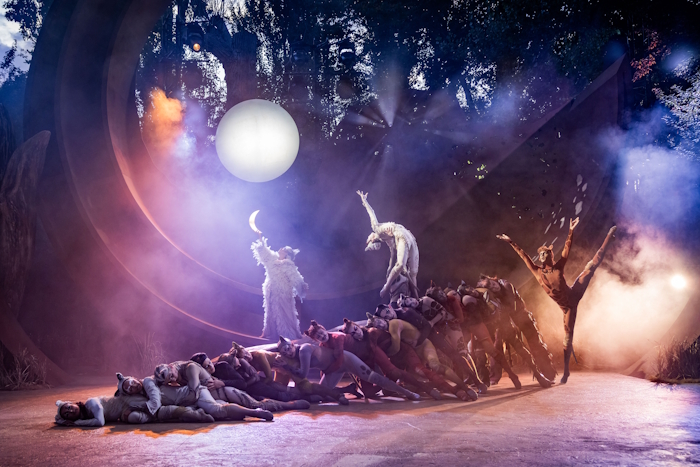
The return of Cats to Regent’s Park Open Air Theatre was clearly met with genuine excitement, and it was easy to understand why. The venue is one of the production’s greatest assets. Framed by trees, open sky and a beautifully atmospheric set, the production embraces its surroundings with confidence. The curved structures, glowing moon and evening light create a world that feels magical while allowing the park itself to remain visible.
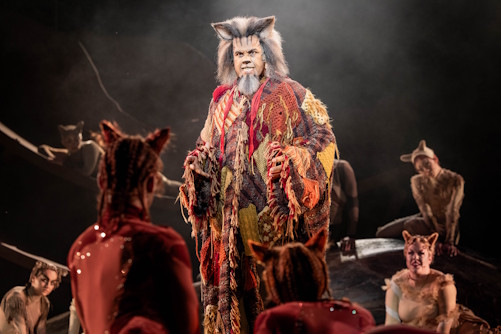
Photo Mark Senior
Andrew Lloyd Webber’s score has lost none of its appeal. More than forty years after its premiere, the music still carries the evening with extraordinary richness, humour and emotion. As the performance settled into its rhythm, so did the cast. The vocals opened up noticeably as the evening progressed, particularly after the interval.
Several performances stand out. Lucie-Mae Sumner’s Jellylorum is full of warmth, wit and wonderfully observed feline behaviour, creating one of the evening’s most convincing cats. Patricia Zhou brings elegance, precision and beautiful classical line to Cassandra, while Matthew Caputo’s Skimbleshanks combines confident singing with infectious charm and energy.
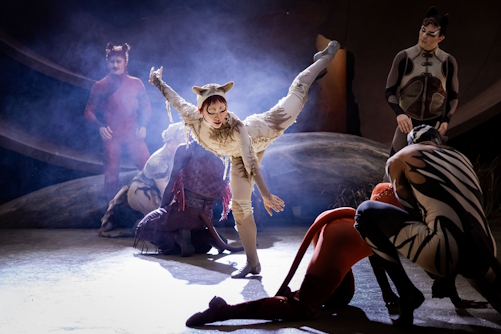
Photo Mark Senior
Jat Yau’s Mr Mistoffelees is another highlight. Drew McOnie’s reimagining gives the character a very different physical identity from the elegant magician familiar from earlier productions, using breaking and athletic virtuosity as the source of his magic. I still have a personal affection for the elegant, mysterious Mistoffelees of earlier productions, yet Yau’s version works on its own terms and brings an exhilarating burst of energy to the production.
McOnie’s choreography is frequently inventive and full of theatrical pleasure. The duet between Demeter and Bombalurina during ‘Macavity’ captures the circling, teasing quality of cats particularly well, and the ensemble repeatedly forms attractive and energetic stage pictures. The movement vocabulary is varied, and many sequences are genuinely exciting to watch.
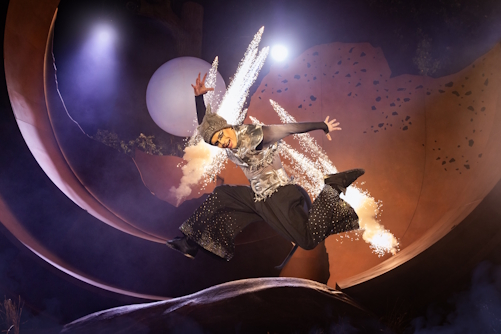
Photo Mark Senior
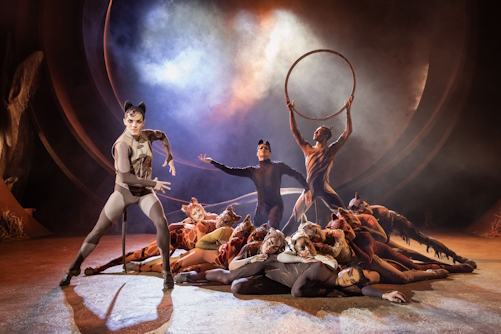
I was less convinced by some recurring physical mannerisms. Sudden, segmented turns of the head and torso create a sense of animal alertness, although the quality does not always feel specifically feline. The production also repeatedly gathers the Jellicle Cats into lines or tightly connected groups, standing shoulder to shoulder, linking together or leaning into one another. These images can be effective, but their frequent return gives the ensemble a physical uniformity that sometimes sits oddly with the creatures they are portraying.
That question of recognition extends to the visual design.
This production has three white cats, and for a surprising amount of the evening I found myself playing an unexpected game of ‘Where’s Victoria?’ With Victoria’s familiar solo gone, one of the character’s clearest means of identification has disappeared too. I initially assumed Patricia Zhou’s Cassandra was Victoria, partly because the refinement and clarity of her dancing carried many of the physical qualities I associate with the role. Only later did I realise I had been following the wrong cat. A character who once seemed instantly recognisable has become curiously elusive.
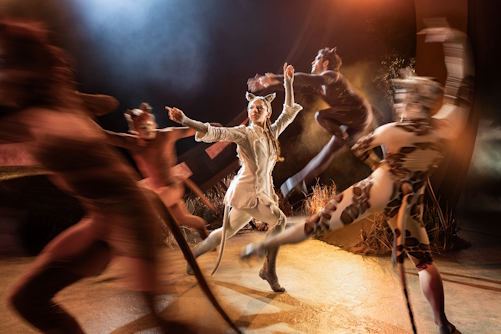
Photo Mark Senior
The costume redesign adds to that uncertainty. The reduction in fur gives the dancers’ bodies greater visibility, an understandable choice for a production so interested in physical movement. Yet the slimmer silhouettes can weaken the feline outline. At times the visual references seem to wander surprisingly far from cats altogether: giraffe, zebra, meerkat, fox, and in Macavity’s case, something alarmingly close to a cockroach.
Macavity’s sequence also makes extensive use of live flame. After a slip while carrying a torch, I never quite relaxed. My attention kept returning to the fire rather than the confrontation itself.
The make-up pushes things further. Much of the emphasis sits around the eyes, while the muzzle and whisker-pad area is far less strongly defined. Without that broader structure around the nose and mouth, several faces register first as stylised creatures and only later, if at all, as cats.
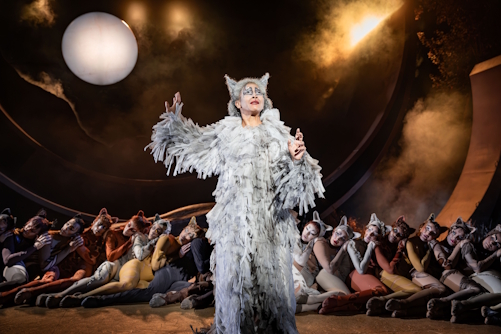
Photo Mark Senior
Old Deuteronomy is especially distracting. His facial design repeatedly reminds me of Rafiki in The Lion King. Once that resemblance entered my head, it stubbornly refused to leave.
And then there are the tails.
I understand the anatomical logic. Remove the fur from a cat’s tail and this is more or less what remains.
Unfortunately, on stage they look remarkably like mouse tails.
More than once I found myself wondering whether the mice from The Nutcracker had wandered into the Jellicle Ball.
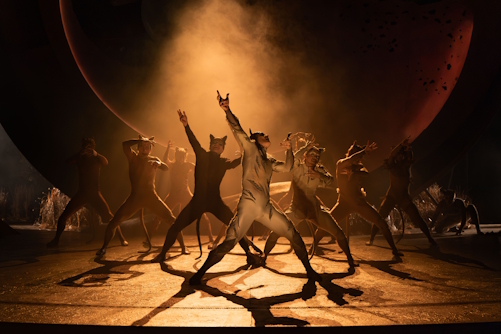
Photo Mark Senior
Grizabella presents a different kind of difficulty. Taziva-Fay Katsande stepped into the role at short notice, covering for the indisposed Rachael Wooding, and deserves genuine credit for taking on the part under those circumstances. Grizabella has relatively little stage time, so the performer must suggest an entire life in just a few appearances: rejection, fear, isolation and the longing contained in ‘Memory’.
Katsande sings the role with considerable power, and apart from a slightly unsettled opening to ‘Memory’, the vocal performance is secure. What I found harder to believe was Grizabella herself. Katsande’s youthful presence remains difficult to disguise, and the performance does not yet fully carry the weariness and accumulated loss that give the character her emotional weight. Her ‘Memory’ grows into something powerful and surprisingly hopeful, but I missed the sense that this hope comes from someone who has already lost almost everything.
It is an assured step-up performance. With more time in the role, that history may settle more deeply into the character.
and cast in Cats
Photo Mark Senior
I am genuinely glad to have Cats back, and I would happily see this production continue to develop during its run.
The musical reminds us that “a cat is not a dog.”
By the end of the evening, I found myself hoping for something quieter alongside all the invention: a little more feline curiosity, a little more feline stillness, a little more mischief, and a little more of the mysterious confidence that makes a cat unmistakably a cat.
Cats is at Regent’s Park Open-Air Theatre to September 19, 2026.
It then heads off on an extensive UK tour, starting at New Theatre, Hull (October 20-24) and the Birmingham Hippodrome (October 27-November 7), and continuing to June 19, 2027.