
Royal Ballet & Opera, London
August 5, 2026
He really is quite simply irrepressible. Now 53, Carlos Acosta has found time between directing Birmingham Royal Ballet and Acosta Danza, and their junior companies, to return to the stage in what is a very impressive and eclectic evening of dance. While I might not be entirely convinced about the programme’s title, it certainly proved he still has a quite magnetic stage presence. But Myths and Modern Masters is not only about him. It’s just as much a celebration of the talent at the two companies he leads.
The opening work, José Límon’s The Moor’s Pavane, gives Acosta the opportunity to take on something new in the shape of the role of Shakespeare’s tragic hero Othello. Set to music by Henry Purcell, Limón’s theatrical but very distilled plot of betrayal and murder focuses entirely on the story of Iago, Othello and their respective wives in choreography that combines a 16th-century pavane with his signature style.
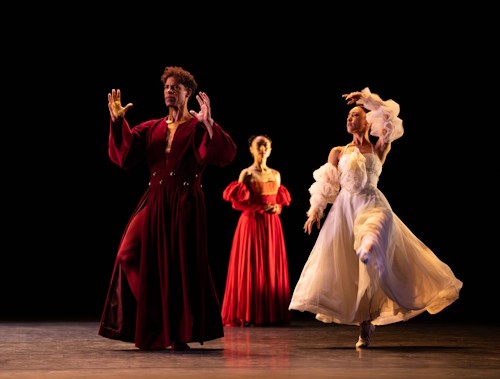
Photo Helen Maybanks
Límon lets the narrative drive everything, telling the story significantly told through gesture. As the pavane’s formal patterns start to splinter apart, we simultaneously sense the crisis among the four protaganists. And while those patterns might temporarily reform, we know they merely conceal swirling emotions and trouble beneath.
The whole cast danced with impressive depth, communicating feeling clearly. Acosta was powerful as Othello, commanding the stage throughout. Both tender and cruel, he was always strong. From Birmingham Royal Ballet, Max Maslen was an elegant Iago, full of dramatic presence but interestingly not coming over as inherently malevolent; Beatrice Parma was a devoted but increasingly bewildered Desdemona; Miki Mizutani, a calculating Emilia.
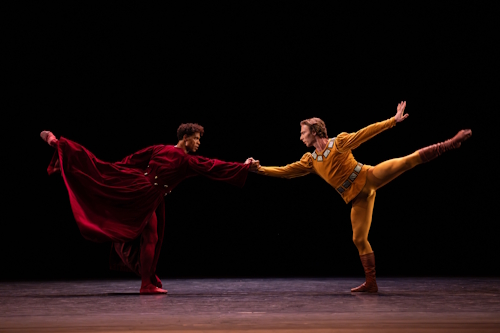
Photo Helen Maybanks
Created in 1949, The Moor’s Pavane is very much of its time, but somehow seems equally strangely timeless. The slow unfolding of the narrative, the lack of any distractions, and four fabulous performances, all combined to give it a strangely hypnotic appeal.
A suite from Acosta’s hugely successful The Nutcracker in Havana brought a change of mood. With the sparkly-waistcoated Acosta himself as the magician conjuring up delights for his real-life daughter Aila, it was colourful and fun.
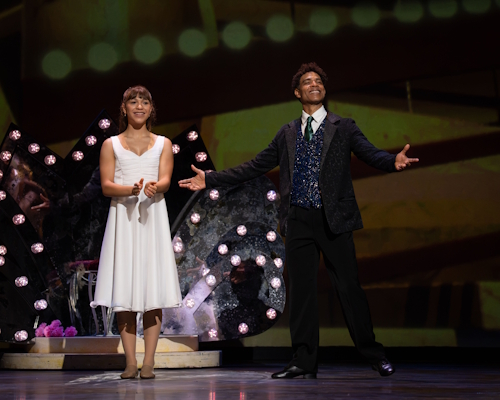
Photo Helen Maybanks
From Acosta Danza, Amisaday Naara and Paul Brando in the ‘Arabian’, and Alexander Arias and Ernesto Muñoz in the ‘Chinese’ dances, the latter a sort of martial arts affair shone, before the whole ensemble gathered, Aila included, in an utterly joyous number that sees everyone in traditional Cuban wooden-soled sandals. It was all topped off by a fine Grand pas de deux by the very regal Parma with the handsome Enrique Berjarano Vidal as her Prince.
The fireworks really came in the following Diana and Actaeon pas de deux. In fact, so amazing were they, it’s a wonder the roof is still on the building! Agrippa Vaganova’s creation may be something of an old warhorse, but when it’s done like this, it’s amazing. Katherine Ochoa and Yasiel Hodelin Bello, neither yet principals (surely it’s only a matter of time) were absolutely flawless. Ochoa delivered one of the best sets of fouettés you are ever going to see. Not only numerous multiple turns, but fast, and I don’t think she moved an inch from the spot. Her partner ate up the stage, and the air above it, in a startling manege of tumbling jetés. Wow!
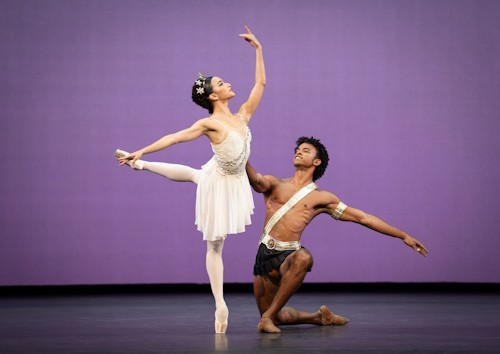
Photo Helen Maybanks
Acosta returned for Beatriz García and Raúl Reinoso’s Nosotros (Us), a duet all about the need for one another, but also the frustrations the relationships can bring, the difficulties and disagreements, and those moments when everything comes beautifully together. It was beautifully danced with Amisaday Naara, whose long solo that speaks of emptiness and desperation was especially full of charge. Beautifully accompanied too, by onstage pianist Pepe Gavilondo and cellist Antonio Novais.
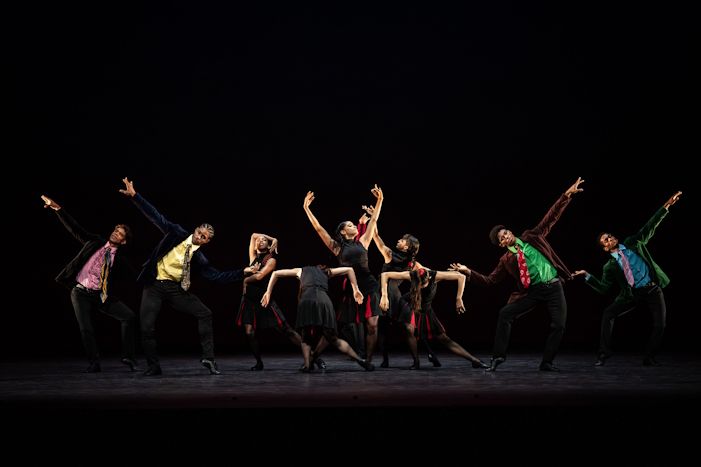
Myths and Modern Masters closes with a pretty much nailed on crowd-pleaser: Christopher Bruce’s 1994 favourite, Rooster. Danced to eight Rolling Stones songs that have stood the test of time remarkably well, it’s the choreographers take on the social attitudes and sexual tensions of the sixties. It’s full of strutting, preening men, Acosta included, all desperate to impress the women, who in turn are often hilariously unimpressed by them all, and who often get the last laugh.
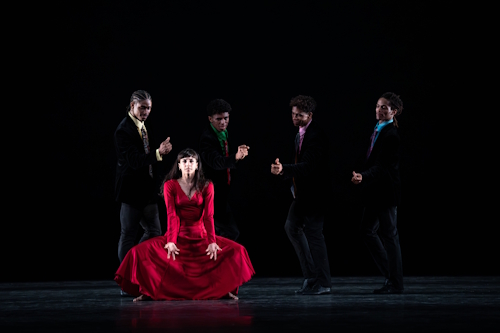
Photo Helen Maybanks
Perhaps time has affected the memory but it didn’t quite have the richness and sharpness that I recall. Even no, there could be no disputing the commitment and energy, especially in ‘Paint It Black’ and the closing, rollicking ‘Sympathy for the Devil’. The highlight came elsewhere, though, in ‘Ruby Tuesday’ and a spirited solo by Adria Dìaz. Even here, though, in one of the more reflective songs, Bruce manages to find a sense of fun when her dance is interrupted and she is tossed around by three of the men.
It really was a super evening. However, a request. I know Carlos Acosta spent many happy years at Covent Garden. But while it may be a sort of spiritual home, how about one of these evenings up in Birmingham? I think it might just go down a storm.