
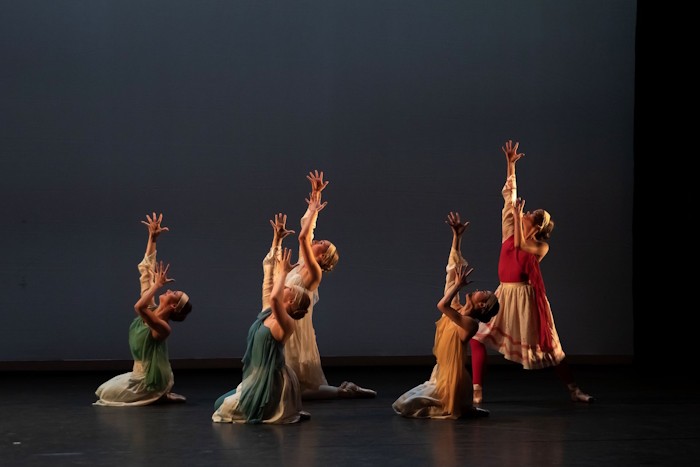
Linbury Theatre, Royal Ballet & Opera
June 18, 2026
There are graduate performances in which highly accomplished students offer glimpses of the professionals they may soon become. Then there are evenings when the distinction between student and professional seems to disappear almost completely. This, with The Royal Ballet School’s 100th graduate cohort and advanced students from the School of American Ballet fell emphatically into the latter category.
The programme featured thirteen short works and excerpts, moving between heritage repertoire, 20th-century classics, contemporary choreography and creations by current Royal Ballet School students.
Before the dancing began, Royal Ballet School artistic director Iain Mackay announced that all thirty of this year’s graduates had already secured professional employment. In a fiercely competitive international profession, that is a considerable achievement. By the end of the evening, it was easy to see why.
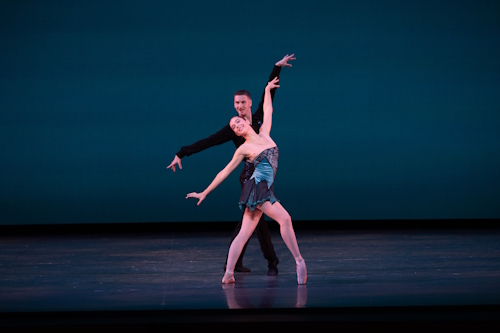
in ‘Embraceable You’ from George Balanchine’s Who Cares?
Photo Rosalie O’Connor
The School of American Ballet contributed two works by George Balanchine. Valse-Fantaisie, set to Mikhail Glinka, is a perpetual motion for six dancers, its speed and musical buoyancy leaving little room for hesitation. Excerpts from Who Cares?, Balanchine’s response to sixteen George Gershwin songs, brought a contrasting flavour of urbane American exuberance.
The SAB dancers displayed impressive technical security, and an evident understanding of Balanchine’s musical demands. Their performances were bright, assured and full of promise. Yet, when placed directly alongside the Royal Ballet School graduates, they sometimes appeared to need that final degree of polish that even a few months within a professional company can provide. It was not a significant shortcoming, but the comparison underlined just how unusually stage-ready this year’s London cohort is.
The Royal Ballet School’s contribution ranged widely, the dancing dominated not simply by technique, but by finish. The dancers completed every line, carried movement and emotion through the whole body, and sustained the intention of a phrase beyond the execution of its steps. Jumps were not merely landed but resolved. In pas de deux, the physical and emotional exchange between partners remained alive throughout. These were not students presenting themselves as potentially employable dancers. They were young professionals showing that they are ready to work.
The evening did, however, begin uncertainly. The Four Cavaliers variation from Raymonda is a demanding. It requires not only individual virtuosity but close musical agreement and a strong sense of unity between the four men. While one performed it with impressive command, the remaining appeared less at home with its technical demands, particularly the repeated tours en l’air. Landings were insecure and, on the final repetition, one dancer came close to falling, although he recovered extremely well. There was also insufficient accord between the quartet, both spatially and musically. Whether the difficulties arose from opening-night nerves, the choice of repertoire, or simply a performance that went wrong on the night, it is impossible to know. All three dancers later appeared in other works and performed with professional assurance, making the opening seem increasingly unrepresentative.
Raymonda was followed by the rarely seen The Arts of the Theatre by Ninette de Valois, a work from 1925, lost for many years, and that sheds light on her formative ideas about classical and modern ballet.
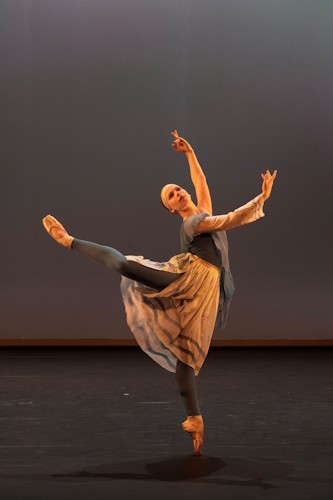
Photo Rachel Cherry
Two student choreographers provided some of the evening’s most encouraging signs for the future. Shiori Yamashita’s Whispers of the Core and Henry Burgess’ solo, Suffocating in Silence, demonstrated striking originality and a clear sense of purpose. Both blended classical ballet with contemporary floor work and movement that occasionally approached the gymnastic, yet neither felt like an arbitrary collection of effects. Each had intention, flow and a distinct choreographic voice.
Yamashita worked with a group of dancers, shaping bodies and movement into a coherent ensemble language. Burgess’ Suffocating in Silence, danced by Samantha Striplin, placed a single performer at the centre of a concentrated and emotionally charged work. Striplin danced it superbly, making its physical language feel inseparable from its internal tension. Both choreographers are still in their pre-professional year. Their work suggested not only imaginative ability, but the discipline to turn ideas into choreography that communicates. They are two young dance-makers whose development will be well worth following.
The first of the evening’s two outstanding highlights was Eccentric Pulses, choreographed by Guillem Cabrera Espinach and danced by Elliott Martin and Yamashita. A modern response to classical dance with echoes of music hall, it felt both contemporary and evocative of another age. Humour ran through the choreography without being overplayed, while the dancers’ complete understanding of one another gave the duet exceptional precision. Martin and Yamashita worked in immaculate accord, their unison clean but never mechanical. They caught the work’s wit, period flavour and underlying strangeness, making it wholly engaging.
The other standout was Le Bourgeois, Ben Van Cauwenbergh’s bravura solo set to Jacques Brel, performed by Millán De Benito Arancon. The choreography creates a louche, mannered figure from a vanished cabaret world, with something of Noël Coward’s cultivated theatricality in its elegant poses, social affectations and waspish humour. Arancon seized every opportunity it offered. His flair for comedy was exceptional, drawing audible laughter from the audience without ever sacrificing the dancing. His musical interpretation was especially impressive. Gesture, expression and step were precisely attached to the phrasing, while his clean line and technical control kept the characterisation from becoming caricature. He understood that comic performance depends on exactness: a delayed glance, a perfectly placed pause or a movement completed at precisely the right instant. It was an outstanding performance from a dancer with genuine theatrical presence.
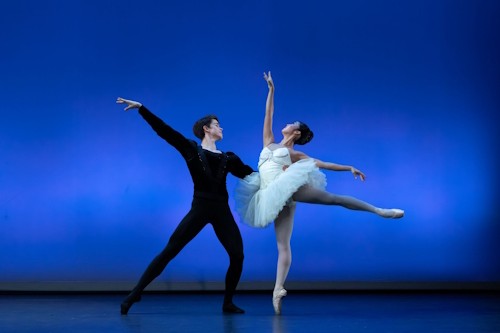
Photo Rachel Cherry
Also danced were Mikhail Fokine’s Dying Swan; the pas de deux from Frederick Ashton’s Rhapsody; Les Ombres du Temps by Luca Branca; Kenneth MacMillan’s balcony pas de deux from Romeo and Juliet, and Christening Suite by Christopher Wheeldon.
Across the programme, what impressed most was the Royal Ballet School graduates’ professional maturity. Graduate dancers often possess formidable technique, but lack the final finish developed through regular company performance. Here, that gap had largely vanished. The dancers did not appear to be demonstrating what they had learned. They were communicating through it. There was an openness and generosity in the performances, a sense that the dancers were enjoying the occasion rather than simply enduring one final examination, all of which added to the evening.
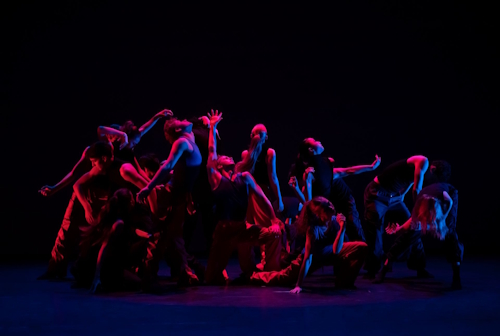
Photo Rachel Cherry
That pleasure passed readily into the auditorium. The performance was ultimately a splendid celebration of The Royal Ballet School’s 100th graduating cohort, generously supported by the School of American Ballet’s two Balanchine offerings. It looked backwards through the repertoire, while making an unusually persuasive case for the future. All thirty graduates now move into professional employment. Judging by the authority, intelligence and polish displayed at the Linbury Theatre, they are more than ready. So too are Yamashita and Burgess to begin establishing themselves as choreographic voices. It will be fascinating to see where all their careers lead.