
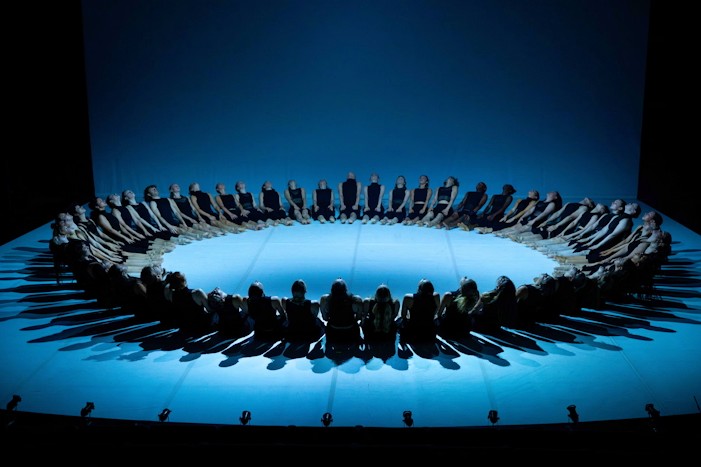
London Contemporary Dance School BA Graduation Performance
Queen Elizabeth Hall, London
June 26, 2026
In the heat of a London summer evening, the Southbank Centre’s outdoor bars were full of happy-hour crowds. Children were shrieking in the nearby fountains. They shared the same space without needing instruction.
Inside the theatre, fifty graduating dance students shared space under very different conditions.
Stephanie Lake’s Colossus is often framed as an exploration of the relationship between the individual and the collective. In London Contemporary Dance School’s BA Graduation Show, that relationship was built through contact, response, pressure, timing and trust. Each dancer remained distinct while being continuously reorganised within a larger, shifting whole.
The work’s vitality lies in the way these relationships are built into the choreography itself. Touch releases another dancer; breath cues the next action. Voices drive movement, while shouting, clapping and stamping become part of the score. Groups gather, disperse and reconfigure. No position holds for long. The choreography keeps setting bodies in motion through one another.
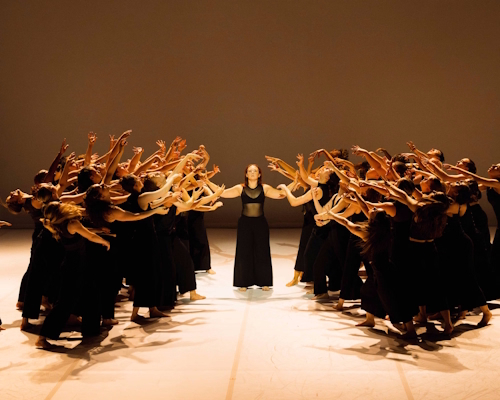
Photo Camilla Greenwell
That system was already active as the audience entered. The dancers lay in a large circle; during the pre-show announcement, their hands rose and settled behind their heads. The shift was minimal but decisive. From that point, formations moved continuously, at times with machine-like precision, at others breaking into smaller, unstable constellations.
Sound repeatedly reorganised what could be seen. In an early blackout, the dancers disappeared but remained audible. When the lights returned, they were tightly grouped at the front, executing spoken instructions with near-mechanical clarity. Throughout, listening structured action: breath, impact and voice functioned as cues. Attention moved through the theatre as much through the ear as the eye.
Again and again, attention and agency were redistributed. Stillness passed between dancers through touch, as if it were something transferable. A duet expanded and altered the surrounding group before dissolving back into it. Leadership moved through the cast as a temporary condition, never settling into a fixed position.
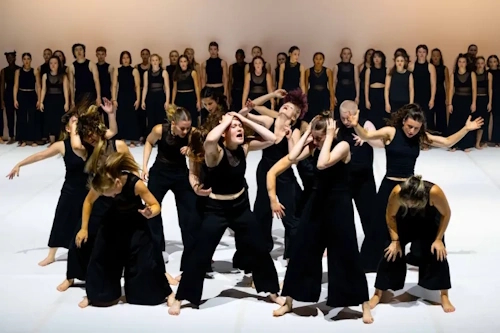
Photo Camilla Greenwell
These relationships did not guarantee support. In one sequence, casual intimacy, embraces and conversation, shifted almost imperceptibly into confrontation. A young man was edged out, then pushed away, repeatedly attempting to return as the group’s rejection intensified. The others did not suddenly become monstrous. That was the unsettling part: the same shared attention that had held bodies together now kept him outside. The transition was so gradual that it was difficult to locate the moment of change. By the time he collapsed, the scene had shown how easily the collective had turned.
Elsewhere, trust appeared in quieter forms. During passages of constant motion, dancers brushed against one another and adjusted without breaking flow. The work did not demand flawless execution. It required sustained attention, an awareness of others as conditions of one’s own movement.
Moments of informality interrupted the system without breaking it. Several dancers paused to retie their hair while watching others perform, briefly returning the stage to something closer to a studio. The image carried the observational focus of training: watching, waiting, preparing to re-enter.
Performed by graduating students, Colossus acquired an additional layer. These dancers are at the threshold of their performing lives, and that proximity to transition remained visible. They did not disappear into the choreography. Their individual qualities persisted within it, producing a social texture specific to this group at this moment.
By the final section, I found myself watching the dancers as closely as the shifting relations that organised them. Their concentration held as the work moved between scale and intimacy, coordination and disruption. When the stage gradually emptied to a single figure, the choreography came to a close. This particular community would soon disperse. Colossus will remain, ready for another group to build a different society inside it.