
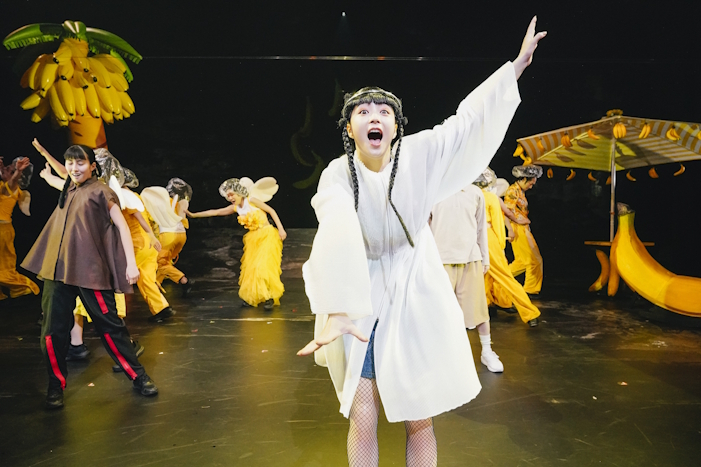
Sadler’s Wells, London
July 2, 2026
−320°F (Minus Three Twenty Fahrenheit) is one of the busiest productions I have seen for a long time. Hideki Noda throws mythology, genetics, medieval legends, biotechnology, absurd comedy and relentless wordplay onto the stage with extraordinary confidence. At its centre is the search for ‘Angel’s Bone’ and the idea of an ‘angel gene’, linked to children born with deafness and other forms of difference. The dialogue arrives at breathtaking speed, while English surtitles race overhead. Performers move between characters almost instantly, scenes dissolve into one another without pause, and there is no interval to allow the audience to catch its breath.
For much of the evening I was simply trying to keep up. For someone with my own version of an ‘angel gene’, namely a sensitivity to sensory overload, this was hardly friendly territory: too much sound, too much speed, too many demands on the eye and ear.
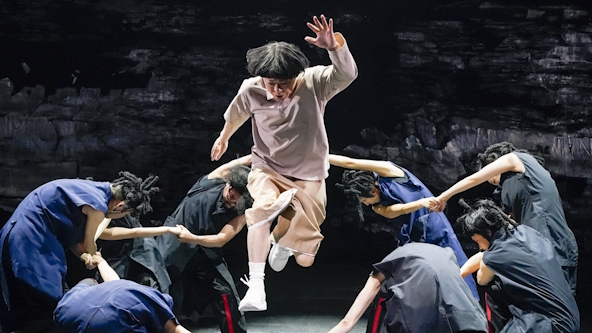
Photo Takashi Okamoto
My attention moved constantly between the stage, the surtitles and the spoken Japanese. At one point, a flattened, flask-shaped light fixture descended from above and blocked part of the surtitles from where I was sitting. It was a small practical obstruction, but it sharpened the larger issue: this was a production that never stopped asking me to choose where to look.
Yet while the language was dense, the bodies remained remarkably clear.
Noda repeatedly asks his performers to become more than characters. Arms extend to suggest dinosaur skeletons, fossils, mountains, angel wings and the invisible structures connecting people across time. Bodies create landscapes, architecture and memory before dissolving back into human form. These transformations happen so fluidly that they often replace scenery altogether. The stage rarely depends on objects when the ensemble could build the world itself.
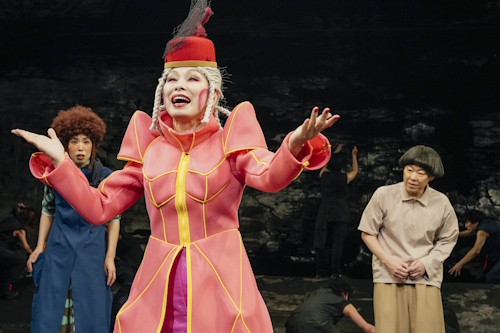
in Hideki Noda’s –320°F
Photo Takashi Okamoto
Every transition lands with astonishing confidence. Emotional shifts happen in an instant without losing clarity. Comic absurdity and genuine grief coexist within the same physical vocabulary, allowing the production to move effortlessly between laughter and profound seriousness.
Led by Sadawo Abe, Suzu Hirose, Eri Fukatsu and Hideki Noda himself, the ensemble navigates the production’s relentless shifts with remarkable precision. Even when individual lines escaped me, the performers rarely did.
By then I had begun to realise that the production’s apparent excess is never random. As the evening progresses, bodies begin to carry more and more of the meaning. Noda’s script is famously dense, packed with ideas, historical references, scientific speculation and verbal humour. The overload did sometimes risk pushing me away. Between the Japanese, the speed and the constant visual activity, there was more than I could process, even with surtitles. Yet none of that prevented the production from reaching me.
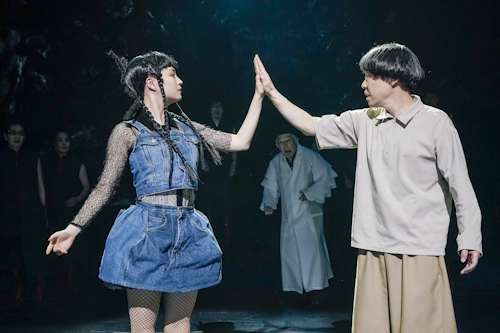
Photo Takashi Okamoto
Gradually, physical language took over. By the final scenes, those earlier transformations had quietly come full circle.
A deaf mother learns that the child she carries will also be deaf. Rather than grieving for the life her child might not have, she speaks about the beauty of a silent world. If her child cannot hear, who could be better placed than herself to show that child everything such a world contains?
It is one of the simplest moments in -320°F. It is also one of its bravest.
I do not know whether Noda has personal experience of the deaf community. I only know what he chooses to leave us with. After more than two hours of words, mythology, science and theatrical excess, he removes sound altogether. The company continue in silence, their hands repeating the sign for “I love you” again and again.
I may not have caught every joke, every reference or every turn of phrase. But I understood this.
I left the theatre thinking about that silent world.
Perhaps, after all that noise, the body was the clearest language left.
-320F by Hideki Noda is at Sadler’s Wells, London to July 11, 2026.