Hamburg State Opera
June 28, 2026
When the John Neumeier era came to an end at Hamburg Ballet in 2024, the German-Argentine choreographer Demis Volpi took over the reins. It was always going to be a difficult act to follow. Change is always difficult. After 51 years, especially so. Perhaps unsurprisingly, Volpi’s tenure as artistic director was brief. He resigned after just one season amidst reports of deep tensions within the company.
His debut programme, The Times Are Racing, returned for this year’s Hamburg Ballet Days season. A quadruple bill titled after Justin Peck’s ballet that closes the evening, it features four very different works that spanned fifty years of dance history, but all centred around emotional states and relationships.
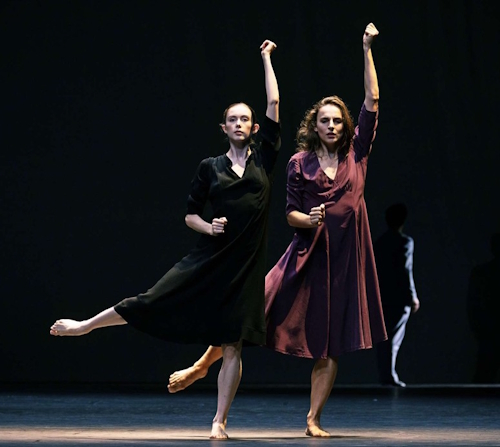
Photo Kiran West
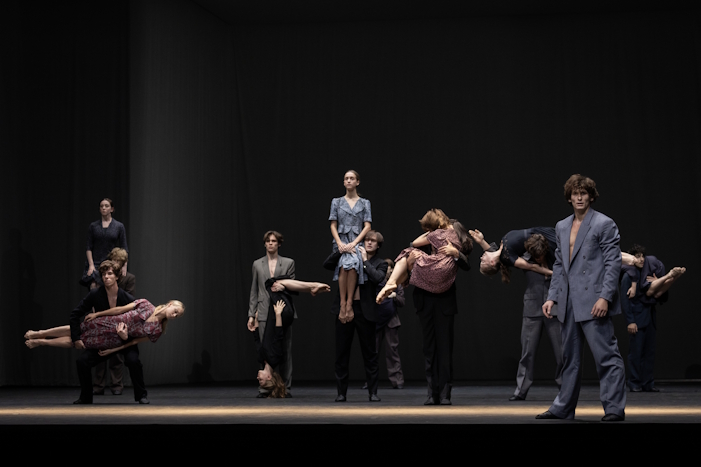
For openers, something special. In December 1974, in only her second season as artistic director in Wuppertaal, Pina Bausch premiered Adagio, a haunting choreography set to the first movement of Gustav Mahler’s unfinished Symphony No.10. It’s partner in what must have been a fascinating double-bill was Kurt Jooss’ Big City.
For reasons that are unclear, Adagio was then not seen again for five decades, not until reconstructed in a collaboration between the Pina Bausch Foundation and Hamburg Ballet in 2024. The project was led by Josephine Ann Endicott, who appeared in the piece fifty years ago, and who worked from memory, a black and white film, and a few photographs.
Mahler’s music feels on the edge and full of irredeemable despair. Bausch’s choreography is similarly loaded. Although there are a few more joyful moments, they are short-lived. It opens with a stage, bare save for a man sat on a chair (photographs from 1974 show many more chairs, in a line, and a table). Another lays on the floor beside him. There are two women, one curled over the other. Enclosed by white walls, the scene evokes an empty room, a ballroom perhaps.
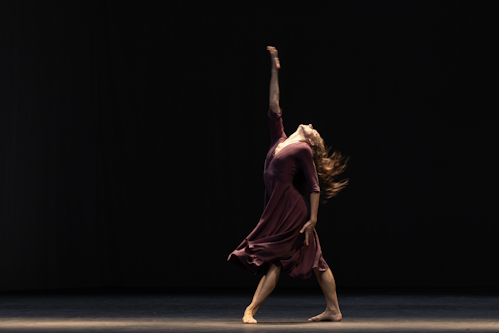
Photo Kiran West
Right from the beginning, it is possible to see connections to Bausch’s later creations. The men are in dark suits. The women are in dresses, although rather more everyday than would be the case later, and barefoot. There’s something about the way the men and women interact too. Much of the movement is expansive. Arms circle, usually at speed, sweeping up as much of the space as possible. Legs kick out, torsos circle. A repeated motif sees a man lift a woman, her body taut, her feet flexed. One female solo makes great use of the dancer’s long hair, which is tossed vigorously back and forth.
All the time, the individuals we see are drawn towards one another as if some magnetic force is at play. Almost invariably, they are then repelled, however, before being attracted once more. The women in particular do a lot of running around. From man to man, but sometimes to a wall, where they rest their head, perhaps despondent, perhaps in frustration.
And yet, it all exudes an odd calmness. Typical of Bausch, there is no explanation. You make of it what you will. There is a distinct sense we are looking at the past, quite possibly the 1970s when it was made, but Adagio doesn’t feel in the least bit outdated. It is certainly incredibly human and utterly fascinating. You dare not let your eyes wander for a second.
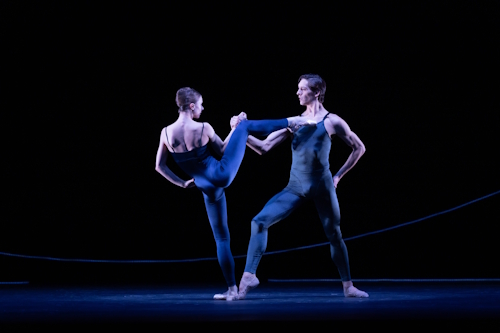
Photo Kiran West
Hans van Manen is one of those choreographers whose work always seems timeless. Variations for Two Couples is just that, the series of short pas de deux exploring love.
The choreography is cooly minimalist yet is deeply sensual, with occasion dashes of humour also thrown in. The variations all match perfectly the music by Benjamin Britten, Einojuhani Rautavaara, J.S. Bach and Astor Piazzolla. Both Ida Praetorius and Matias Oberlin, and Futabe Ishizaki and Louis Musin, excelled, although the latter got the more suggestive choreography.
Volpi’s The Thing with Feathers disappoints, especially when one considers some of his previous creations in Stuttgart. Originally made for the Ballett am Rhein, the work is based on a lyric poem by Emily Dickinson the describes how hope is an indestructible, resilient concept “That perches in the soul… And never stops – at all,”
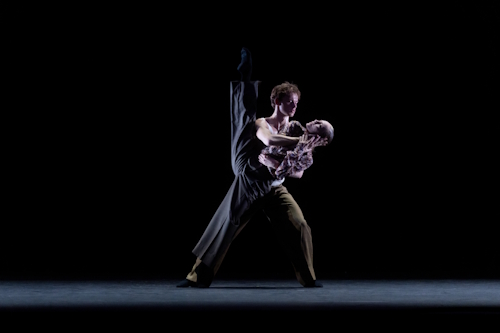
Photo Kiran West
As in Bausch’s Adagio, there is a lot of running about the stage. But whereas there one felt it all had meaning, purpose, in The Thing with Feathers things are altogether more obscure. The most interesting moments almost all come when the ensemble leaves the stage to a couple or solo dancer
Also obscure, thanks to it being danced behind a gauze, were the dancers faces, and the meaning behind a beautiful seascape that is lowered at one point, then held above the floor by a line of dancers such that only their legs are visible.
Rounding off the programme, Justin Peck’s The Times are Racing is a blast. Created for New York City Ballet in 2017, it’s one of the ‘sneaker ballets’ that he is so good at crafting. It yells freedom.
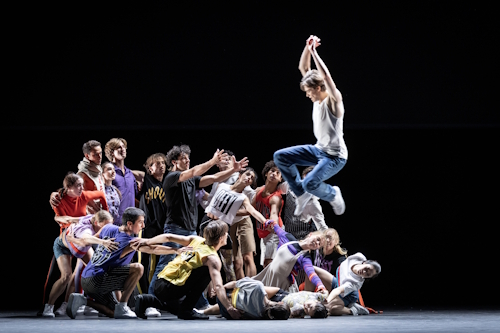
Photo Kiran West
The fast-paced choreography is as bright as the music, ‘USA I-IV’, the four tracks that make up the second half of Dan Deacon’s album America. Elements of Broadway sitting happily alongside classical technique.
The whole cast launched into the dance with bags of attack and energy. The highlight was undoubtedly a sort of tap-inspired duet for Louis Musin and Caspar Sasse. I found myself imagining very easily the sound tap shoes might make. Prior to that is a super pas de quatre, full of excellent interplay, danced here by Anita Ferreira, Paula Iniesta, Almundena Izquierdo and Pepijn Gelderman. Towards the end, Ishizaki and Oberlin shone in a beautiful duet that screamed relationship.
It was great fun and a very entertaining way to end the evening. It was no surprise when it brought the house to its feet.
For a few snippets from Pina Bausch’s Adagio, check out this video from Hamburg Ballet.